Overview
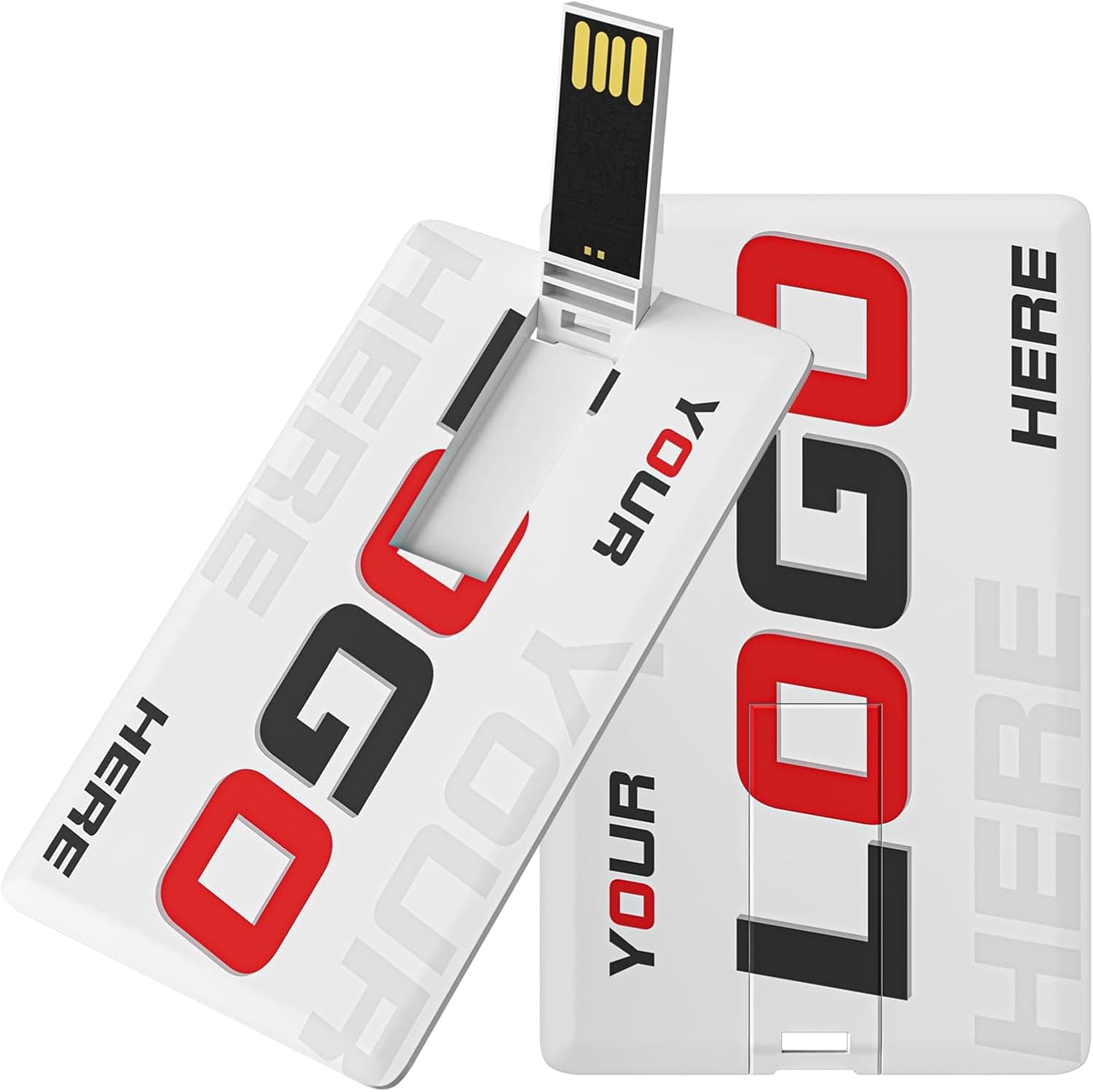
The ABLAZE Custom USB Personalize Flash Drive is a 10-pack of credit-card-shaped USB drives aimed at corporate giveaways. Each drive holds 2GB, uses USB 2.0, and measures 86.4 x 54.6 x 1.5 mm.
The honest framing: this is not a storage product, it is a printable surface that happens to hold files. Individuals buying it as a thumb drive will be disappointed.
The deciding factor is print area, not capacity or speed. A 86.4 x 54.6 mm face is roughly business-card sized, so it can carry a logo, QR code, tagline, and contact details together — something an engraved stick drive cannot do.
That makes it strongest for trade shows where you want to merge a business card and a data handout into one item.
Amazon.co.jp showed 11 reviews at 4.9 out of 5 stars (98% positive) as of the June 8, 2026 capture.
With a sample size of 11, treat that as "no major complaints reported" rather than a statistical guarantee of quality.
Compatibility Guide
The only connection requirement is a USB 2.0 or later port, and no driver is needed.
Plug-and-play operation is listed for Windows, macOS, Linux, and Chrome OS. Motherboard chipsets, PSU headroom, and other PC-build compatibility factors are irrelevant here.
Plugging into a USB 3.0/3.2 port works fine electrically, but throughput stays capped at USB 2.0 rates.
The real snag is shape, not standard. At 1.5 mm thick but 54.6 mm wide, the card body juts out around the connector.
On laptops with tightly spaced side ports, or when a neighboring port is already occupied, you may not be able to use both at once. On a desktop rear I/O panel, expect the card to hang down and potentially block the port below.
| Environment | Works | Caveat |
|---|---|---|
| Windows PC (USB-A) | Yes | Watch for adjacent-port blocking |
| Mac with USB-A | Yes | Recent Macs are USB-C only; hub needed |
| Chromebook | Yes | No driver required |
| USB-C only devices | Adapter | Requires Type-C adapter |
| Phones / tablets | Conditional | Needs OTG support plus adapter |
For giveaways, where you cannot control the recipient's hardware, being USB-A is the biggest compatibility risk. Many current laptops ship USB-C only, so some recipients simply cannot open the contents on the spot.
If the payload matters, mirror it on a web page reachable via a printed QR code as insurance.
Product Info
Key specifications:
| Item | Value |
|---|---|
| Capacity | 2 GB |
| Interface | USB 2.0 |
| Write speed | 15 MB/s |
| Dimensions | 86.4 x 54.6 x 1.5 mm (3.4 x 2.15 x 0.06 in) |
| Supported OS | Windows, Linux, macOS, Chrome OS |
| Features | Waterproof, shockproof, custom print |
| Package | 10 units |
The listed price was ¥21,371 on Amazon.co.jp as captured on June 9, 2026.
Across ten drives that is roughly ¥2,137 each — clearly above the going rate for generic 2GB drives, but the premium buys printing and small-batch handling, not flash memory. Prices move with sales and stock, so confirm the current figure on the product page before ordering.
Equivalent listings appear on overseas marketplaces such as eBay, where pricing varies per seller.
The 15 MB/s write figure is realistic against the USB 2.0 ceiling of 480 Mbps.
Filling 2GB takes a bit over two minutes, so loading all ten drives one at a time runs past twenty minutes. If you plan to write a hundred units in-house before an event, budget that time explicitly.
Competitive Comparison
Among ten-packs of USB 2.0 drives, the right pick depends entirely on intent.
If capacity per yen matters, a 16GB ten-pack wins outright. If it is a daily carry drive, a USB 3.1 capless model beats this on both speed and durability.
This product only wins when two conditions hold at once: you actually want the printable face, and you want something that slips into a wallet or card case. If speed, capacity, or unit cost tops your list, a conventional stick drive will leave you happier.
Practical Notes
The most common failure with promotional drives is that recipients refuse to plug them in. Plenty of companies forbid connecting unknown USB devices to work machines.
Explaining the contents verbally at handover, or printing what is on it, changes the effective response rate more than the hardware spec does.
Second, plan for the data being writable. No hardware write-protect switch is documented for this product, so assume files can be deleted or overwritten after handout.
Keep your master copy elsewhere and write from a duplicate.
Best Use Cases
This suits marketing and PR staff preparing dozens of branded handouts for trade shows, conferences, or recruiting events. Company brochures, product catalogs, and portfolios in the few-megabyte to few-hundred-megabyte range fit comfortably in 2GB, and the card face doubles as promotional real estate.
It also works for small-batch personal projects: wedding photo or video favors, or a "data business card" for designers and independent professionals.
It does not suit anyone wanting photo or video backup, OS installation media, or a daily file-transfer drive. For that money, buy a high-capacity USB 3.x drive instead.
Things to Know Before Buying
2GB is far tighter than it sounds. That is a few hundred phone photos, or a couple of minutes of 4K video.
It is too small for a Windows 11 installer and too small for many application installers. Buying this as "ten general-purpose drives" almost guarantees they sit unused in a drawer.
Custom printing happens at order time; you cannot print these yourself after delivery. Artwork submission, color and layout approval, and production lead time all apply.
If you are targeting an event date, work backwards through print-spec confirmation, artwork submission, manufacturing, and shipping. A single-color logo and a full-color image look very different in the final product, so approve a physical or proof sample before committing to a large run.
Even where double-sided printing is offered, extra fees or minimum quantities may apply.
"Waterproof and shockproof" says nothing about data longevity. Those claims describe the sealed physical package, not flash cell wear or data retention in a drive left unpowered for years.
Given that giveaways often sit untouched for a long time, do not assume the files will still be readable later, and never make this the only copy of anything important.
Accept the trade on price and speed. At ¥21,371 as of June 2026, this is not defensible on storage performance alone.
A 15 MB/s write rate is noticeably slow for routine use and will keep you waiting on large files. The value sits in the printed face and the form factor; if that is not worth the money to you, skip it.
Note the thin review base. The 4.9 rating is high, but 11 reviews cannot surface unit-to-unit variation in print quality.
Test a small quantity first, or ask the seller about print samples, before committing to a large order. Also be aware that manufacturer and model-number metadata on Amazon listings is sometimes mis-registered by the seller and can show details belonging to a different product — confirm the item from the product images and title before ordering.
FAQ
Q. What actually fits in 2GB? A.
Roughly hundreds of PDFs or moderate-resolution images, or a few to a dozen-odd minutes of typical video. Treat it strictly as a handout payload.
Q. Will it work on a USB-C-only laptop? A.
Not directly — the connector is USB-A. It works through a USB-C adapter or hub.
This is the main stumbling block when you cannot control recipients' hardware.
Q. Does a USB 3.0 port make it faster? A.
No. It is compatible with newer ports, but speed stays at USB 2.0 limits.
The rated write speed is 15 MB/s.
Q. Can I do the printing myself? A.
No. Customization is part of the ordering process, not something performed at home.
Check the listing for artwork submission and proofing steps.
Q. What if I need more than ten? A.
Larger quantities such as 20, 50, and 100 are described as available, but terms and pricing require contacting the seller. Larger runs make print approval and lead time more critical.
Q. Can I stop recipients from erasing the data? A.
No hardware write-protect switch is documented, so assume the contents can be changed after handout. Always keep your own master copy.