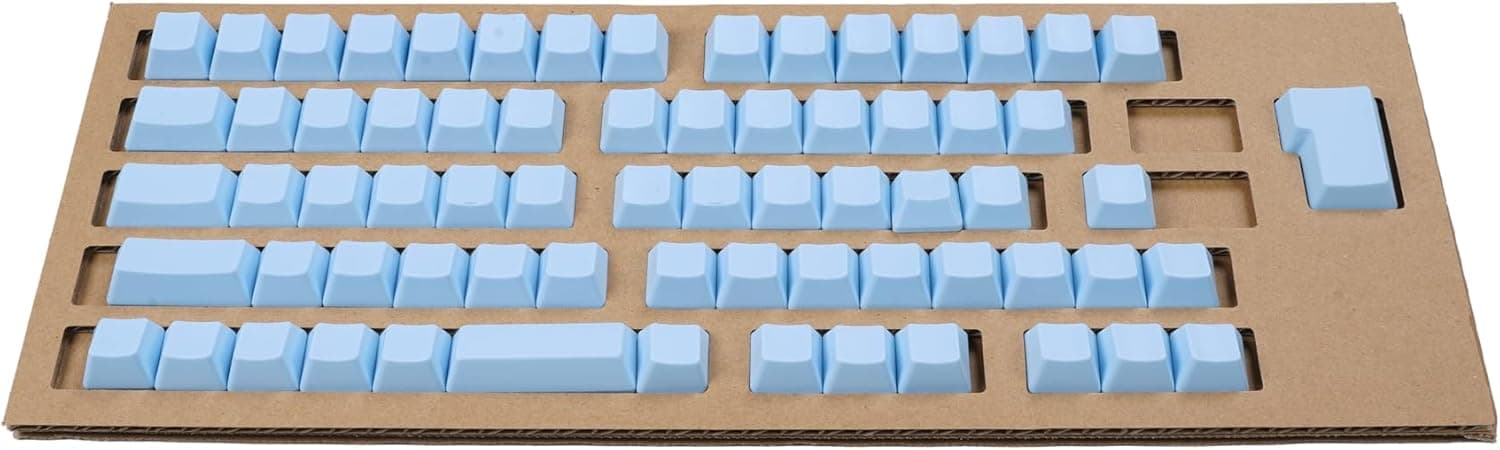
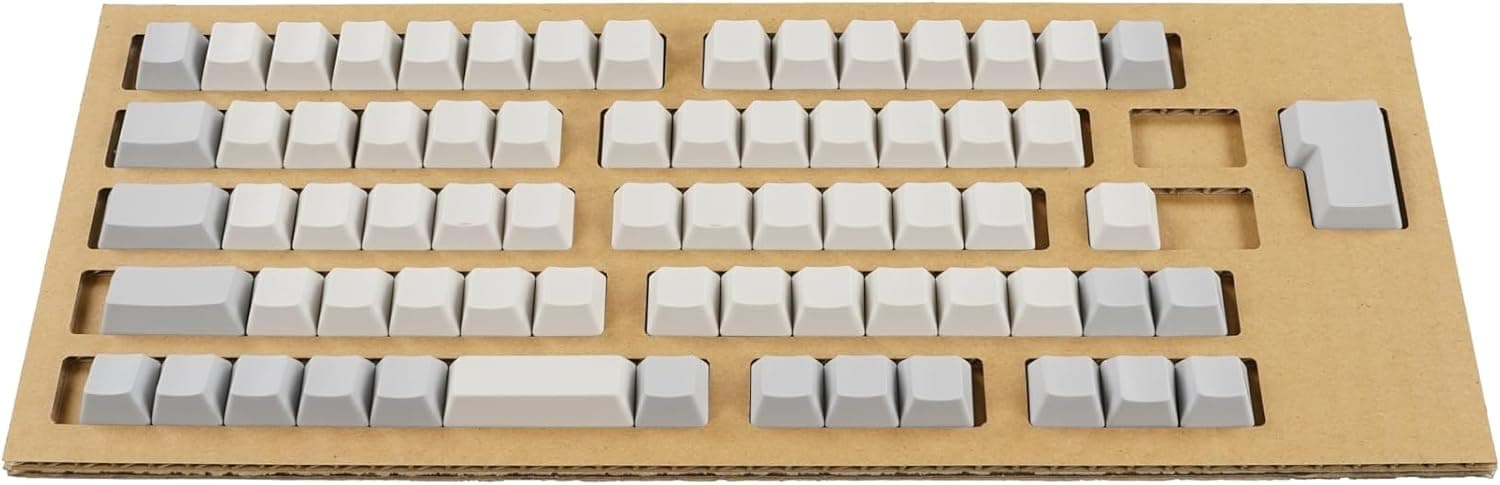
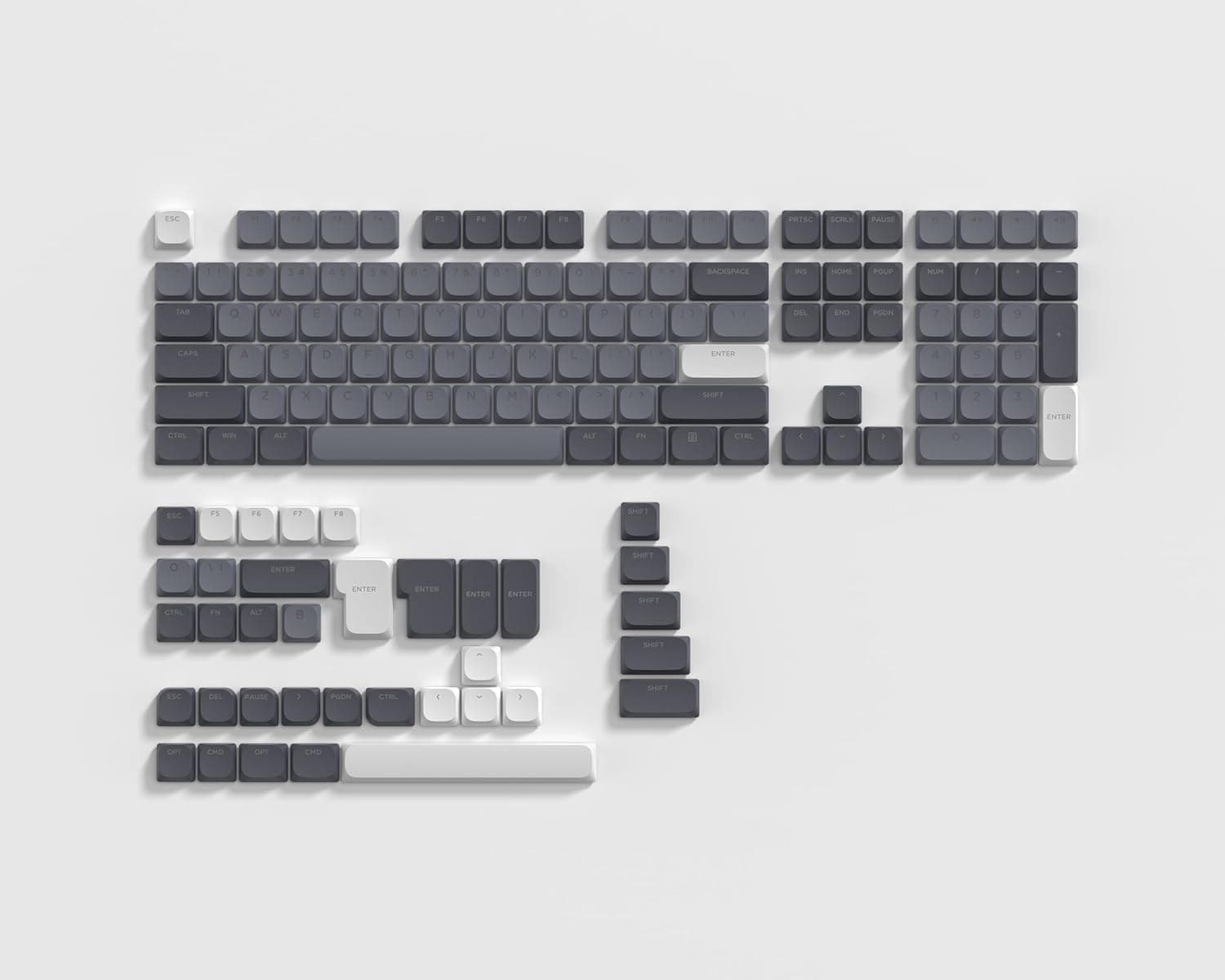
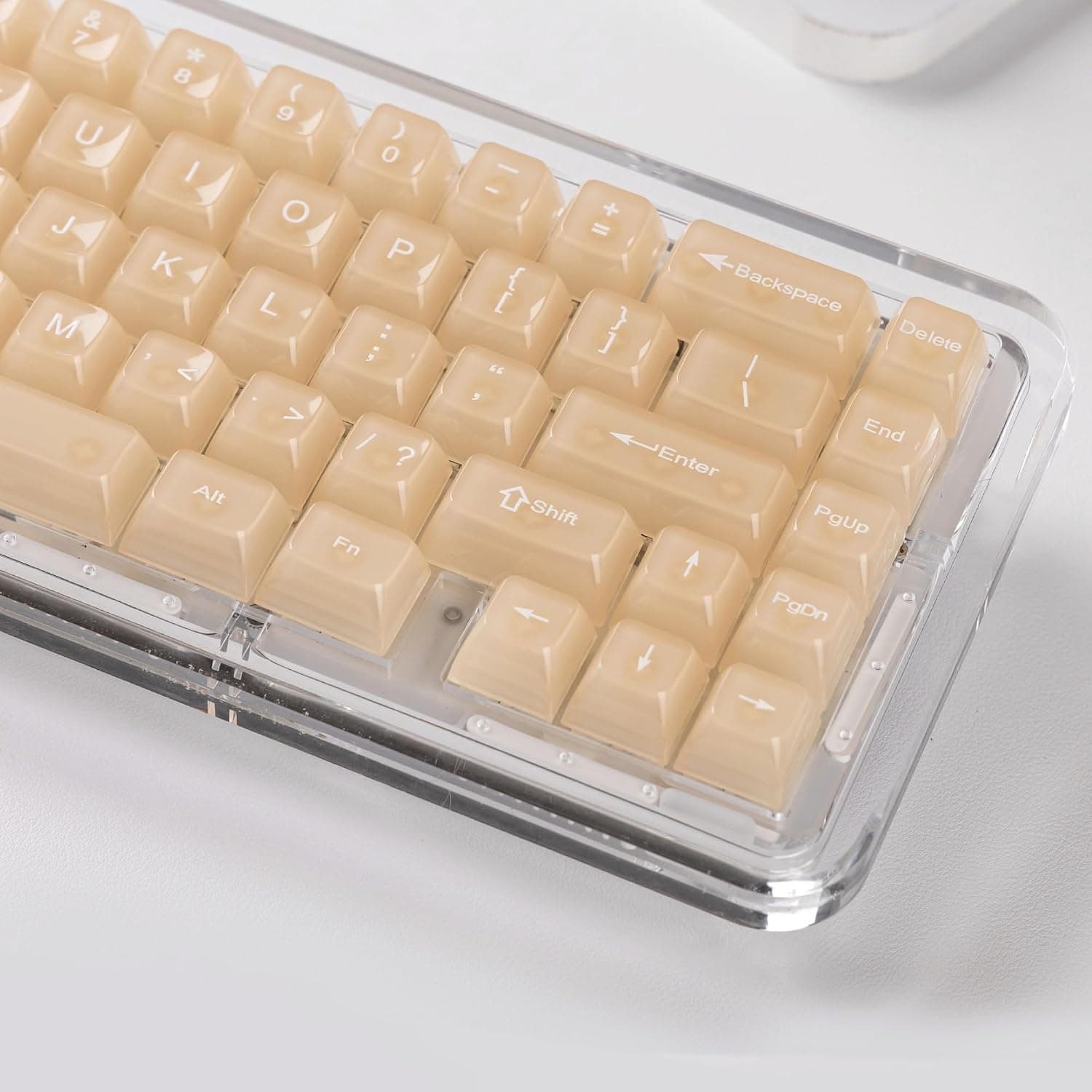
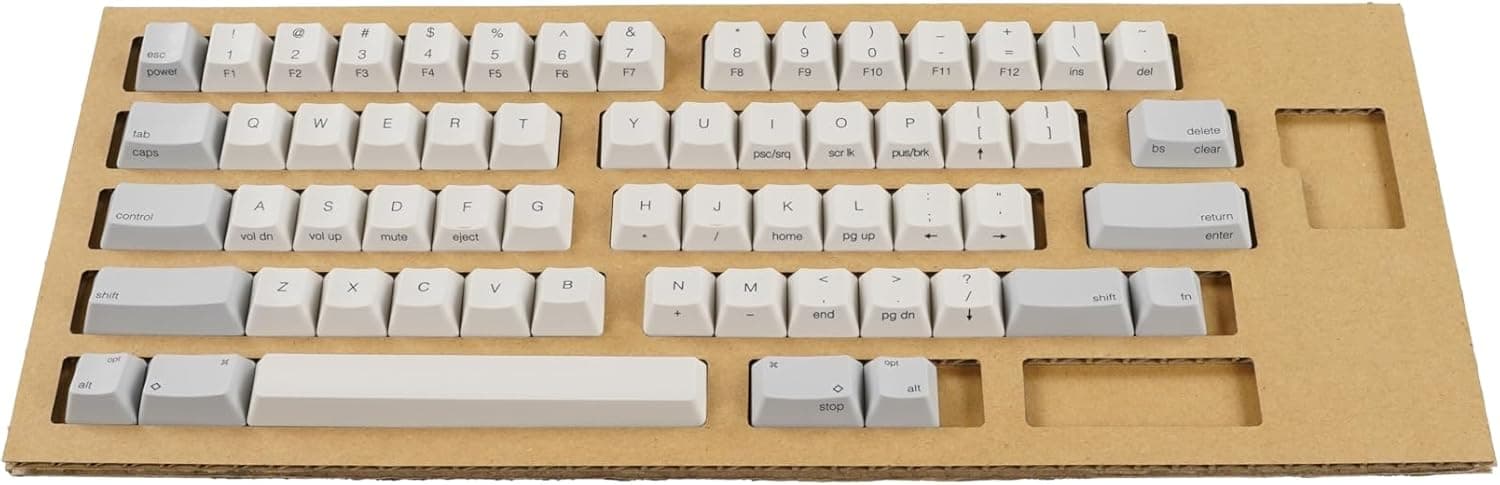
The daixiahu Mithril Theme Cherry Profile Keycap Set is a large 176-key set built from two materials: PBT and PC. This article digs into what actually matters before you buy — whether it will physically fit your board, whether the price makes sense, and the pitfalls people only discover after installation.
Overview
The set contains 166 base keys plus 10 extras for a total of 176, in Cherry profile. The color scheme evokes mithril — a pale metallic fantasy palette — with translucent parts molded in polycarbonate (PC) and everything else in PBT.
Legends use two processes: dye-sublimation on the PBT keys and silk-screen on the translucent ones.
The short version: this set fits people running a standard-layout full-size or TKL board who want to change the mood of their desk with a fantasy-themed palette. It is a poor fit for anyone on a non-standard layout, or anyone expecting every legend to glow.
It is a keycap-only product — no keyboard and no switches are included.
On materials, two points are worth internalizing. PBT resists wear and shine far better than ABS, and dye-sublimation infuses the dye into the plastic, so legends do not rub off with normal use.
The PC translucent pieces trade that durability for light transmission — they show scratches and finger oils more readily. Understanding that the set mixes a durable body with a deliberately compromised translucent accent will keep expectations realistic.
Compatibility Guide
The set fits Cherry MX-style switches, meaning cross-shaped (+) stems. Gateron, Kailh, TTC, Outemu, Akko and most in-house switches on current mechanical keyboards use this stem.
The following do not work:
| Keyboard type | Fits | Reason |
|---|---|---|
| Cherry MX / MX-compatible switches | Yes | Cross stem, standard spacing |
| Low-profile (Kailh Choc etc.) | No | Different stem and key pitch |
| Electrostatic capacitive (HHKB / REALFORCE) | No | Different stem; needs proprietary caps |
| Split spacebar / odd bottom row | Partial | Those specific keys may not exist in the set |
| Scissor / laptop-style | No | Entirely different mechanism |
In practice, failures happen at the bottom row, not at the switch. A 176-key count means broad layout coverage, not a guarantee that every unusual key width is included.
A standard ANSI/JIS bottom row uses a 6.25u spacebar with 1.25u modifiers.
Some gaming boards and custom kits use a 7u spacebar or 1.5u modifiers.
In those cases everything above the bottom row seats perfectly and only the last row is left mismatched — the most frustrating possible outcome.
Check three things before ordering. First, pull one keycap and confirm the stem is a cross.
Second, measure the spacebar and the modifiers flanking it. Third, if you type on a JIS layout, decide whether you need the Japanese-specific keys — overseas sets frequently omit them.
Confirm the included-keys photo on the product page rather than assuming coverage.
Set realistic RGB expectations too. Only the PC translucent pieces pass light; the PBT keys do not.
The effect is accent lighting from a handful of clear keys, not glowing legends across the board. If you want shine-through legends, a purpose-built shine-through set will satisfy you more.
Product Info
| Spec | Value |
|---|---|
| Key count | 176 (166 + 10) |
| Material | PBT + PC (polycarbonate) |
| Profile | Cherry |
| Printing | Dye-sublimation + silk-screen |
| Switch support | Cherry MX compatible (cross stem) |
Cherry profile is sculpted — each row has its own height and angle — and sits slightly lower than OEM profile. Shorter finger travel is generally reported as less fatiguing, which is why Cherry remains one of the default choices in the custom keycap scene.
The flip side: if your board shipped with OEM caps, the swap will feel noticeably lower at first. Most people adapt within a few days.
On price, the listing was ¥21,712 as captured on 24 May 2026 and ¥21,709 as captured on 2 June 2026. Essentially flat across that window, which suggests a regular price rather than a sale.
Prices change often and this article will not, so verify the current figure on the product page before buying. The overseas marketplace entry resolves only to a search results page, so no confirmed second-market price is available.
Roughly ¥21,700 is firmly in the upper tier for keycaps. Typical PBT dye-sub sets sold in Japan land somewhere between a few thousand yen and a little over ten thousand.
The 176-key count and dual-material construction explain the premium, but this is not an entry-level budget set. If cost is the priority, a smaller Cherry-profile PBT set gives better value per yen.
Ratings sat at 4.8/5 (96% favorable) at capture time — but from only 9 reviews.
At that sample size a single defective unit swings the average sharply, and a clean streak is not yet evidence of consistent quality control. Read the review text for which keyboard each buyer installed on and whether the bottom row fit; that is far more useful than the star average.
How It Compares
Keycap decisions come down to four axes: key count, printing method, light transmission, and price. This set bets on key count and material mix.
- If coverage matters most, this set wins — 176 keys can serve anything from full-size down to 60%, and likely survives your next keyboard purchase.
- If you want glowing legends, look at shine-through sets — only the clear pieces light up here. Different category entirely.
- If you want uniform typing sound, consider a single-material set — PBT and PC differ slightly in hardness and acoustics.
- If you own an HHKB or REALFORCE, buy the proprietary key top set — MX caps simply will not mount.
Installation Notes
Swapping caps is straightforward, but a few habits prevent damage. Always use a wire keycap puller and pull straight up.
Prying at an angle with fingers or a screwdriver is how switch stems snap, and a snapped stem means replacing the whole switch.
Stabilized keys — spacebar, Enter, Shift, Backspace — are the fiddly part. They ride on wire stabilizers underneath and need care in both directions.
If the spacebar binds or Enter tilts after the swap, the cause is usually stabilizer seating rather than keycap fit. Pull it off and reseat it straight before concluding the set is defective.
Photograph your original layout first. With 176 keys it is easy to lose track of which row (R1–R4) a given cap belongs to, and because Cherry profile is sculpted per row, a misplaced cap feels wrong immediately.
Best Use Cases
- Standard-layout full-size, TKL, 65% or 60% keyboards — where the 176-key coverage pays off, especially if you own several boards and can redistribute spares.
- People building a fantasy/RPG desk aesthetic — the Mithril theme is the core value here. If the theme does not appeal, cheaper sets will serve you better.
- Heavy typists who want legends that survive — PBT plus dye-sublimation is about as resistant to shine and legend wear as current manufacturing gets.
- RGB users who prefer accent lighting — a few glowing translucent keys rather than a fully lit board.
Before You Buy
1. Do not misjudge the price tier. Around ¥21,700 at capture time is upper-tier for keycaps.
Reading only "Cherry profile PBT set" and assuming a few thousand yen leads to a surprise at checkout. The premium is justified only if the coverage and the theme genuinely matter to you.
2. The bottom row is the real risk. The most common complaint about any keycap set is that a handful of keys did not fit.
Measure the spacebar and its flanking modifiers first.
3. JIS users should be especially careful. Overseas themed sets are usually designed around ANSI and may omit Japanese-specific keys or the tall Enter.
If so, you will be leaving a few original caps in place.
4. Verify the listing details yourself. Marketplace listings sometimes register seller, fulfillment, or market labels inconsistently — this product's price records show a marketplace label that does not match the actual currency and region.
If the digits, currency, or seller brand look off, do not take the display at face value; confirm the product from the images, title, and included-keys photo.
5. Nine reviews is not yet enough data. A 4.8 average looks great, but that sample cannot tell you anything about unit-to-unit variance or color consistency.
Waiting for more reviews is a rational choice if you dislike that risk.
6. Do not expect a sound transformation. Keycaps shift the sound somewhat, but switch swaps, lubing, and case foam do far more.
Treat a keycap change as primarily a visual upgrade.
FAQ
Q. How do I confirm it fits my keyboard? A.
Pull one keycap and look at the stem. A cross-shaped (+) post means MX compatible.
A round cylinder or proprietary shape means no. Also measure your spacebar width.
Q. Will it work on an HHKB or REALFORCE?
A. No. Capacitive boards use a different stem and require the manufacturer's own key top sets.
Q. Do all the keys light up? A.
Only the translucent PC pieces pass light. PBT keys are opaque, so this is not a shine-through legend set.
Q. Will the legends wear off? A.
The dye-sublimated PBT legends should not wear off under normal use. Silk-screen printing on the translucent keys sits on the surface and is less abrasion-resistant, so treat those with a bit more care.
Q. What do I do with the leftover keys? A.
Keep them as spares or redistribute them to another board. Broad key coverage is a long-term benefit when you change keyboards later.
Q. Is a keyboard included?
A. No. Keycaps only — no keyboard and no switches.
Product Disclosure (Amazon)
- Manufacturer: daixiahu
- Seller: メゾンレーヴ
- Fulfilled by: メゾンレーヴ
- ASIN: B0DJR97QLP
- Note: This article covers a manufacturer-made product based on Amazon listing details.