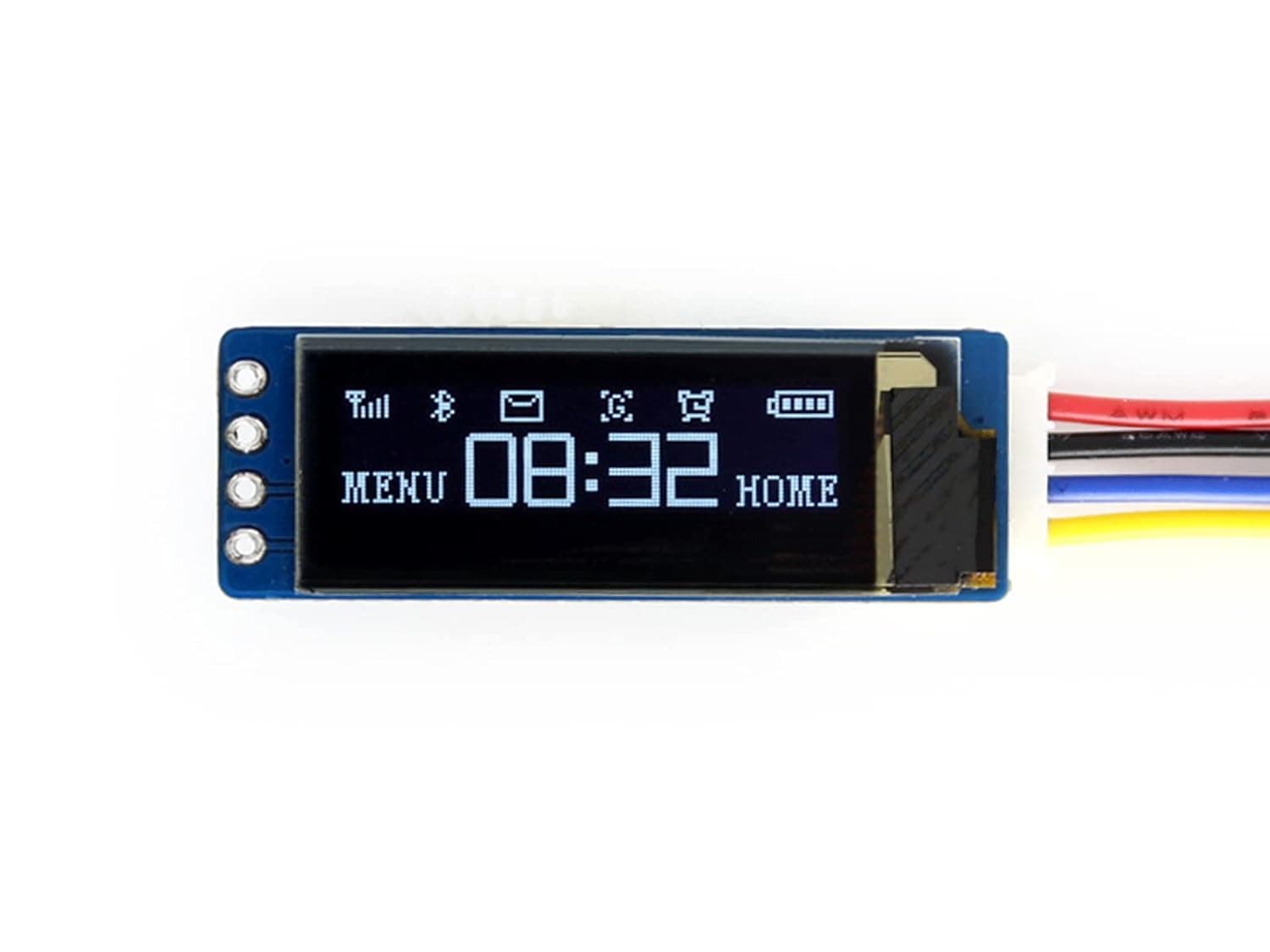
This article covers Waveshare 0.9インチ OLED ディスプレイモジュール 128x32ピクセル 埋め込みコントローラー付き I2C経由で通信 Raspberry Pi.
Overview
The Waveshare 0.9-inch OLED display module offers a 128×32 pixel resolution in a compact form factor. It integrates the SSD1306 controller and communicates via I2C, making it compatible with 3.3V and 5V logic levels. This module is designed to work directly with popular single-board computers like Raspberry Pi, Jetson Nano, and STM32 boards. Its low power consumption and small footprint make it an excellent choice for status displays, menu interfaces, and IoT projects where space and energy are limited.
Compatibility Guide
The module uses the I2C interface (SDA/SCL) with a default address of 0x3C. It can be powered by either 3.3V or 5V, giving flexibility for different platforms. On Raspberry Pi, connect SDA (GPIO2, pin 3) and SCL (GPIO3, pin 5) directly. Jetson Nano’s 40-pin header follows a similar pinout. STM32 boards with I2C peripherals – such as the STM32F103 – work without special adapters. For other microcontrollers (Arduino, ESP32), ensure the I2C pins are connected and pull-up resistors (2.2k–10kΩ) are installed if not already present on the module.
Product Info
This module is manufactured by Waveshare and widely available through Japan and other online retailers. The current price is approximately 6,034 yen (tax included, May 2026). It sits at the entry-to-mid level in the display module market, offering a good balance of ease of use and reliability. The product has been on the market for several years, with consistent availability and extensive community support.
Best Use Cases
- Adding a status display to Raspberry Pi: With well-documented Python libraries, you can show CPU temperature, IP address, or sensor readings with just a few lines of code. Wiring takes only four pins, making it beginner-friendly. - Compact IoT projects: Its ultra-low power consumption (as low as 0.1W) makes it ideal for battery-powered sensors or wearable devices that need a simple text/graphics output. - Learning I2C communication: STM32 and Arduino users can practice basic protocol implementation. Many open-source code examples are available for displaying characters, bitmaps, and animations.
Things to Consider
The resolution (128×32 pixels) is adequate for text but not for detailed graphics or images. If you need more visual information, consider a 128×64 or larger OLED. The I2C address is fixed (0x3C), so multi-device I2C buses require address conflict management. Pull-up resistors may need adjustment depending on your wiring length. OLED burn-in is possible under static images over long periods; implement periodic refresh or a screen saver to prolong lifespan. Also, the module does not include a level shifter; ensure your host's I/O voltage is compatible (3.3V/5V tolerance).
![Dell 27 LED backlit LCD Monitor SE2719H IPS Full HD 1080p 1920 x 1080 at 60 Hz HDMI VGA[並行輸入]](/_next/image?url=https%3A%2F%2Fm.media-amazon.com%2Fimages%2FI%2F81nSaeP3AvL._AC_SL1500_.jpg&w=1920&q=75)