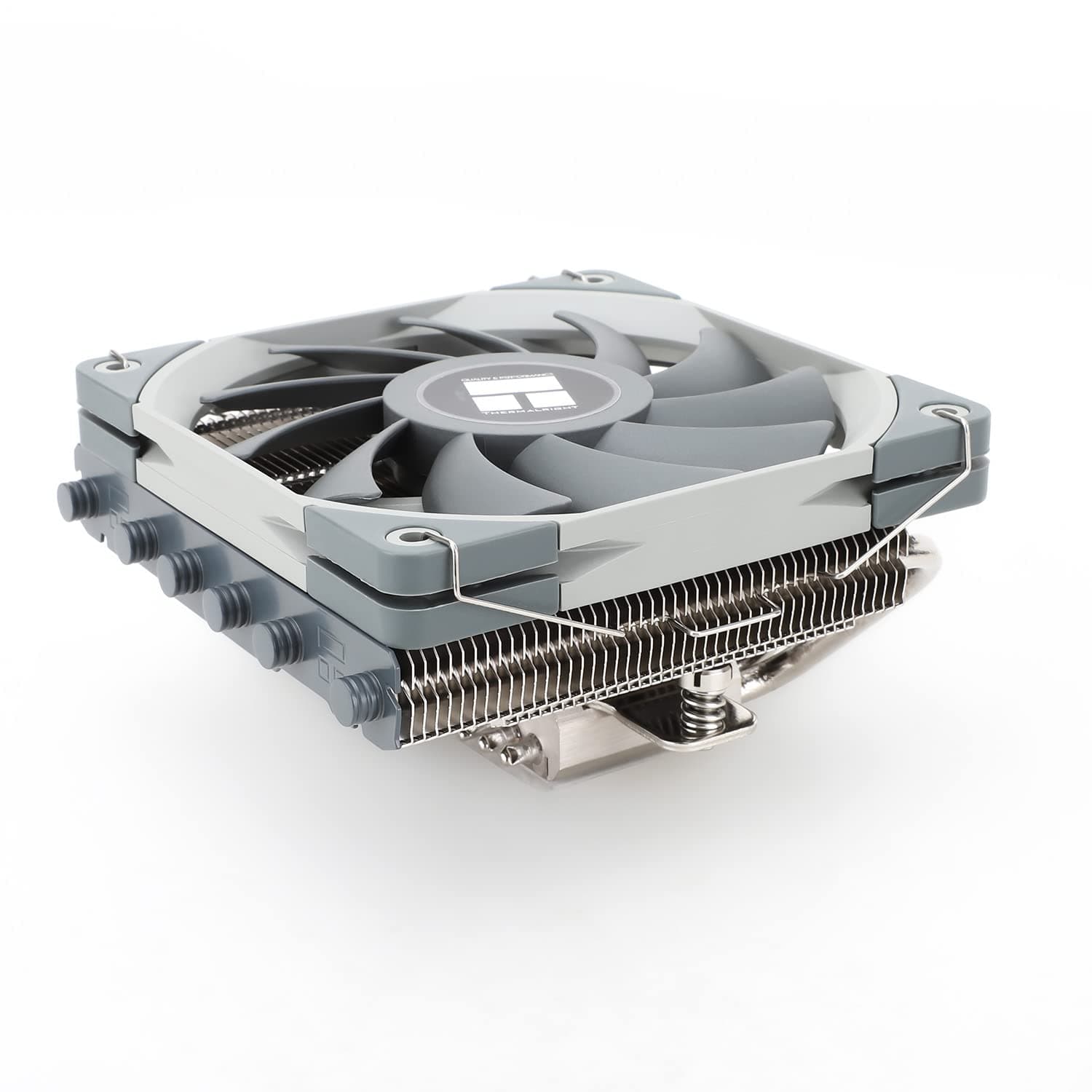
The Thermalright AXP-120 X67 is a low-profile, top-flow (downward-blowing) CPU air cooler that keeps overall height in the 67mm class. It targets slim cases, Mini-ITX builds and HTPCs where a large tower cooler simply will not fit, but where the stock cooler is too loud.
On Amazon.co.jp it holds 4.3 out of 5 stars from 74 reviews (86% positive), which is solid for its price bracket.
Overview
With low-profile coolers, the first question is not performance but whether it physically fits. The AXP-120 X67 lays a 120mm-class fan flat over the fin stack to keep total height around 67mm, so it clears the top panel or side panel of cases with very little vertical room.
Because it is a top-flow design, exhaust air drops onto the socket area, which also cools the VRM heatsinks, memory and the M.2 area around the socket.
The trade-off is that this airflow does not ride the front-to-back path of a well-ventilated case. In a mid-tower with good airflow, a dual-tower side-flow cooler at the same price will cool better.
Treat the AXP-120 X67 as the best compromise within a height limit, not as an absolute-performance pick.
Why a Low-Profile Top-Flow Cooler
Stock coolers in slim cases tend to spin high and produce a whiny, high-frequency noise under load, because the small fin area forces them to trade RPM for heat dissipation. Swapping in a heatpipe cooler with a much larger fin stack lets the same heat load be handled at lower RPM, and the perceived noise drop is significant.
Realistically, this class of cooler suits roughly 65W-TDP CPUs up to mid-range parts running with a power limit applied. If you plan to run a high-end CPU pulling 150W or more continuously, low-profile coolers in general will run out of headroom.
In that case, a 240mm-or-larger AIO, or a case that accepts a tall tower cooler, is the cheaper answer in the long run.
Compatibility Guide
Start with your case's maximum CPU cooler height. Even when the spec sheet says "up to 70mm," reinforcement ribs or an intake filter frame on the panel can eat several millimetres.
If your nominal margin is only about 3mm, measure it yourself before ordering.
Next, check memory height. Top-flow coolers overhang the socket area, so tall heat spreaders and addressable-RGB modules can foul the fin stack.
Low-profile memory is the safe choice. The same applies to boards with oversized VRM heatsinks: heatsink-to-heatsink contact can prevent the backplate from tightening fully.
Mounting hardware differs by socket generation — Intel LGA1700-era and AMD AM4/AM5 use different kits. For newer sockets such as LGA1851 or AM5, the bundled kit can vary by production batch, so cross-check the listing's socket list against your motherboard's socket before ordering.
Thermalright often sells later-socket mounting kits separately, but inclusion is not guaranteed.
One more slim-case caveat: if a case fan, the PSU, or a drive bay sits directly above the cooler, the cooler simply cannot draw enough air. Whether the top panel has intake vents can shift results by several degrees, so check the vent layout too.
Product Info
As captured on 29 May 2026, Amazon.co.jp listed it at ¥4,509.
A marketplace capture from July 2026 shows $44.29 on eBay US.
Both are point-in-time figures that move with sales, exchange rates and stock, so confirm the current price on the product page before buying. If you are in Japan, the Amazon.co.jp listing is the easier route once shipping and lead time are considered.
Reviews stood at 74 ratings, 4.3 out of 5 (86% positive) as of 29 May 2026.
That is not a huge sample, but for a niche low-profile category it suggests the cooler does what buyers expect. Negative reviews in this category usually come down to clearance and fitment mistakes rather than cooling performance.
| Item | Detail |
|---|---|
| Type | Top-flow air CPU cooler |
| Height | 67mm class (the "X67" in the name) |
| Fan size | 120mm class |
| Price (captured) | ¥4,509 (Amazon.co.jp, 29 May 2026) |
| User rating | 4.3 / 5 from 74 reviews (29 May 2026) |
Every value above is a point-in-time capture. Prices in particular move monthly, so read the figures as a rough baseline and verify on the product page.
How It Compares
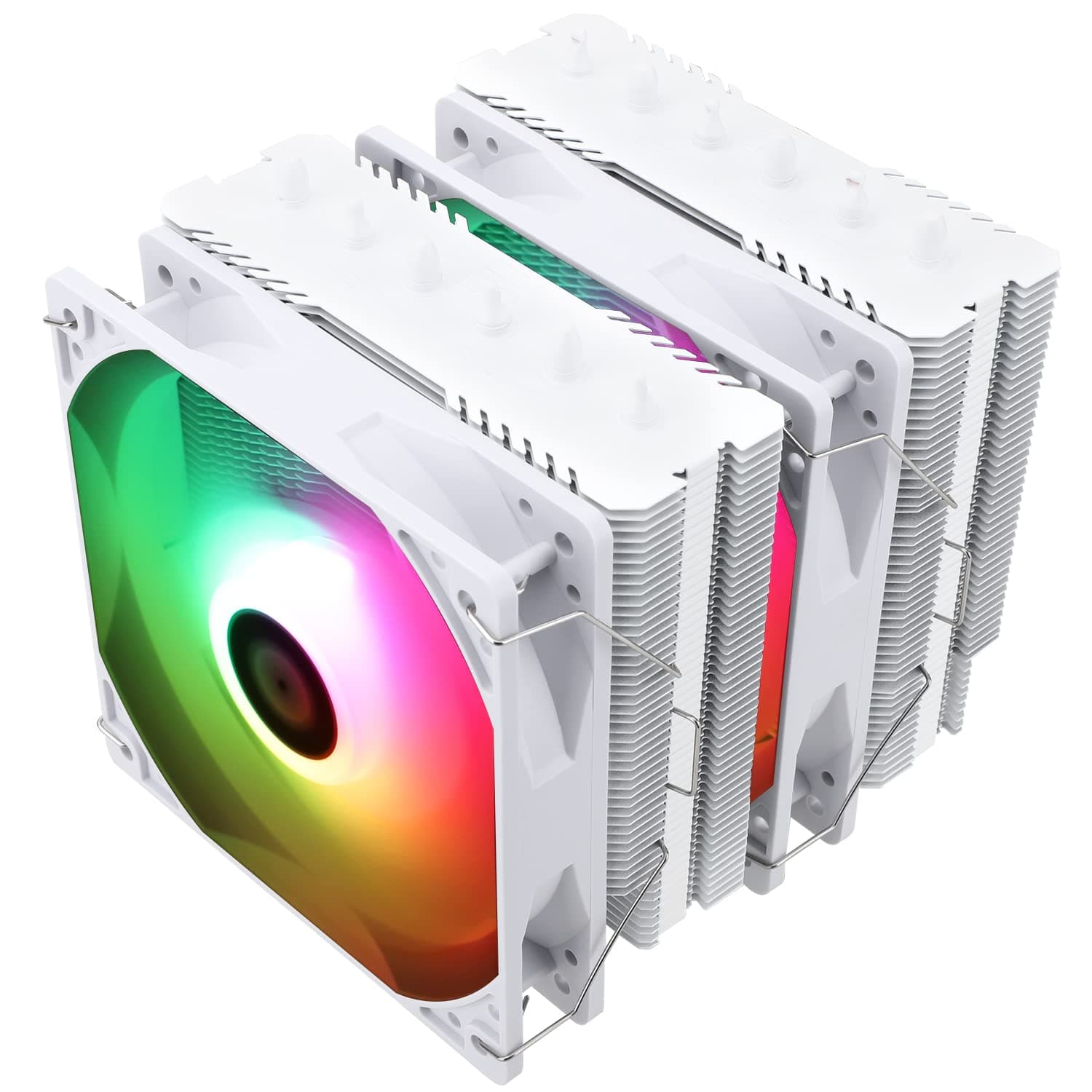
Thermalright's own Peerless Assassin 120 series cools clearly better thanks to its dual-tower stack, but at roughly 155mm tall it will not fit a slim case. The same goes for single-tower coolers like the Cooler Master Hyper 212 EVO V2.
The real comparison set for the AXP-120 X67 is other coolers that fit the same height limit, or a small-radiator AIO.
If you are considering liquid cooling, 240mm radiators rarely fit slim chassis, so it comes down to what your case supports. Where a radiator does fit, liquid cools better — but you add a pump as a moving part and multiply the cost.
For a roughly ¥5,000 upgrade aimed at quieter operation, low-profile air is the better value.
Best Use Cases
This cooler is an easy recommendation if you:
- Use a slim or Mini-ITX case with a cooler height limit around 70mm
- Want a quieter HTPC or recording box in the living room
- Run a 65W-class CPU, or a mid-range CPU with a power limit applied
- Are making a first upgrade from the stock cooler on a modest budget
- Want the top-flow side benefit of airflow over the VRM, memory and M.2 area
Conversely, if you have a mid-tower with plenty of vertical room, the same budget spent on a dual-tower side-flow cooler will cool better. Without a height constraint, there is little reason to choose this one.
Real-World Impressions
The biggest perceived difference shows up at idle and light load. Stock coolers constantly ramp up and down, which draws attention; with more fin area the fan settles at a low, steady RPM that fades into the background.
For browsing and video playback, that difference is most of the satisfaction.
Under sustained load, results depend heavily on case exhaust. A top-flow cooler dumps heat into the chassis, so a case with weak exhaust raises internal air temperature and CPU temperatures plateau higher.
Adding a single rear or top exhaust fan can be worth several degrees, so consider it alongside the cooler swap.
Things to Check Before Buying
The main pitfall is height and memory clearance. "My case supports 70mm, so 67mm fits" ignores fan cable routing and internal panel protrusions — a common failure is crushing the fan connector when closing the top panel.
Measure from the socket surface to the inside of the panel with a ruler before you commit.
The second is expectation setting. A low-profile cooler is quieter and cooler than a stock cooler; it is not equivalent to a large tower or an AIO.
Long rendering or encoding runs, or all-core loads on a high-end CPU, can hit thermal throttling. With a modest power limit (PL1/PL2 or PPT) applied, it remains perfectly usable.
A note on installation: top-flow coolers cover the board surface, making screws and the 4-pin header near the socket hard to reach afterwards. Mount the cooler with the motherboard out of the case and route the EPS 12V cable first — it makes the build far easier.
Finally, a data warning. While preparing this article, the source product data contained specifications for a completely unrelated Wi-Fi 6 USB wireless adapter. Listing metadata and spec tables on retail sites really do get cross-contaminated with other products.
When you open the product page, do not take the spec table at face value — confirm with your own eyes that the images, title and model number say "AXP-120 X67." If you see wireless standards or throughput figures in the spec list, that is not information about this CPU cooler.
FAQ
Q. It says 67mm tall. Will it definitely fit a case rated for 70mm? A.
On paper yes, but fan cable routing and panel protrusions can consume the margin. With only ~3mm of headroom, measure before buying.
Q. Does it support my socket? A.
Mounting kits differ by generation. Check the listing's socket list against your motherboard before ordering; newer sockets may require a separately sold kit.
Q. Can I use it with a high-end CPU? A.
It will work, but sustained all-core loads may cause thermal throttling. Apply a power limit, or move to a case that accepts a larger cooler.
Q. Will tall RAM fit? A.
Top-flow coolers overhang the socket, so tall heat spreaders can interfere. Low-profile memory is the safe choice.
Q. Is it worth upgrading from the stock cooler? A.
Especially for noise. The same heat is handled at lower RPM, so idle and light-load noise drops noticeably.
Q. Is thermal paste included? A.
Thermalright coolers generally ship with paste and mounting hardware, but contents can vary by batch. Check the accessories section on the product page.
Product Disclosure (Amazon)
- Manufacturer: THERMALRIGHT(サーマルライト)
- ASIN: B0B1DFW3H2
- Note: This article covers a manufacturer-made product based on Amazon listing details.