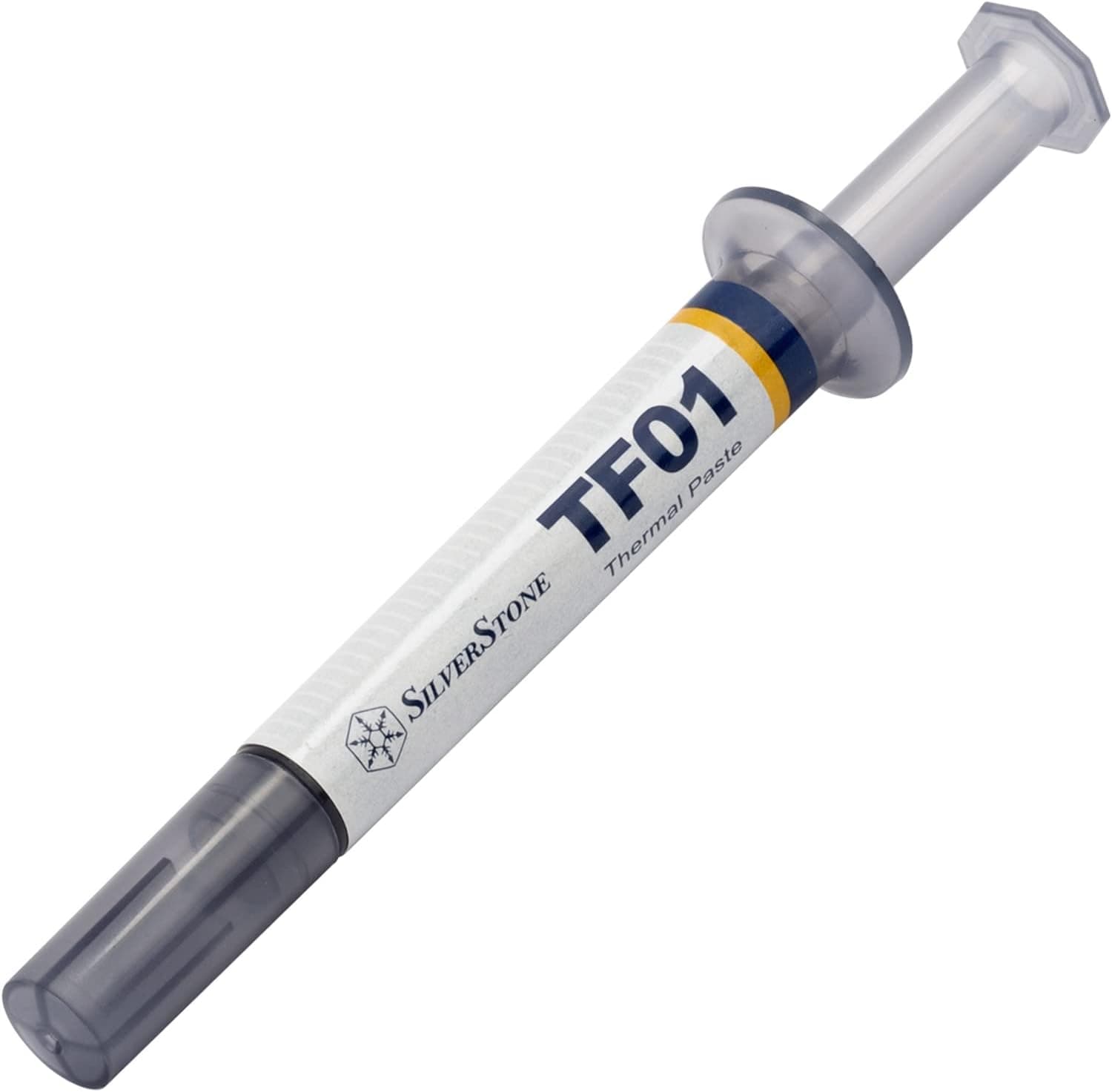
The SilverStone SST-TF01 is a silicone thermal grease applied between a CPU or GPU and its cooler. This article goes beyond the spec sheet to answer the question buyers actually have: who should get this tube, and who should spend a little more elsewhere.
Overview
SST-TF01 is SilverStone's "high thermal conductivity" silicone grease, distributed in Japan through an official importer. The manufacturer emphasizes resistance to separation, bleeding, and leakage, meaning the compound is meant to stay where you put it rather than migrating onto the board.
The listed weight is 20 g, which — against a typical per-CPU dose of roughly 0.2–0.5 g — works out to dozens of applications.
Position it as a high-volume, low-cost general-purpose paste rather than a chart-topping enthusiast compound.
As captured on 19 May 2026, the Amazon listing showed 14 reviews averaging 4.2 out of 5 (84% positive).
That is a decent score, but 14 is a small sample. Compared with mainstream pastes carrying thousands of ratings, there is simply less accumulated evidence across many different systems.
Compatibility Guide
Thermal paste has no socket compatibility in the usual sense, but it is not "works anywhere, no thought required" either. Four practical checks:
| Check | How it applies to SST-TF01 |
|---|---|
| CPU socket | Intel LGA and AMD AM4/AM5 alike; socket shape imposes no limits |
| Surfaces | IHS, bare die (delidded), GPU core, chipset, VRM heatsinks |
| Surface prep | Must be clean and dry; remove old paste completely with isopropyl or similar |
| In the box | Tube only. Spreader, cleaner, and wipes are not included |
The official compatibility note is simply that the surface must be clean and dry. In practice most disappointing results come from preparation, not from the compound.
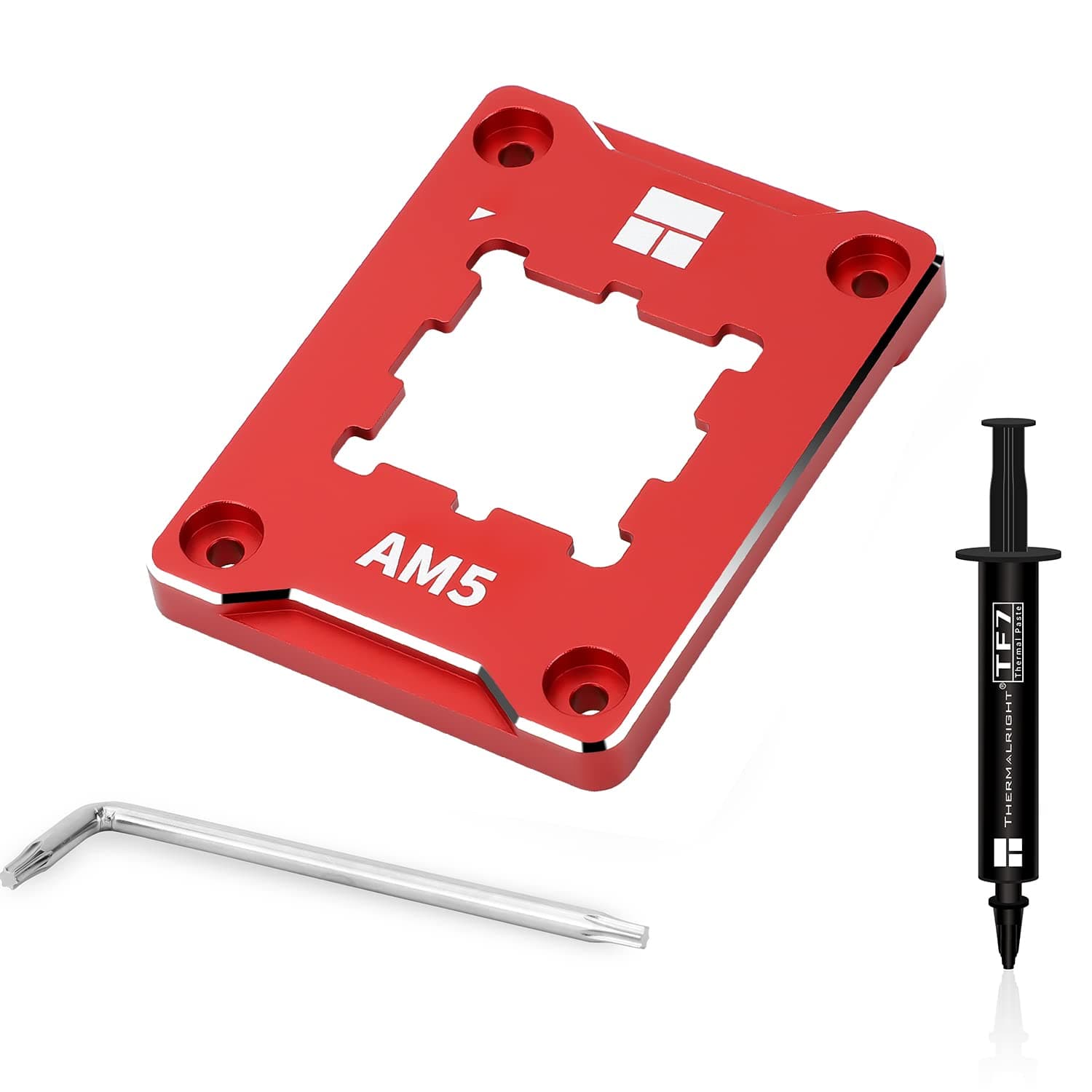
On sockets where IHS flatness gets discussed — AM5 in particular — mounting pressure and even contact matter far more to your temperatures than which paste brand you chose. If you suspect flex, a contact frame is a better first purchase than a new tube of grease.
One caveat: the available data does not state electrical conductivity. Non-metallic silicone pastes are generally regarded as electrically non-conductive, but with any brand you should avoid powering up a board with squeeze-out sitting on socket pins.
Do not over-apply, and wipe away anything that escapes the IHS.
Product Info
The registered details list SilverStone as both brand and manufacturer, model number SST-TF01, ASIN B08QYV54LD, package dimensions 16.2 × 11.2 × 0.6 cm, weight 20 g, and no battery included.
The 6 mm package thickness tells you this is an ordinary flat retail blister with a tube inside.
Price was ¥1,118 on Amazon.co.jp as captured on 19 May 2026.
Thermal paste pricing moves frequently with stock and promotions, so treat that figure strictly as a snapshot from that date. A second channel — an eBay search — returned no price, only "See listing." Overseas listings rarely win once shipping and transit time are counted, so check the domestic price first.
The specific W/m·K rating is not present in the data available here. It appears on the package and the manufacturer's product page; check there if you want to compare numbers against another paste.
This article will not invent a figure it cannot verify.
Application Tips
A large tube means you can apply generously — but more paste does not lower temperatures. The compound exists to fill microscopic gaps between two metal surfaces; a thick layer becomes thermal resistance in its own right.
- Remove the old paste completely. Residue you leave behind stays as an insulating layer.
- Place a pea- to rice-grain-sized dot in the center of the IHS and let mounting pressure spread it. Reaching the corners is not the goal.
- Tighten the cooler diagonally in small, even increments. Uneven torque is the number one cause of poor contact.
- After reseating, log both idle and sustained-load temperatures under real workloads so you have a baseline for next time.
Swapping paste typically buys 2–5°C. If you see a 10°C-plus improvement, the cause was almost certainly dried-out old paste or a cooler that was not seated properly — not the brand on the tube.
How It Compares
ARCTIC MX-4 offers a 20 g tube in the same bulk category with a far longer track record and a much larger review base. If you want a small, trusted amount instead, Noctua NT-H1 is the usual answer.
SST-TF01's relative strengths are domestic availability as an officially imported product at a low price, and a per-application cost that drops sharply with the large tube. Its relative weakness is evidence: fewer reviews and less published comparison data.
When the price gap is only a few hundred yen, picking the proven option is a perfectly rational call. But if you repaste dozens of times a year on a repair bench, the bulk tube wins on total cost.
Choose by how often you actually apply it.
Best Use Cases
- People who build or service multiple PCs. At a few hundred milligrams per CPU, 20 g covers dozens of applications, which cuts the cost per job for system builders and anyone maintaining machines for family or the office.
- First-time repasters. Having plenty in reserve means a botched first attempt costs you nothing but time — you can clean up and try again without rationing.
- Intermediate users on a maintenance schedule. For a repaste every few years, this sits at a sensible price for something you keep on the shelf.
- Anyone who wants a spare on hand. Discovering you are out of paste with the cooler already off is a genuinely annoying way to lose an evening.
Before You Buy
Not for people chasing the last few degrees. If you are overclocking a 200 W-plus CPU and want every point of benchmark score, a premium paste with published conductivity figures and extensive third-party testing — or liquid metal — fits that goal better.
SST-TF01 is about adequate performance, cheaply, in quantity.
Accept that the review sample is only 14. A 4.2 average is good, but with 14 ratings a single outlier moves the number noticeably.
There is not enough data there to judge long-term dry-out or pump-out behavior (paste being pushed out of the joint by thermal cycling). For a high-end build you intend to leave untouched for years, a paste with a deeper track record is the safer bet.
Read the 20 g figure carefully. The listed weight comes from the product listing, and net compound weight is not necessarily identical to packaged weight.
If the exact fill quantity matters to you, verify it on the manufacturer's product page.
The price is a point-in-time capture. The ¥1,118 above reflects 19 May 2026 and will change with sales and stock.
Confirm the current price on the product page before ordering. Note also that channel labels do not always match reality — here the entry was labeled "Amazon US" while carrying an Amazon.co.jp URL and a yen price.
Judge by the destination domain and currency symbol, not the label.
Listing metadata itself is sometimes wrong. Thermal compounds have many similarly named SKUs, and retail listings do occasionally carry another product's manufacturer name or model number.
In this case the manufacturer field (SilverStone) matches the title, but confirm with your own eyes — via the product images and title — that you are ordering SST-TF01.
No applicator is included. A spreader, isopropyl alcohol, and lint-free wipes must be bought separately.
First-timers who skip this end up stalled halfway through the job.
FAQ
Q. How many applications does 20 g cover? A.
A typical CPU dose is roughly 0.2–0.5 g, so arithmetic puts it in the dozens.
Actual consumption depends on surface area — AM5 and large GPU dies take more.
Q. Can I use it on a GPU? A.
Yes. GPUs have exposed dies with VRAM and small components nearby, so be careful about squeeze-out.
Note that disassembling a graphics card may void its warranty.
Q. What is the thermal conductivity in W/m·K? A.
That figure is not in the data referenced here. It is printed on the package and on the manufacturer's page; check there rather than trusting a guessed number.
Q. How much cooler will it run than a mainstream paste? A.
With the same cooler and the same mounting pressure, differences between ordinary pastes usually land within a few degrees. A larger gap points to mounting or cleaning differences.
Q. How often should I repaste? A.
Every few years is plenty for normal use. Reinspect regardless of schedule if load temperatures have clearly crept up or fans ramp sooner than they used to.
Product Disclosure (Amazon)
- Manufacturer: SilverStone
- Seller: Amazon.co.jp
- Fulfilled by: Amazon.co.jp
- ASIN: B08QYV54LD
- Note: This article covers a manufacturer-made product based on Amazon listing details.