Overview
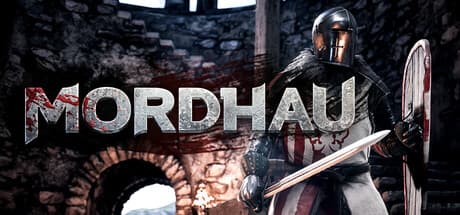
MORDHAU is a medieval multiplayer slasher developed and published by Triternion, released on Steam on 29 April 2019 (App ID: 629760). You do not play a fixed protagonist — you build a mercenary and drop into battlefields that hold up to 64 players at once.
First and third person views are both available, and large-scale siege battles are the signature experience.
The loop is not campaign progression. You join a server, swing at the front line, die, respawn and walk back in.
Siege engines break walls, cavalry crashes in from the flank, arrows cross overhead — and your job inside that chaos is to manage exactly one thing: your own distance and timing.
Features and Systems
The core is directional melee. Attacks come from a direction, and your defence has to match it.
On top of that sit the techniques that turn a brawl into a read:
- Feint — cancel a wind-up so the opponent's parry hits nothing.
- Morph — switch between a strike and a stab mid-animation.
- Chamber — meet an incoming attack with the same direction to counter it outright.
- Drag / accel — move the camera to shift when the weapon actually lands, breaking parry timing.
These are explained in the tutorial but take a long time to internalise. The upside is that skill decides fights; there is no level or gear power curve to hide behind.
The other pillar is character building. You combine weapons, armour, perks and appearance, and save several mercenaries in loadout slots.
Heavy armour absorbs punishment but slows you down; light armour moves but folds to one clean hit. Polearms, longswords, two-handed axes, shields, bows and crossbows, throwables and horses are all in play, so the same map supports very different roles.
Modes cover large attack-and-defend sieges, team objective fights, smaller deathmatch, and a co-op mode against waves of AI. Steam lists Co-op and Online Co-op support, and that co-op mode is the realistic place to learn before facing people.
System Requirements
| Item | Minimum | Recommended |
|---|---|---|
| OS | Windows 10 64-bit (latest update) | Windows 10 / 11 64-bit (latest update) |
| CPU | Intel Core i5-4670 or AMD equivalent | Intel Core i5-6600K or AMD equivalent |
| GPU | NVIDIA GTX 680 or AMD equivalent | NVIDIA GTX 1060 or AMD equivalent |
| RAM | 8 GB | 16 GB |
| Storage | 40 GB | 40 GB |
| DirectX | 11 | 11 |
The interesting detail is the gap between the GPU and RAM recommendations. The recommended GPU stops at a GTX 1060, but RAM doubles from 8 GB to 16 GB.
That reflects what the game actually stresses: 64 player models, their loadouts, AI and destruction all resolved at once. The game will launch on 8 GB, but if you want stable frames on full servers, plan around 16 GB.
The CPU target tells a similar story. An i5-6600K is a strong four-core part rather than a high core-count one, so single-thread performance matters more than thread count here.
Because melee is decided in a handful of frames, the number that matters is your worst-case frame rate in a crowd, not your average. If you are allocating budget, CPU and memory usually buy more than a GPU tier does.
Storage is 40 GB for both tiers. An HDD meets the requirement, but load and respawn times make an SSD the sensible choice.
The DirectX 11 target means PCs from around 2019 still qualify.
Review Trends
Years after launch the game still holds a strong standing on Steam. Praise focuses almost entirely on the combat system — the common refrain is that other medieval action games feel shallow afterwards — plus the scale of the sieges and the rush of a team that actually pushes together.
Criticism is just as consistent. The learning curve is brutal, and new players get cut down repeatedly by veterans.
Server population varies by region and time of day, which limits which modes you can actually play. Some players are also unhappy with the update cadence and matchmaking.
In short: the fighting is loved, the surroundings are contested — and that split is exactly what you should weigh before buying.
For the current standing, check the rating panel on this page or the Steam store listing.
Who It's For
- Players who enjoy losing their way to competence, like in a fighting game.
- Anyone drawn to reach and timing rather than gunplay, and to the medieval setting itself.
- People who want the feel of a mass battle without needing voice comms.
- Players who like designing their own loadouts and perk combinations.
- Anyone comfortable sinking dozens to hundreds of hours into one game.
Getting Started
Before joining the front line, spend time against AI or in offline practice until matching defence direction is automatic. Thrown straight into a siege, you will die without understanding why.
For a first build, take a long, forgiving weapon — a polearm or a longsword — with medium armour. Light armour dies to one mistake; heavy armour gets surrounded.
And do not measure early progress by duel wins: flanking, holding objectives and protecting siege engines all count.
Caveats and Who Should Skip It
Skip it if you want a solo story. There is no campaign to follow.
Essentially all of the content is player-versus-player combat and practice for it.
Skip it if you can't invest time. Feints and chambers are standard equipment for your opponents.
Joining years after launch means starting on the same field as veterans, so it does not work as a casual thirty-minute game.
Skip it if graphic violence bothers you. Gore is a listed genre tag: dismemberment and decapitation are routine.
Consider that for streaming or shared spaces too.
Population matters. Large modes only exist when people fill them.
At off-peak hours, or for one specific mode, servers may be empty — check activity at the hours you actually play.
Japanese language support is not confirmed in this data. The dataset here contains no language information, so if you need a localised interface or subtitles, verify the supported-languages section on the Steam store page before buying.
The language barrier is low for a PvP game, but perk and weapon descriptions do matter if you like reading systems.
Store listings and aggregator pages sometimes carry wrong genre or publisher metadata. This article covers the Triternion title with App ID 629760 — confirm the title and developer on the store page before you pay.
Versus Similar Games
Compared with medieval fighters that assign fixed movesets and stances to specific heroes, MORDHAU leans on you assembling weapons and perks yourself. You don't extract value from a designed character; you carry the weaknesses of the one you built.
The flip side is that no hero-balance patch will save you — losses trace back to your own inputs. Whether that reads as fascinating or unfair is exactly where the fit line falls.