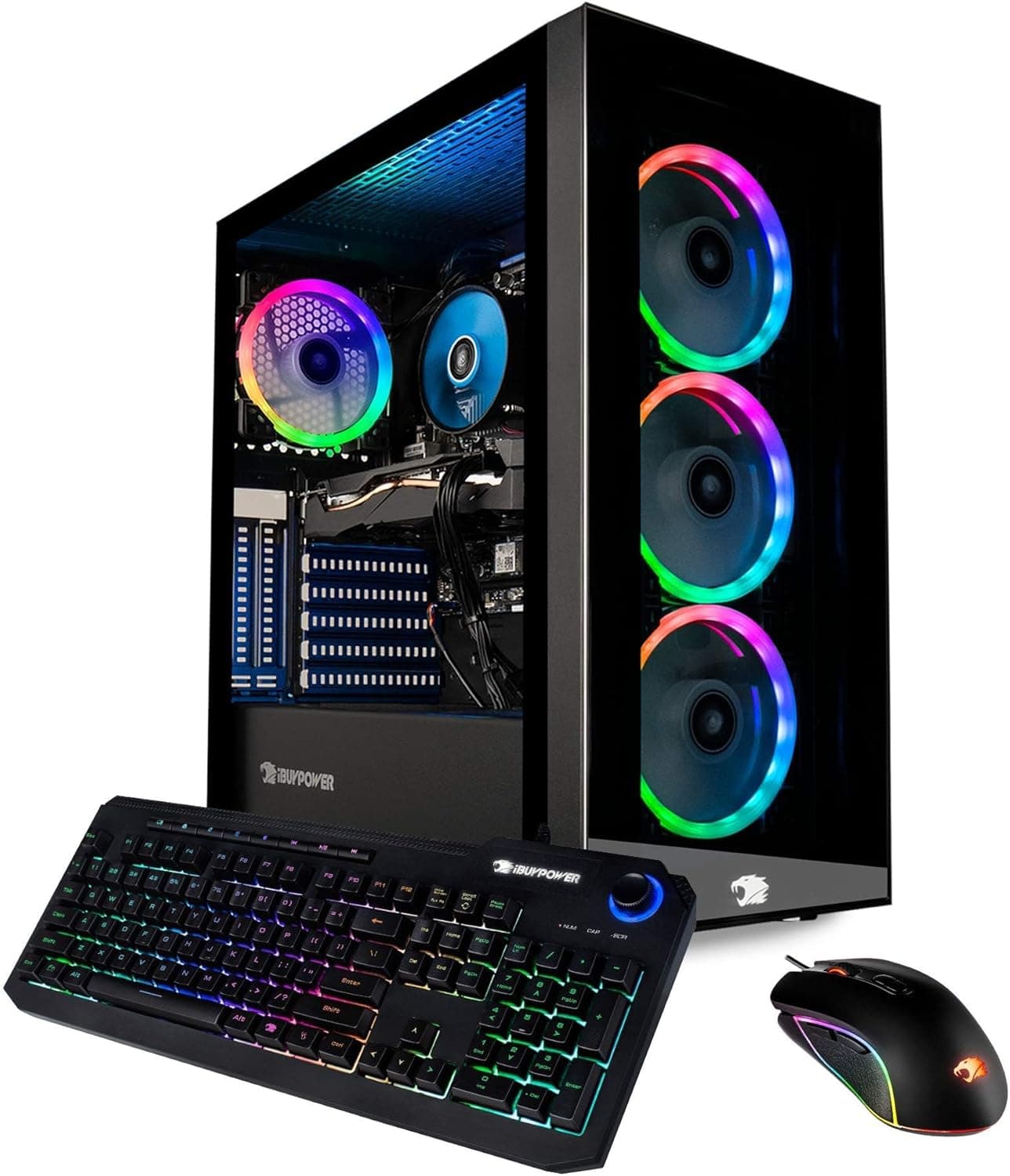
This article takes a closer look at the iBUYPOWER Gaming Desktop Element 9260 (Intel Core i7-9700F 3.0GHz) and asks the question that matters most: is it still worth buying?
Overview
The iBUYPOWER Element 9260 is a pre-built gaming desktop powered by an Intel Core i7-9700F processor and an NVIDIA GeForce GTX 1660 Ti 6GB graphics card. It ships with 16GB of DDR4-2666 RAM and a dual-storage setup: a 240GB SSD for the OS and a 1TB HDD for bulk game storage.
The short verdict: this machine makes sense only for 1080p esports gaming, and only at a discounted, end-of-generation price.
The Core i7-9700F is an LGA1151-generation 8-core / 8-thread CPU running at a 3.0GHz base and 4.7GHz boost.
The trailing "F" means it has no integrated graphics, so if the discrete GPU fails, you lose video output entirely — more on that below. The chassis has a tempered glass side panel and 16-color RGB lighting, and Windows 10 Home 64-bit ships clean without bloatware.
On Amazon.co.jp the system holds a 4.4 out of 5 rating across 3,360 reviews (captured May 2026), which is a solid score for a pre-built.
Performance in Context
The GTX 1660 Ti is a Turing-generation GPU without RT cores or Tensor cores. That means no meaningful ray tracing and no DLSS upscaling to fall back on.
Its 6GB of VRAM is adequate for 1080p esports titles — Fortnite, Apex Legends, and VALORANT will run at high frame rates once you tune the settings.
Modern AAA games are the sticking point. Many recent big releases list 8GB of VRAM even for 1080p medium settings, so 6GB means turning texture quality down.
The Core i7-9700F only has 8 threads as well, so newer games built around high thread counts — or gaming and streaming simultaneously — will run into a CPU bottleneck. Current for 1080p competitive play; underpowered for high-fidelity AAA gaming.
Compatibility Guide
The board uses an LGA1151 socket and supports DDR4-2666 memory up to 64GB. The expansion bus is PCIe 3.0, and the listed storage interfaces are SATA III and M.2 SATA.
That last detail is easy to miss and important: an M.2 slot wired for SATA will not deliver NVMe-class speeds, and an NVMe-only drive may not be detected at all. Confirm the slot specification before buying an add-in SSD.
The system uses a standard ATX power supply with a recommended 500W capacity. That is comfortable for the GTX 1660 Ti, but it leaves little headroom for a future high-power GPU.
If a GPU upgrade is part of your plan, budget for a PSU swap at the same time. The graphics card is dual-slot, so treat the PCIe slot beneath it as unusable, and measure card length against the drive cage before any swap.
CPU upgrades are effectively capped at the same generation — an LGA1151 Core i9-9900-class chip at best. The socket is a dead end, so if you want more CPU power, replacing the whole system is the rational move.
In practice, only memory, storage, and the GPU are upgradeable here.
Connectivity
The front panel carries four USB 3.0 ports; the rear adds two USB 2.0 ports.
Since the fast ports are all up front, plan on putting external SSDs and capture devices there and leaving low-bandwidth peripherals like wireless receivers on the back. Wired networking is Gigabit Ethernet, and 802.11ac Wi-Fi is built in.
802.11ac is Wi-Fi 5 — perfectly usable, but you get none of the Wi-Fi 6/6E benefits.
For online competitive play, use the Ethernet port.
Audio supports 7.1-channel output.
The GPU provides one DVI, one HDMI, and one DisplayPort output, so a three-monitor setup is possible — though only DisplayPort and HDMI realistically drive high refresh rates. The bundled gaming keyboard and RGB mouse get you playing on day one, but treat them as entry-level starter gear.
Product Info
Assembled in the United States, the Element 9260 pairs a Core i7-9700F (8C/8T, 3.0GHz base, 4.7GHz boost) with 16GB DDR4-2666, a 240GB SSD plus 1TB HDD, and Windows 10 Home 64-bit.
Coverage includes a 1-year parts-and-labor warranty and free lifetime US-based technical support. Note the word "US-based": from Japan that means English-language support, a time-zone gap, and impractical return shipping.
Plan as though the warranty effectively does not apply.
On pricing, eBay US listed the system at $750.00 as of June 1, 2026 — a figure consistent with a used or end-of-life machine of this specification.
A Japanese listing, by contrast, carries a yen price that is an order of magnitude out of line with this product class, which points to a data-collection error or reseller markup, so this article does not quote it. Prices swing widely by seller, timing, and exchange rate — always check the product page for the current figure.
Alternatives to Consider
If you are weighing new systems at a similar budget, make GPU generation the deciding axis. Because the GTX 1660 Ti supports neither DLSS nor ray tracing, a newer GPU with comparable raw throughput can still deliver a better real-world experience thanks to upscaling.
If you intend to keep the machine for years, put newer-generation builds on your shortlist. If your priority is starting 1080p online gaming right now at the lowest possible outlay, the bundled-peripheral total here remains competitive.
Best Use Cases
This system is a good fit for:
- 1080p high-frame-rate esports players. Fortnite, Apex Legends, and VALORANT run well on this configuration.
- First-time buyers who don't want to build. A keyboard and mouse are included, so it works out of the box.
- Anyone needing a cheap second or streaming-support PC. The 8-core CPU and 1TB HDD make a reasonable scratch space for recordings.
- Budget-first buyers comfortable lowering graphics settings.
It is not a fit for 4K gaming, ray tracing, VR, or maxed-out modern AAA titles. For those, look at systems with a newer-generation GPU.
Before You Buy
The platform is generationally finished. LGA1151, DDR4-2666, and PCIe 3.0 leave limited room to grow.
You can add memory (up to 64GB), add storage, and swap the GPU — but a CPU upgrade path effectively does not exist. Buy it planning to use this configuration as-is for a few years rather than to build on it gradually.
The Core i7-9700F has no integrated graphics. If the graphics card develops a fault, you get no display output at all and cannot even troubleshoot without a spare GPU.
Factor that into your risk assessment.
Power headroom is tight. A 500W recommendation is right for the GTX 1660 Ti but was never sized for a power-hungry replacement card.
Include the cost of a PSU in any GPU upgrade plan.
The storage split has a practical quirk. After Windows and its update reserve, a 240GB SSD leaves less free space than you would expect — two or three large modern games will fill it.
Most titles end up on the HDD with correspondingly longer load times. Adding an SSD is the single upgrade with the biggest felt impact.
Finally, check the listing data itself. Japanese product pages for this system have shown a price wildly out of step with the hardware class.
Retail listings can carry errors in price, model number, and manufacturer fields, so cross-check the product images, title, and seller name to confirm you are actually buying the iBUYPOWER Element 9260. For overseas listings, also verify the power cable type for 100V use in Japan, wireless certification status, and who pays return shipping on a defective unit.
FAQ
Q. Will it run the latest AAA games? A.
Many will launch and play, but expect medium-to-low settings even at 1080p. The 6GB VRAM limit hits texture quality hardest.
For comfortable high-fidelity play, choose a newer GPU generation.
Q. How much memory can I add? A.
Up to 64GB of DDR4-2666. For gaming alone, 16GB is generally fine; for streaming or video editing alongside, 32GB is a worthwhile step up.
Match the specification and capacity of the existing modules to avoid compatibility issues.
Q. Can I add an NVMe SSD? A.
The listed storage interfaces are SATA III and M.2 SATA.
If the M.2 slot is SATA-only, an NVMe drive will not be recognized.
Check the manual or product page before purchasing. A SATA SSD is the safe choice.
Q. Can I swap the graphics card? A.
Physically yes — it is a standard ATX case with a standard ATX PSU. The constraints are the 500W recommended capacity, dual-slot clearance, and card length.
For a higher-power card, plan on replacing the power supply too.
Q. Does the warranty work in Japan? A.
It includes 1-year parts-and-labor coverage plus free lifetime US-based technical support. From Japan, the language barrier, time difference, and international shipping make that impractical, so assume little effective coverage.
If domestic warranty service matters, consider a locally sold pre-built.
Q. Are the ratings trustworthy? A.
Amazon.co.jp shows 4.4 out of 5 from 3,360 reviews (captured May 2026, roughly an 88% positive score).
That is a healthy sample and a good result for a pre-built, but most reviews date from the system's original release period — read them with that in mind.