Overview
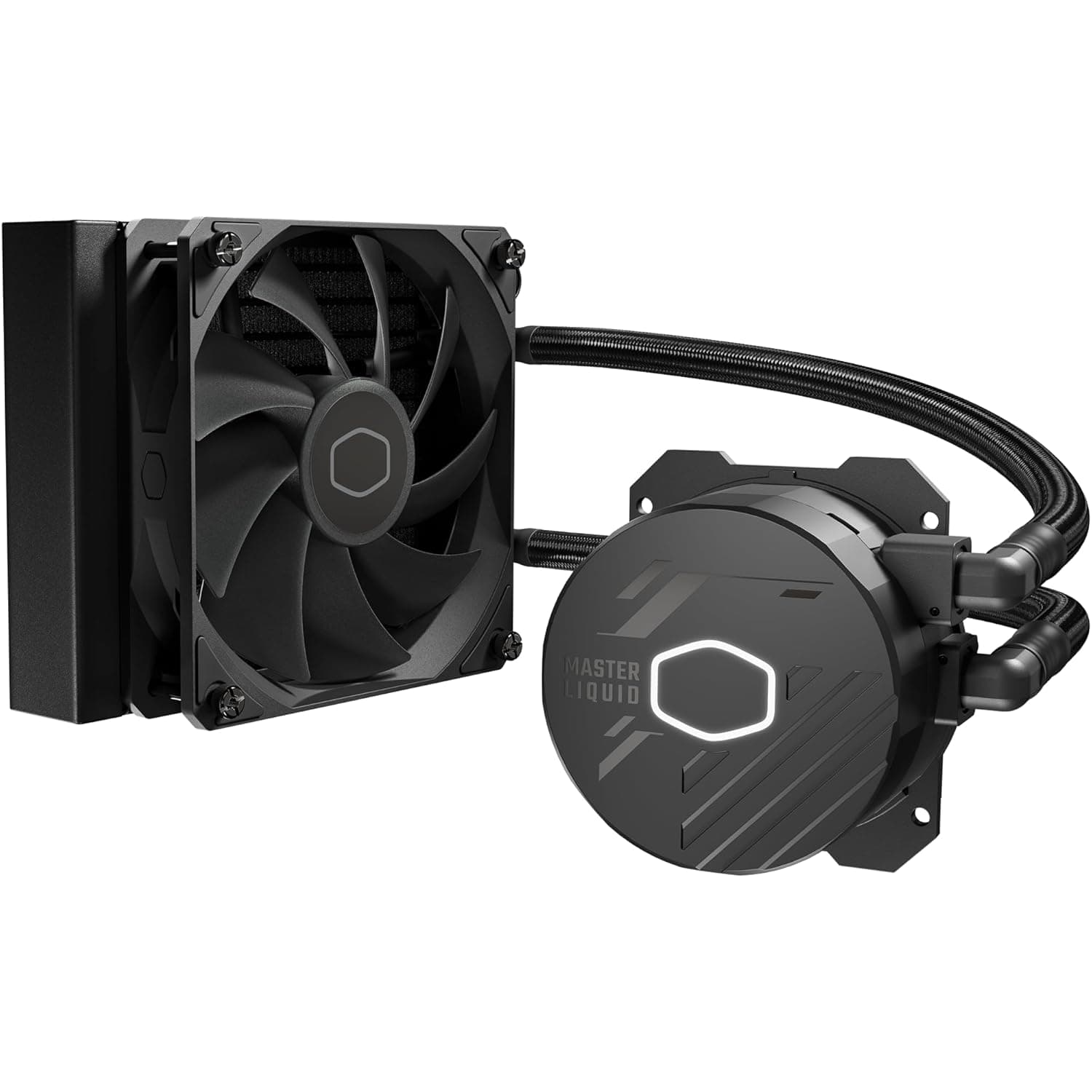
The Cooler Master 120L Core AIO CPU Liquid Cooler is an entry-level all-in-one liquid cooler built around a single 120mm radiator. The honest framing: this is not a cooler that beats a large air tower — it is a cooler for builds where a large air tower does not fit, or where you would rather not hang that much mass off the socket.
With one 120mm radiator, total dissipation area is less than half that of a 240mm or 360mm class unit.
The headline feature is the patented Gen S dual-chamber pump, which raises water pressure to push coolant directly at CPU hotspots. The bundled SickleFlow 120 PWM fan spans 650–1,750 RPM (1,800 RPM max), with a rated 12 dBA noise floor.
The pump head carries white LED lighting only — no RGB — which suits monochrome builds.
On Amazon.co.jp the listing showed 280 reviews at 4.4 out of 5 stars (roughly 88% positive) as captured in May 2026.
That is a meaningful sample size for an entry AIO, and the score suggests it is not a product plagued by DOA units or pump whine complaints.
Compatibility Guide
Supported sockets are AMD AM5 / AM4 and Intel LGA1851 / LGA1700 — and nothing else. LGA1200, LGA115x, and AM3+ boards are not supported, so this is not a candidate for extending the life of an older platform.
Check your motherboard's socket designation before ordering.
Electrically it is a single 4-pin PWM connection to the CPU_FAN header. How pump and fan power are split can vary by revision, so if you want the pump running at full speed, verify your BIOS fan curve (set CPU_FAN to fixed 100% PWM rather than a silent DC profile).
Hanging the pump off an aggressive silent curve is a common cause of poor temperatures.
Stated product dimensions are 15.7 x 11.9 x 2.8 cm, which corresponds roughly to the bare radiator.
Add a 120mm fan and budget around 5cm-plus of total clearance.
| Mount position | Feasibility | Watch out for |
|---|---|---|
| Rear 120mm exhaust | Safest choice | Confirm the rear cutout is 120mm; check VRM heatsink clearance |
| Front 120mm | Workable | Tube routing gets tight when tubes exit downward |
| Top 120mm | Case dependent | Micro-ATX cases often collide with memory and VRM height |
Most cases advertising "120mm radiator support" will take it, but cases with 140mm-only cutouts, or with the PSU crowding the radiator position, make tube routing difficult. Check tube length on the product page against your case dimensions.
The clear advantage over an air tower is that memory and GPU clearance issues effectively disappear — with tall heatspreader RAM, that alone can justify the choice.
Product Info
Key specs: liquid (AIO) cooling, 120mm radiator, one 120mm fan, 650–1,750 RPM (1,800 RPM max), 12 dBA rated noise, Gen S dual-chamber pump, white LED lighting, and aluminium/copper/plastic construction. An aluminium radiator with a copper coldplate is standard for this class.
In the box: one SickleFlow 120 PWM fan, mounting hardware for AM5/AM4 and LGA1851/1700, and CryoFuze thermal paste — so no separate paste purchase is needed. Warranty is listed as 2 years from the manufacturer, though this varies by region and retailer; confirm before buying.
Pricing deserves scrutiny. The Amazon.co.jp listing showed ¥19,297 as captured in May 2026, while the eBay US listing showed $45.00 as captured in July 2026.
Those two figures are not consistent with each other for a single-120mm entry AIO — the $45.00 figure is far closer to the normal market level for this class.
The yen figure may reflect a mismatched listing, a parallel import, or a reseller. Both are point-in-time captures subject to sales and exchange rates, so make the actual purchase decision from the current price on the product page.
Competitive Comparison
At this budget the real competition is not another AIO — it is a dual-tower air cooler. A six-heatpipe, dual-120mm air cooler such as the Thermalright Peerless Assassin 120 family typically matches or exceeds a single-120mm AIO on raw thermals.
If cooling performance alone is your criterion, the 120L Core is not the obvious pick.
Where it wins is when (1) socket-area height clearance is tight, (2) you want to avoid memory or GPU backplate interference, (3) you want less mass hanging on the motherboard, or (4) you want a cleaner interior. If you are targeting a Core i7/i9 or Ryzen 9, put the money toward a 240mm-or-larger AIO instead — radiator area is physics, and pump design does not compensate for it.
Real-World Notes
The 12 dBA figure should be read as a low-RPM value. Push the fan toward 1,750 RPM under load and you will hear it.
Realistic quiet operation means a gentle BIOS fan curve and accepting higher temperatures during transient spikes. The upside of a single-fan design is that there is only one fan making that noise.
An AIO also adds a moving part that air cooling does not have. With a 2-year warranty, that is worth factoring into any long-term build plan.
Best Use Cases
- Mini-ITX / Micro-ATX builders — if the case takes a 120mm radiator, you free up the space above the socket that an air tower would occupy. Pairs well with tall memory modules.
- Ryzen 5/7 and Core i5 users — this is the band where the cooler works without strain, and it is comfortably sufficient for gaming loads.
- Builders who want a clean look — white LED only, no RGB, fits monochrome themes.
- First-time AIO buyers — bundled paste, simplified brackets, and a single 120mm radiator make for a low-risk introduction.
Before You Buy
The listed prices disagree. As noted, ¥19,297 (captured May 2026) and $45.00 (captured July 2026) do not line up as prices for the same product.
Product page metadata genuinely does get mismatched. Verify the target product by image, title, and model number, and judge price from the current listing.
Read the gap as "one of these may be wrong," not as a bargain signal.
Not for high-TDP CPUs. A single 120mm radiator is not enough for a Core i9 or Ryzen 9 under sustained full load.
For overclocking or daily rendering work, choose a 240mm or larger unit.
Socket support is narrow. AM5/AM4 and LGA1851/1700 only.
If you are buying with a future CPU upgrade in mind, do not assume brackets for future sockets will be offered.
"Liquid" does not mean silent. It is quiet at low RPM; under load the fan spins up, and you also gain a pump as a noise source that air cooling does not have.
If true near-silence is the goal, a large air cooler is the safer bet.
Mind the mounting orientation. Installing so the pump head is the highest point in the loop (radiator below the pump) invites air pockets and pump noise.
Where possible, mount the radiator above the pump with tubes exiting downward.
Release timing. This model is generally described as arriving around 2023, but confirm the exact release date and current revision specs on the product page — fans and brackets can change between revisions of the same product name.
FAQ
Q. Will it handle a Core i7 or Ryzen 7? A.
Yes, though sustained heavy work like video encoding or long renders leaves little thermal headroom. For gaming-led use it is fine.
i9 / Ryzen 9 is not recommended.
Q. How does it compare to an air cooler like the Hyper 212? A.
Broadly speaking, a single-120mm AIO and a large dual-tower air cooler land in a similar range. To clearly beat air cooling you need a 240mm-or-larger AIO.
Choose the 120L Core for installation flexibility and space, not for peak thermals.
Q. Can I use it on an LGA1200 or AM3 board?
A. No. Support is limited to AM5/AM4 and LGA1851/1700.
Q. Do I need to buy thermal paste? A.
No — CryoFuze paste is included for the first install. Keeping a spare tube for future remounts is wise.
Q. Does it need coolant top-ups or maintenance? A.
It is a sealed AIO; user refilling is not intended. Periodically clearing dust from the radiator fins is sufficient.
Q. Can I add a second fan in a push-pull sandwich? A.
Radiators in this class generally allow fans on both sides, but only one is included and the added thickness demands more case clearance. Check your case's supported radiator thickness.