Overview
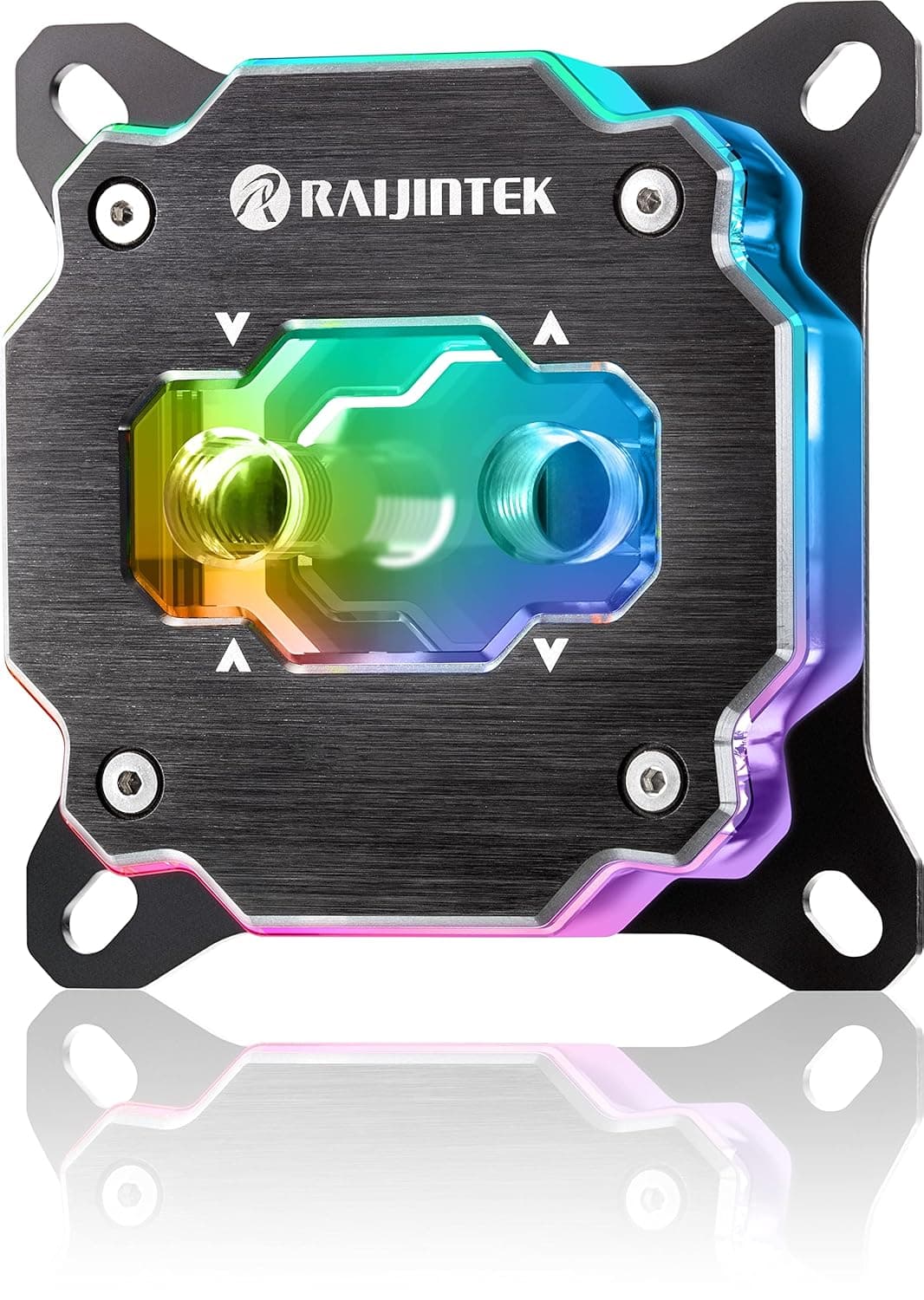
The RAIJINTEK FORKIS PRO RBW is a full-copper CPU water block with addressable RGB (rainbow) lighting. The key point first: this is not an all-in-one liquid cooler.
It is a single component for a custom loop, and it ships without a pump, reservoir, radiator, tubing or coolant. On its own it cannot cool anything.
Misreading that is the most common and most expensive mistake with a product like this.
Two construction details matter. First, alloy brazing joins copper to copper only, which reduces the galvanic corrosion risk that comes from mixing dissimilar metals in a loop.
Second, an internal 3D microfin structure increases the surface area in contact with coolant to improve heat exchange. The exterior is nickel-plated and mirror-polished, so it suits show builds.
Supported sockets are Intel LGA1700 and AMD AM5.
Compatibility Guide
Published socket support is LGA1700 and AM5 only — roughly 12th–14th Gen Core and Ryzen 7000-series or newer. Assume LGA1200 and AM4 mounting hardware is not included, and that HEDT platforms such as Threadripper are out of scope.
Check the socket on your board before ordering.
The ports use the industry-standard G1/4 inch thread, which matters more than it sounds: you are not locked to one brand of fittings or tubing. Any G1/4 fitting, hard tube or soft tube, will generally work.
Watch for clearance, though — compression fittings tend to be wide and can foul VRM heatsinks around the socket or tall memory modules. On Mini-ITX and Micro-ATX boards, measure the port orientation and fitting diameter before committing.
Lighting is 5V 4-pin ARGB, intended to connect to a motherboard 5V 3-pin ARGB header and sync through Aura Sync, Mystic Light, RGB Fusion or Polychrome. Critically, it is not compatible with 12V 4-pin RGB headers.
The connectors look similar, and feeding 12V into a 5V device destroys the LEDs. Read the silkscreen next to the header.
If your board has no free ARGB header, budget for a separate ARGB controller or hub.
Rated power draw is 3W, which is best read as the LED load rather than anything thermal. Recommended PSU wattage is listed as 0 (unspecified); size your power supply around the CPU, GPU and pump instead.
Product Info
Pricing was ¥9,150 on Amazon JP as captured on 27 May 2026. Water cooling parts move with exchange rates and stock, and this article will not update itself, so confirm the current price on the product page.
The global listing resolved to the same ASIN and price, and the eBay entry is a search page rather than a specific listing. For a full-copper, nickel mirror-finish block with integrated ARGB, sitting under ¥10,000 places it in the mid-range; comparable blocks from premium brands often land well above that.
Published specs are noise level 45 dBA, power consumption 3W and 5V operating voltage. One caveat worth stating plainly: a CPU water block has no moving parts and does not generate noise by itself. The 45 dBA figure is best treated as listing metadata rather than a measured characteristic — it should not be read as "this is quiet" or "this is loud".
Loop noise comes from pump vibration and radiator fan speed. If silence is the goal, spend the budget there.
Included accessories are ARGB cabling and basic mounting parts. Fittings, tubing, coolant, pump and radiator are not included, so first-time loop builders should plan around the total system cost.
Check the official RAIJINTEK site for warranty terms.
User reviews stood at 15 reviews averaging 3.3 out of 5 stars (66%) as of May 2026.
Fifteen is a thin sample: each individual review carries heavy weight in that average. Rather than reading 3.3 as a verdict, read what the individual reviews complain about — a DOA unit and disappointment with the lighting are very different signals.
Installation Notes
A typical custom-loop sequence: dry-fit the block to check fitting clearance, mount the radiator and pump/reservoir, route and connect tubing, then leak test with the pump powered alone and the PC off (24 hours is the usual guideline), and only then wire everything up. Skipping the leak test is common and occasionally catastrophic — coolant on a motherboard costs far more than the block did.
For paste, a rice-grain-sized dot in the centre is the standard approach. Tighten mounting screws in a diagonal pattern, a little at a time.
Copper bases are soft, and excessive torque compromises flatness.
How It Compares
Its main rivals at this price are acrylic-top blocks with copper bases. The differentiator here is full copper with alloy brazing, which structurally avoids the crazing and cracking that acrylic can develop over time.
The trade-off is visual: acrylic tops let you see coolant moving through the channels, and a full-copper block does not. If a visible flow path is part of your build's appeal, this is the wrong block.
Actual thermal numbers are not in the supplied data, so this article will not claim a temperature figure. As a general rule, differences between current-generation CPU blocks are smaller than differences in radiator area and flow rate — but check measured reviews for specifics.
Best Use Cases
This fits best for someone already running or actively planning a custom loop on LGA1700 or AM5. If your fittings are already G1/4, it drops straight in.
It also suits builders who want block lighting synced to the motherboard's ARGB ecosystem, and those who prefer full copper's durability over acrylic's transparency. Budget-wise it lands squarely between "cannot justify a premium-brand block" and "do not want an unbranded bargain part".
Before You Buy
The biggest trap is treating this as a complete cooler. You will need a pump, reservoir, radiator, fittings, tubing and coolant on top of it — for a first build, several times the block's price.
If you simply want liquid cooling without the project, an AIO is cheaper, faster and far less risky.
Socket mismatch is the second common failure. Assume it will not fit LGA1200 or AM4 systems, and verify with the manufacturer whether any additional mounting kit exists.
Likewise, LED damage from plugging into a 12V RGB header is a recurring and avoidable mistake — check the voltage marking every time.
One data caveat: this product is filed under a case-fan category even though it is a CPU water block, and the 45 dBA noise spec makes no sense for a part with no moving components. Listing metadata is not always accurate, so confirm the product from the images and product name before ordering. If the photos show no fan and no radiator, you are looking at a bare block — which is what this is.
Finally, loops require ongoing maintenance. Coolant changes and internal cleaning are commonly done about once a year, and fittings need periodic checks for loosening.
This is a build-and-maintain component, not a fit-and-forget one.
FAQ
Q. Can I cool my CPU with just this? A.
No. You also need a pump, reservoir, radiator, fittings, tubing and coolant.
This is one part of a loop.
Q. Will it fit AM4 or LGA1200? A.
Published support covers LGA1700 and AM5 only. Older sockets are not part of the stated compatibility; ask the manufacturer about mounting hardware.
Q. My board has no ARGB header. Can I still light it? A.
Yes, with a separate ARGB controller powered from the PSU and driven by a button or remote. You lose motherboard software sync.
Q. Can I plug it into a 12V RGB header? A.
Do not. This is a 5V device and 12V will damage the LEDs.
Check the voltage label beside the header.
Q. It lists 45 dBA — is it loud? A.
A water block has no moving parts and produces no noise itself. Loop noise comes from the pump and radiator fans.
Treat that figure as listing metadata.
Q. Is 3.3 stars from 15 reviews a red flag? A.
Fifteen reviews is a small sample with a wide margin of error; it is not comparable to a product with thousands. Read what the individual reviews actually report before deciding.
Product Disclosure (Amazon)
- Manufacturer: RAIJINTEK
- Seller: RAIJINTEK CO., LTD.
- Fulfilled by: Amazon
- ASIN: B08TBQFPPR
- Note: This article covers a manufacturer-made product based on Amazon listing details.