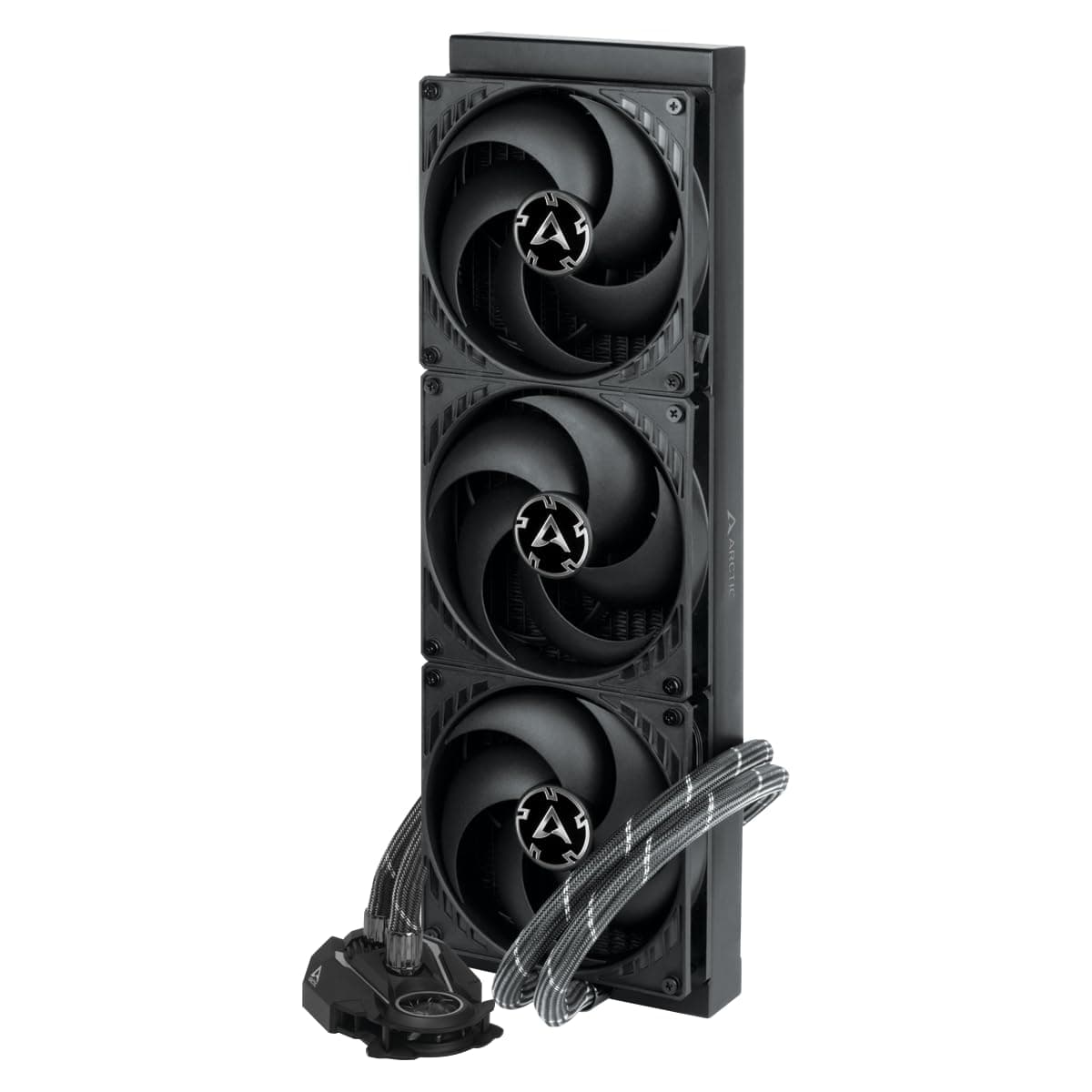
The ARCTIC Liquid Freezer III 420 is an all-in-one liquid CPU cooler built around a 420mm-class radiator with three 140mm fans. The short version: it suits people running Core i9 / Ryzen 9-class many-core CPUs who want them cooled quietly, and it is not the cooler a first-time water-cooling buyer should start with — because very few cases physically accept a 420mm radiator.
Overview
ARCTIC's Liquid Freezer line has, since the II generation, prioritized cooling capacity, low noise and price over looks. The III generation keeps that character: instead of an LCD screen or elaborate RGB, the design leans on a thick radiator, large fans, and a small VRM fan on the pump head — features that pay off in thermals rather than photographs.
The 420 sits at the top of the size range. Three 140mm fans give roughly 20% more surface area than a 360mm (120mm x 3) unit, which means the same heat load can be dissipated at a lower fan speed.
Treat that as a noise advantage first and a temperature advantage second; framing it that way leads to better buying decisions.
On Amazon.co.jp the cooler holds 4.6 out of 5 stars across 419 reviews (about 92% positive) as of June 2026.
A three-digit review count still sitting at 4.6 suggests this is not a product with wild unit-to-unit variance.
That said, review scores mostly reflect whether the unit arrived working — they say nothing about pump lifespan or performance three years in.
Why Pick a 420mm Radiator
The case for 420mm is almost entirely about noise. More radiator area means less airflow is needed to reject the same heat; less airflow means lower RPM; lower RPM means less turbulence noise.
Holding your temperature target at roughly 800–1000 rpm matters more day to day than shaving a few degrees off a peak reading.
The costs are real, though. Case support is scarce.
The assembly is heavy, especially hanging from a top mount. And while 140mm fans have more low-speed headroom than 120mm units, they tend toward a lower-pitched drone when pushed hard — so an aggressive fan curve throws away the very advantage you paid for.
A 420mm radiator earns its keep under sustained load: video encoding, 3D rendering, compiling, long simulations — anything that keeps every core busy for minutes or hours. In gaming, where load comes in bursts and the loop's thermal mass absorbs the spikes, the gap versus a 360mm unit is much harder to feel.
Compatibility Guide
Check three things, in this order: does your case take a 420mm radiator, does the cooler ship with your socket's bracket, and will the pump head and tubing clear everything nearby.
| Check | What to look at | Common failure |
|---|---|---|
| Case support | Top/front 420mm (140mm x 3) rating | Buying it for a "360mm max" case |
| Top clearance | Radiator depth + fan depth + margin | Fouling RAM or VRM heatsinks |
| Socket | LGA1700 / LGA1851 / AM4 / AM5 | Missing bracket for your generation |
| Tube routing | Orientation and hose length | Mounting inverted, straining the tubes |
| Fan headers | PWM and pump header count | Fans running on mismatched curves |
Case support is the real gate. Explicit 420mm support is generally limited to large mid-towers and full towers.
Do not reason from fan size alone — mounting hole pitch and offset will stop you even when the raw dimensions look fine. Find "420mm radiator support" in the case manufacturer's spec sheet before you buy.
RAM clearance is the other classic. In a top-mount build, radiator depth plus fan depth has to fit between the case roof and the top of the motherboard.
Tall heat-spreader memory can miss by a few millimetres. Subtract the numbers yourself instead of eyeballing it.
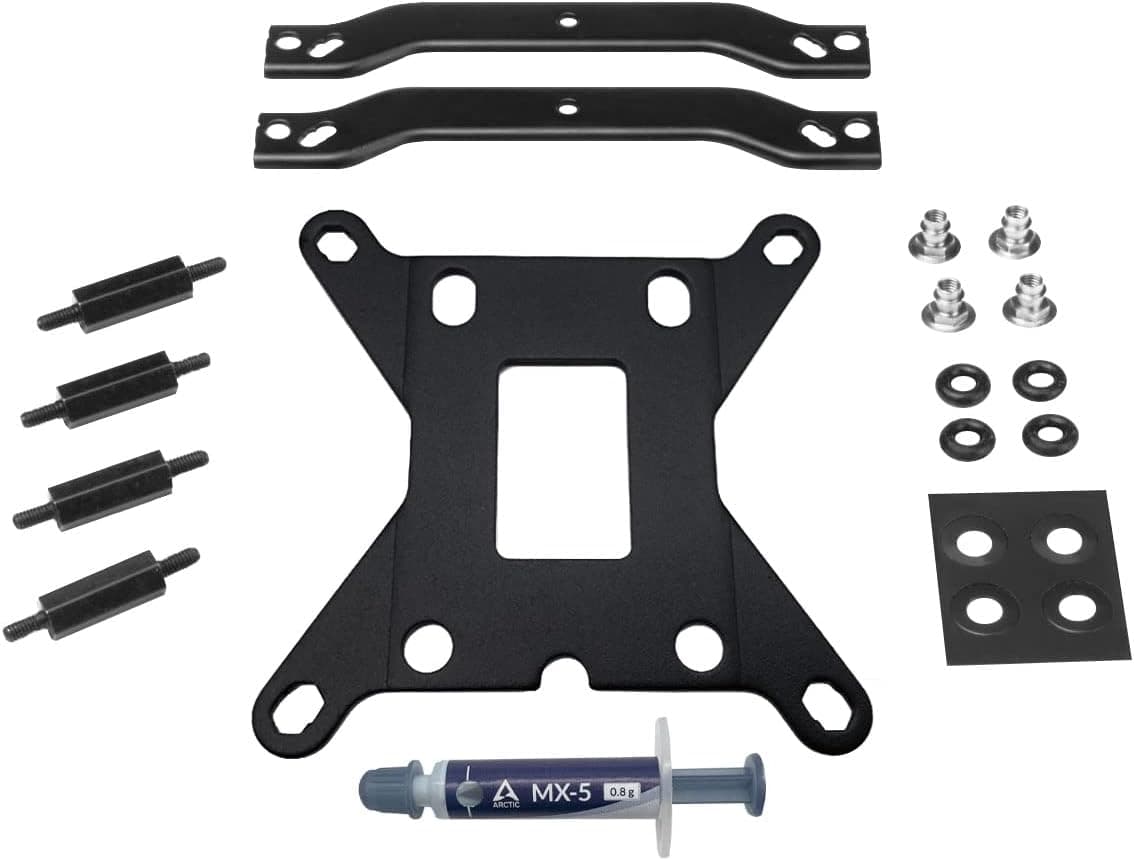
On sockets, Liquid Freezer III units ship covering recent Intel LGA sockets plus AM4/AM5, but bundled brackets can differ by production run and region. If you are on the newest Intel socket, confirm your exact SKU lists it on ARCTIC's product page.
For AM5, an offset cold-plate arrangement is often cited as beneficial given where the heat concentrates under the IHS — again, the product page is the authority.
If your unit has the small pump-head fan, note that it blows across the VRM and memory area; leave it room and plan the cable route.
Product Info
This is an ARCTIC-made AIO liquid CPU cooler, listed on Amazon.co.jp under ASIN B09VH34TB8, rated 4.6/5 from 419 reviews as of June 2026.
Pricing needs a caveat. The Amazon price field we captured (¥62,773) is an order of magnitude off for a 420mm AIO — that bracket belongs to high-end GPUs and monitors, so we treat it as a collection error and do not present it as this product's price.
The eBay listing showed $95.99 as captured on 13 July 2026, which is a plausible range for a 420mm AIO.
Even that is a point-in-time figure: currency, shipping, duties and sales move it constantly. Check the live product page before buying.
Warranty terms and box contents also vary by region and seller. ARCTIC is known for relatively long coverage, but the shop's stated terms are what actually apply to you.
How It Compares
- 360mm AIO (120mm x 3) — far more cases accept it and prices are lower. It gives up some capacity, but under bursty loads the gap is modest. If your case is not 420-rated, this is the answer.
- LCD/RGB flagship AIOs — worth it if the display matters to you, but at a given budget they usually cool less. ARCTIC deliberately spends elsewhere.
- Large dual-tower air coolers — no pump, so no wear item and no failure mode that spikes your CPU temps. Often sufficient even for many-core chips, and cheaper.
The 420 makes the most sense when three things line up: a case that supports it, genuinely sustained all-core workloads, and a priority on quiet. Miss any one and a 360mm AIO or big air cooler will likely leave you happier.
Best Use Cases
- Owners of Core i9 / Ryzen 9-class CPUs doing encoding, rendering or long builds, where radiator headroom shows up as both lower temps and lower noise.
- Anyone who already owns a 420mm-capable full or large mid tower — with the hard constraint satisfied, there is little reason to step down.
- Noise-first builders, who value being able to run low RPM all day more than a peak benchmark number.
- Function-over-form buyers who would rather not pay for a screen.
If you run a stock Core i5 or Ryzen 5, a 420mm AIO is overkill; that money does more for you in a GPU or SSD.
Before You Buy
First, this listing's data is inconsistent. Part of the captured specification set describes a USB NVMe M.2 SSD enclosure, which plainly is not this cooler, and the price field does not match the product class either.
You will likely see the same mismatch when you open the page, so verify the product against the images, the title, and ARCTIC's official product page before ordering. Listing metadata can stay wrong for a long time.
Second, a radiator that does not fit can only be fixed by a return. This is the most common regret with 420mm AIOs.
"My case is big, it'll be fine" is not a check. Confirm the explicit 420mm rating first.
Third, top-mount RAM and VRM clearance. Radiator plus fan depth adds up faster than people expect.
With tall memory, verify with numbers, and consider low-profile modules if it is marginal.
Fourth, weight and installation. A filled 420mm radiator is heavy.
Lay the case flat, mount the pump head to the board first, then hang the radiator so the tubing is never load-bearing.
Fifth, an AIO is a consumable. Pumps are moving parts; they change pitch and lose flow with age, and a failure spikes CPU temperature in a way air cooling cannot.
A long warranty is not a promise of longevity. For a machine that must not go down, air cooling remains a rational choice.
Finally, plan fan control. Running three fans and the pump off separate headers with different curves produces exactly the uneven noise you were trying to avoid.
Check your header count, use a splitter if needed, and drive all three fans from one curve.
FAQ
Q. Is 420mm actually worth it over 360mm? A.
Yes, if you have sustained all-core workloads and care about noise. For bursty gaming loads the difference is small.
If your case is not 420-rated, take the 360mm without hesitation.
Q. How do I know my case fits it? A.
Look for "420mm" or "140mm x 3" in the case's radiator support spec. Fan dimensions alone will mislead you — hole pitch and offset decide it.
Q. Does it support the latest Intel and AMD sockets? A.
Liquid Freezer III units cover the recent mainstream sockets, but bundled brackets vary by run and region. Confirm your exact SKU on ARCTIC's product page.
Q. Does the high review score mean it will last? A.
4.6/5 from 419 reviews as of June 2026 is good evidence of solid out-of-box quality.
It is not evidence about pump wear years later.
Q. Would air cooling be enough? A.
For a stock 6–8 core CPU, a large dual-tower air cooler usually is — with fewer failure points and no pump noise to manage.
Product Disclosure (Amazon)
- Manufacturer: ARCTIC
- ASIN: B09VH34TB8
- Note: This article covers a manufacturer-made product based on Amazon listing details.