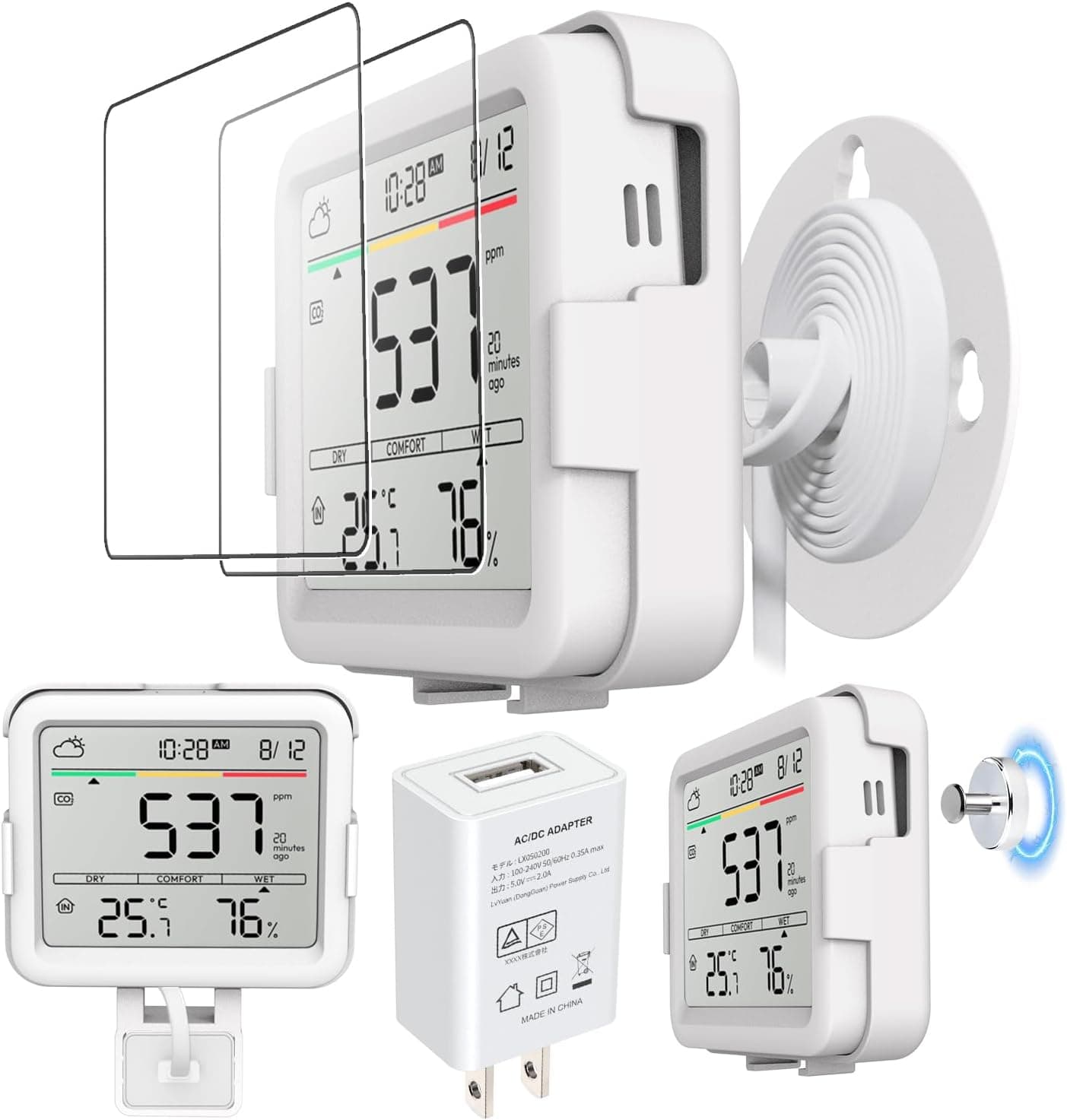
This is a dedicated holder for mounting the SwitchBot CO2 Sensor on a wall or metal surface. Below is what the kit actually includes, how to choose between magnet, screw and tape, and who should not buy it.
Overview
The short version: this is for people who want the SwitchBot CO2 Sensor off their desk. It is a separable mount kit made of ABS plastic in white, bundled with two tempered glass films, a magnetic screw, an adapter, a screw/nail set and a strip of double-sided tape.
As captured on 24 May 2026, the listed price on Amazon.co.jp was ¥1,499.
Prices for small accessories move often, so check the product page for the current figure. At that same capture, it carried 55 reviews at 4.4 out of 5 stars (roughly 88% positive).
That is a solid direction, but 55 reviews is a thin sample — unusual mounting surfaces and long-term adhesive behaviour are unlikely to be fully represented yet.
A CO2 sensor is a measuring instrument whose reading depends on where it sits. On a desk it picks up your own breath and reads higher than the room average.
The real value of wall mounting is not tidiness but a stable, repeatable measurement position.
Connectivity & Compatibility
Compatibility is limited to the SwitchBot CO2 Sensor. Because the cradle is shaped to that body, other brands' CO2 monitors — and SwitchBot's own Meter or Meter Pro, which look similar — will not fit.
Confirm the exact product name before ordering; mixing up similarly shaped models in the same brand family is the most common mistake here.
There are three mounting routes. The magnetic screw sticks to ferrous surfaces such as refrigerator side panels, steel doors, metal shelving or a breaker cover.
No drilling makes it friendly to rentals, but it only works on magnetic steel or iron. Aluminium, many stainless finishes, plastic panels and plasterboard will not hold it, and a fridge with a resin- or glass-faced front may resist as well — test the side panel instead.
Screw mounting is the most secure, but screws driven straight into plasterboard will not hold. Hit a stud, or buy drywall anchors separately.
Tape avoids holes but fails on textured wallpaper, sand or fibre walls, and stain-resistant silicone-coated surfaces. If tape is your plan, degrease the surface with alcohol, press firmly and leave it unloaded for about 24 hours.
One more thing: plan the power run. A CO2 sensor is meant to stay powered continuously, and neither the sensor nor a cable is included with this mount.
Measure the distance from your chosen wall spot to the outlet first, and buy a USB cable or extension separately if needed. Skipping this step is how people end up with a neatly mounted sensor and a cable dangling down the wall.
Choosing the Spot
For measurement quality, aim for breathing height when seated — roughly 1.1 to 1.5 m above the floor — but not directly beside someone's head.
Avoid windows, exhaust fans, air-conditioner outlets and doorways, where airflow pushes readings below the true room level.
Avoid the area around a gas hob too: combustion produces CO2 directly and makes the number useless as a ventilation indicator. Direct sunlight will also skew the temperature and humidity side.
Since a wall mount is awkward to move, tape it up provisionally for a few days, watch the trend, then commit with screws.
Product Info
The published specifications are: compatible model, SwitchBot CO2 Sensor; material, ABS resin; colour, white; mounting methods, magnetic, screw and double-sided tape. The box contains 1 mount body, 1 magnetic screw, 2 tempered glass films, 1 adapter, 1 screw set and 1 piece of double-sided tape.
The sensor itself and any power cable are not included.
The two films matter more than they sound. Films of this type are easy to ruin on the first attempt through bubbles or trapped dust, so a spare changes the practical success rate.
They protect the display from scratches only — they are not drop protection.
As noted, the captured price was ¥1,499 on 24 May 2026. The source label reads "Amazon US", but the link and currency are both Amazon.co.jp in Japanese yen.
The amount itself is entirely reasonable for a small moulded mount with films and hardware. The marketplace entry shows only "See listing" with no resolved price, so it offers nothing to compare against.
Alternatives
The cheapest alternative is sticking the sensor to the wall with generic mounting tape for a few hundred yen. The catch is that adhesive applied to the housing leaves residue and rarely survives repositioning.
A dedicated mount keeps the disposable adhesive layer separate from the device, and being separable means you can lift the sensor off alone for battery changes or recalibration.
Generic phone magnets or mini tripods can work, but a poor fit can hold the unit crooked or block its air intake. A CO2 sensor with an obstructed intake responds sluggishly, which is where purpose-built shaping earns its keep.
Conversely, if you already own a holder that fits properly, there is little reason to add this one.
Best Use Cases
- Desk declutterers — moving the sensor to a wall frees the work surface and shifts it out of your direct exhaled breath, which is better for the readings too.
- Renters — magnet or tape means no holes and nothing to repair when you move out.
- Homes with kids or pets — mount it out of reach and remove the risk of knocks and drops.
- Existing SwitchBot automation users — if CO2 triggers a fan or humidifier, a fixed measurement point is a prerequisite for consistent behaviour.
Things to Consider
The biggest trap is buying it for the wrong device. SwitchBot sells several similar-looking units, and this fits only the CO2 Sensor.
Related to that: Amazon listing metadata — manufacturer, model number, category — frequently disagrees with the actual product. This item is filed under "adapter" at the source, yet it is a plastic mounting bracket, not an electrical adapter.
Trust the product image and title over the registered listing details when you open the page.
Don't over-trust the magnet. Ferrous surfaces only, and magnetic holding can shift under door slams or a cleaning cloth.
For a genuinely permanent position, use screws — and budget for drywall anchors, since the bundled screws and nails assume wood or a backing stud.
Also, this product does not make the cable disappear. Wherever you fix it, you still need to route power, whether that means cable trunking or simply mounting it just above an outlet.
If you bought it purely expecting a clean wall, that one detail will disappoint.
It is a poor fit if you want to carry the sensor room to room, if you read the display frequently at desk height, or if every candidate surface in your space is aluminium, stainless or tile. In those cases the loss of flexibility outweighs the benefit of fixing it in place.
FAQ
Q. Will it fit the SwitchBot Meter Pro? A.
No. Compatibility is stated for the SwitchBot CO2 Sensor only; differently shaped models will not seat correctly.
Q. Is the sensor included? A.
No. You get the mount, a magnetic screw, two tempered glass films, an adapter, a screw set and tape.
A power cable is not included either.
Q. Will it stick to my fridge? A.
If the panel is ferrous, yes. Resin- or glass-fronted models may not hold; test a side panel with exposed steel.
Q. Can I screw it into plasterboard?
A. Not directly — it will pull out. Hit a stud or use drywall anchors.
Q. Does wall mounting change the readings? A.
It can. Away from your breath, values typically read lower and steadier than on a desk.
Avoid windows and vents, which push readings artificially low.
Q. How much weight should I give the reviews? A.
55 reviews at 4.4 stars (about 88%) as of 24 May 2026 — positive in direction, but too thin a sample to settle questions like long-term adhesive strength.