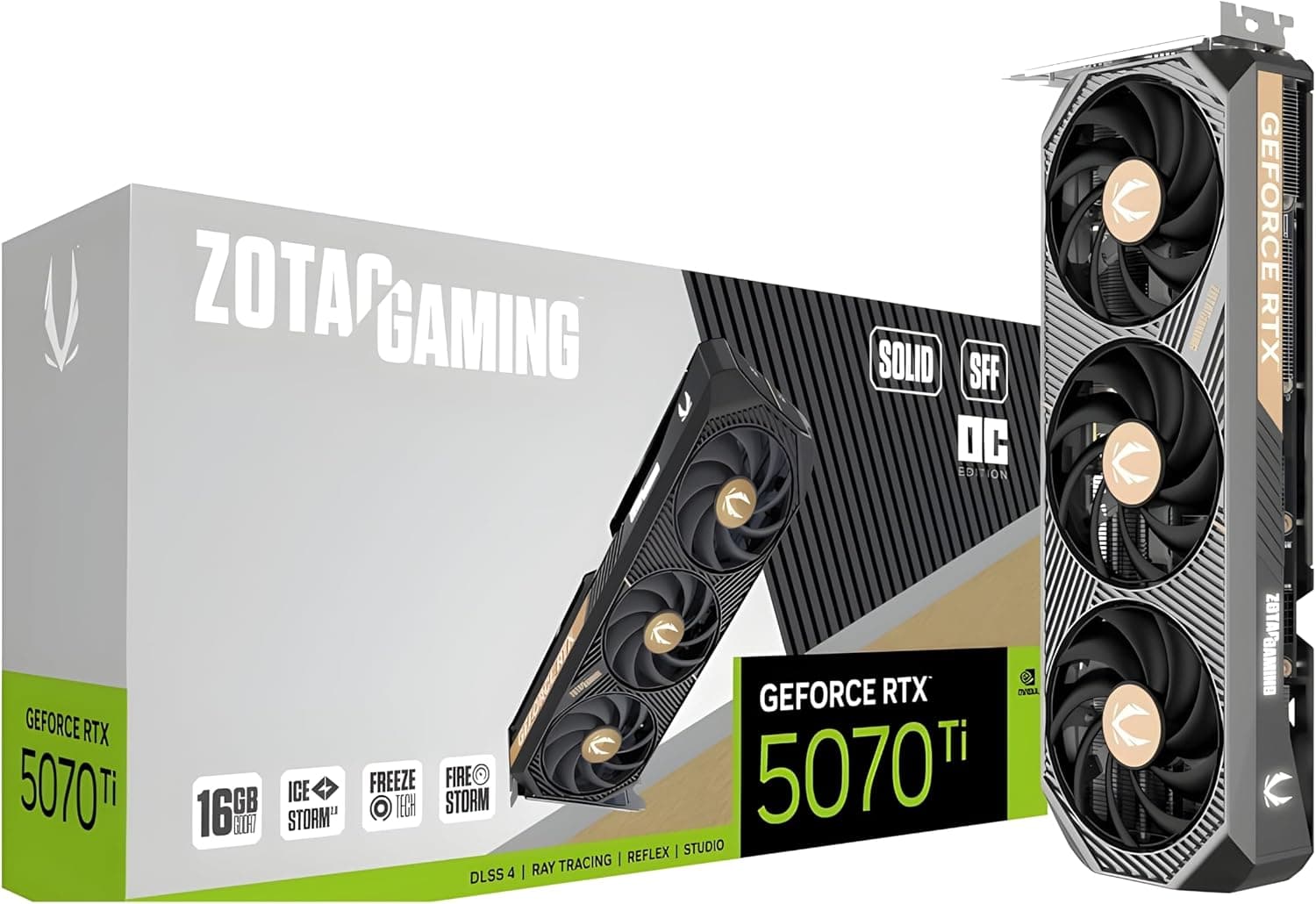
This article covers ZOTAC Gaming Geforce RTX 5070 Ti Solid Sff Oc Nvidia 16Gb.
Overview
The ZOTAC Gaming GeForce RTX 5070 Ti SOLID SFF OC is a compact graphics card built on NVIDIA's latest Blackwell architecture. It features the GeForce RTX 5070 Ti GPU with 16GB of GDDR7 memory, making it a strong contender for high-refresh-rate 1440p gaming and capable 4K performance. The "SOLID SFF OC" designation highlights its small-form-factor-friendly design and factory overclock. With a boost clock of 2482 MHz, this card exceeds reference specifications while maintaining efficient cooling in a dual-slot, 226mm-long package. ZOTAC's SOLID series is known for balancing thermal performance and noise, and this SFF variant is specifically tailored for compact PC builds. Positioned in the mid-high range, the RTX 5070 Ti delivers excellent performance for modern titles with ray tracing and DLSS 4 support. It competes directly with AMD's Radeon RX 9070 XT, offering superior ray tracing capabilities and a robust feature set.
Compatibility Guide
This card uses a PCIe 5.0 x16 interface and is fully backward compatible with PCIe 4.0 slots. While PCIe 4.0 halves the theoretical bandwidth, real-world gaming performance impact is minimal—typically under 5% in most scenarios. Power is supplied via a single 12VHPWR (16-pin) connector. An adapter for two 8-pin PCIe power cables is included. A minimum 750W power supply is recommended, with 850W or higher advised for systems with high-end CPUs or multiple drives. The card measures 226mm in length and occupies two slots. It fits most Mini-ITX and compact ATX cases, but always check clearance, especially in cases with limited depth or restrictive GPU brackets.
Product Info
Released in March 2025, the ZOTAC Gaming GeForce RTX 5070 Ti SOLID SFF OC carries a street price around ¥335,833 (as of August 2025). The standard manufacturer warranty is three years. This model sits in the mid-high tier of the GPU market. The RTX 5070 Ti chip succeeds the RTX 4070 Ti SUPER, and the SOLID SFF OC variant emphasizes compactness without sacrificing performance. It's an excellent choice for users building small-form-factor gaming or workstation PCs. Key specs include a boost clock of 2482 MHz, 16GB GDDR7 memory on a 256-bit bus, a TDP of 300W, and outputs including three DisplayPort and one HDMI port.
Best Use Cases
1440p High-Refresh Gamers If you game at 1440p with a 144Hz or higher monitor, this card delivers smooth frame rates in demanding titles with high settings. DLSS 4 further boosts performance in supported games, making 4K gaming viable as well. Small Form Factor (SFF) Builders The compact 226mm length and dual-slot design make this card ideal for Mini-ITX and other space-constrained cases. It offers high-end performance without requiring a full-size chassis. However, verify case dimensions—some ultra-compact cases like the Dan A4-SFX may still have clearance issues. Content Creators (Video Editing, 3D Rendering) 16GB of VRAM is beneficial for 4K video editing and 3D modeling in applications like Blender or DaVinci Resolve. The ample CUDA core count accelerates rendering tasks. For heavy AI training workloads, consider cards with 24GB or more VRAM.
Things to Consider
The 12VHPWR connector requires careful cable management, especially in tight SFF cases. The included adapter can be bulky, so a native 12VHPWR cable on your PSU is preferable. Ensure your power supply has sufficient 8-pin connectors if using the adapter. Compared to the AMD Radeon RX 9070 XT, the RTX 5070 Ti leads in ray tracing performance and DLSS 4 quality, but rasterization performance is roughly similar. Your choice may depend on game library and preference for NVIDIA's ecosystem (e.g., Broadcast, CUDA). The factory overclock provides a modest performance uplift (2-5% typically). If budget is tight, a non-OC model or a lower-tier custom card may offer better value while still delivering excellent 1440p performance. ## FAQ
Q: Can I use this card with a PCIe 4.0 motherboard? A: Yes, it works without issues. PCIe 5.0 is backward compatible, and the performance difference in games is negligible—usually under 5%. Q: What power supply do I need? A: NVIDIA recommends at least 750W. For headroom and stability, especially with overclocked CPUs, an 850W 80 PLUS Gold or better unit is recommended. Q: Is it worth upgrading from an RTX 4070 Ti SUPER? A: The performance gain is roughly 20-30%, with significant improvements in ray tracing and DLSS 4. If you play at 4K or want the latest features, it's a worthwhile upgrade. For 1440p gaming, you may wait for next generation.
Product Disclosure (Amazon)
- Manufacturer: ZOTAC
- Seller: Islands Hoppers
- Fulfilled by: Islands Hoppers
- ASIN: B0F4359C6F
- Note: This article covers a manufacturer-made product based on Amazon listing details.