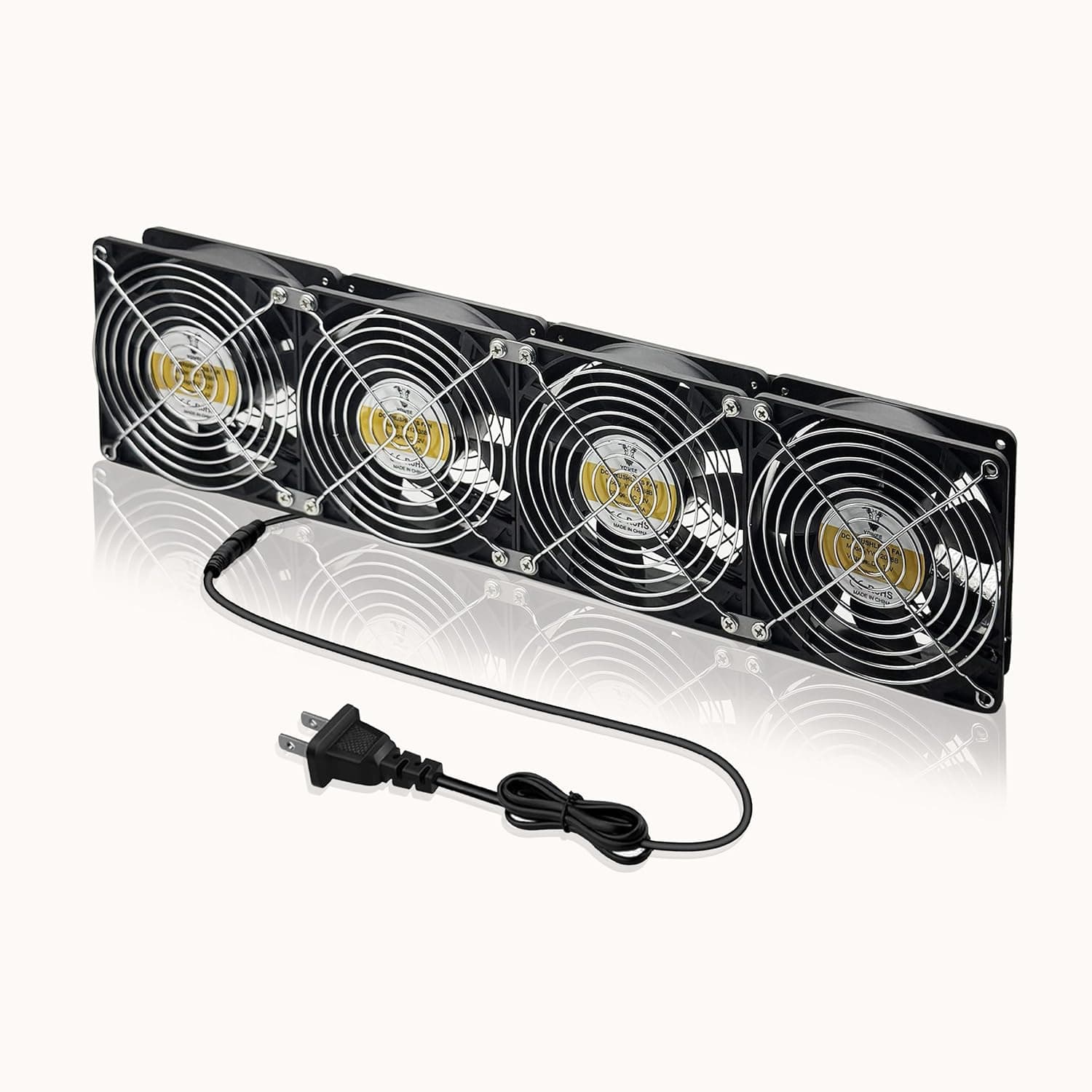
The YOWEE 4-pack 120mm x 38mm AC100-240V ventilation fan sits on the case-fan shelf, but it is a very different animal from a normal PC fan. This article works through the published specs and listing data to explain what it can and cannot do, and where buyers typically get caught out.
Overview
This is a quad-fan unit: four 120mm x 38mm AC fans mounted in a single frame. Published figures are 450 CFM maximum airflow, 3000 RPM maximum speed, 82 dBA noise, and 22.8 W power draw.
The fans use dual ball bearings and are protected on both sides by iron mesh guards. An inline speed controller sits in the power line and lets you dial airflow down steplessly.
The key point is that this is not a fan for building a quiet PC. A typical 120mm case fan moves 20-80 CFM on its own and, in quiet models, stays in the 20-30 dBA range.
450 CFM at 82 dBA is not an extension of that class — it belongs to the ventilation-blower category. It earns its keep where you can tolerate noise in exchange for moving a lot of air: garages and sheds, greenhouses, a workshop window, ventilating a vehicle while car camping, or forcing air through an open test bench, mining rig, or equipment rack.
As captured in May 2026, the Amazon.co.jp listing showed 15 reviews averaging 4.1 out of 5 (roughly 82% positive).
With a sample that small, treat the rating as a rough sanity check rather than a verdict.
Connectivity & Compatibility
Start with how it is powered. This unit runs on AC100-240V and plugs straight into a wall outlet.
It cannot connect to a motherboard 3-pin or 4-pin fan header. That means no BIOS or software fan control, no temperature-linked fan curves, and no RPM monitoring.
Speed adjustment is the physical dial on the included controller and nothing else. If you wanted a fan that spins up automatically when the CPU heats up, this is not it.
Physically, each fan is 120mm square and 38mm thick. Standard PC case fans are 25mm thick, so this is 13mm deeper.
In front of a radiator, behind a front panel, or near a CPU cooler — anywhere clearance was designed around 25mm — interference is likely. The mounting holes follow the standard 120mm pattern with 105mm pitch, so a case's 120mm mounts will line up.
Use the supplied screws, since generic case-fan screws may be too short for a 38mm frame.
The listed outer dimensions are 48 x 48 x 3.8 cm.
The 3.8cm depth matches the fan thickness, but four 120mm fans in a row should measure roughly 48cm by 12cm.
The 48 x 48 cm figure may be packaging size or a listing error. If your installation space is tight, check the product images for the actual layout (single row versus 2x2) and confirm real dimensions before ordering. The four fans are described as separable into smaller units, so planning around a split configuration is also an option.
The plug is a US-style Type A connector, which fits standard Japanese outlets directly. Confirm on the product page whether it includes a ground pin.
For outdoor or greenhouse use, note that no weatherproof rating is stated — mount it where rain cannot reach it and route extension cords with care.
Product Info
The published specifications are as follows.
| Item | Value |
|---|---|
| Max airflow | 450 CFM |
| Max speed | 3000 RPM |
| Noise | 82 dBA |
| Power draw | 22.8 W |
| Voltage | AC100-240V |
| Fan size | 120mm x 38mm (each) |
| Bearing | Dual ball bearing |
| Material | Plastic, iron mesh |
| Dimensions | 48 x 48 x 3.8 cm |
Read 450 CFM as the combined free-air figure for all four fans at full speed. Filters, mesh, ducting, or a partially blocked window frame all add static pressure and cut effective airflow, and turning the speed dial down reduces it further.
In practice you will rarely run it flat out, so plan around a throttled operating point rather than the headline number.
The 22.8 W draw is likewise a combined figure, so continuous operation costs little to run.
Dual ball bearings tolerate heat and any mounting orientation, which suits long-duration ventilation duty, though they tend to be more audible at low speeds than sleeve bearings.
On pricing: the Amazon.co.jp listing showed ¥4,299 as captured on 22 May 2026 and ¥4,799 as captured on 2 June 2026.
A ¥500 move in ten days tells you the number drifts, so check the product page for the current price. The eBay entry was a search link only, with no price listed.
Per fan that works out to a little over a thousand yen, cheaper than ARGB PWM case fans — but judge it as a single four-fan ventilation unit, not as a four-pack of case fans. The box includes the fan unit, speed controller, power cable, and mounting screws, with standard manufacturer warranty.
Compared With Regular Case Fans
Here is how the choice breaks down by use case.
| What you want to do | This unit | Typical PWM case fan |
|---|---|---|
| Quiet desktop PC | Poor fit (82 dBA) | Good fit |
| Temperature-linked control | Not possible (manual dial) | Yes |
| Room / garage / greenhouse ventilation | Good fit | Not enough airflow |
| Open bench or rack exhaust | Good fit | Needs many units |
| RGB lighting | Not supported | Widely available |
If your goal is better airflow inside a PC case, buying several 120mm or 140mm PWM fans wins on noise, control, and appearance. This unit only pulls ahead when you do not need motherboard control and simply want to move a large volume of air.
Getting that distinction wrong is the most common reason people regret this purchase.
Practical Setup Tips
For a window install, fix the frame in the opening and block the surrounding gaps with cardboard or foam board. Without that, exhausted air loops straight back in and actual ventilation falls far short of the rated airflow.
Placing intake and exhaust on opposite sides of the room creates a usable air path.
Always start the speed controller near its minimum and raise it only as needed. 82 dBA is close to vacuum-cleaner level and is not livable in an occupied room.
Throttled down, it becomes reasonable — treat full speed as an emergency setting.
If you use it with a PC or rack, be careful routing the AC cable into the chassis. Do not bundle mains wiring with boards or DC cables; keep it clear of moving parts and heat sources and secure it.
Where possible, mount the unit outside the chassis and simply blow air through it.
Best Use Cases
This suits people who have somewhere that airflow matters more than noise: clearing heat or fumes from a garage or workshop, circulating air in a greenhouse, venting hot air from a vehicle while car camping, or forcing air across an open test bench or equipment rack. In every one of those cases, the plug-it-in-and-turn-the-dial simplicity is the selling point.
No electrical work is required and nothing in your existing wiring has to change.
For PC use, blowing air at the intake or exhaust vents from outside the case is far more realistic than installing it inside a sealed desktop. Think of it as a temporary summer cooling booster — that framing matches the product's character best.
Things to Check Before Buying
Noise is the biggest trap. The published 82 dBA is a completely different experience from a 20-something dBA quiet PC fan; holding a conversation or a call in the same room is difficult.
If the "four fans, 450 CFM" figure tempted you toward a bedroom or home office, reconsider the application first. The speed controller helps, but the moment you dial it down you also give up the 450 CFM headline.
The lack of PWM support is easy to miss. Because it cannot connect to a motherboard, there is no automatic speed control, no temperature linkage, and no software monitoring.
It also does not turn on and off with the PC. A switched power strip or smart plug is a sensible companion so you do not leave it running.
Watch the 38mm thickness and the dimension listing. Anywhere designed around 25mm fans, this will interfere.
And the listed 48 x 48 x 3.8 cm is hard to reconcile with four 120mm fans.
If space is tight, cross-check the product images against the stated dimensions before you buy.
Read the listing metadata critically. Store listings auto-populate fields such as manufacturer, model number, dimensions, and price, and values from a different product sometimes creep in.
At the time of writing, the brand and price band both matched this product, but before ordering, look at the product image and title to confirm what will actually arrive is the four-fan 120mm unit. The listed price also moved from ¥4,299 to ¥4,799 between May and June 2026, so the figures here are reference points only.
Finally, keep the 15-review sample in mind. A 4.1-star average is respectable, but that base is too small to reveal unit variance or long-term durability.
If you plan on continuous operation, have a fallback ready — a spare fan or a second ventilation path.
FAQ
Q. Can I connect it to a motherboard for automatic control? A.
No. It runs on AC100-240V from a wall outlet and cannot connect to 3-pin or 4-pin fan headers.
Speed is adjusted only by the manual dial on the included controller.
Q. Will it fit standard 120mm case mounts? A.
The mounting holes follow the standard 120mm pattern with 105mm pitch, so the holes line up. The 38mm thickness may still interfere in spaces designed for 25mm fans.
Q. Can it run quietly? A.
The rated maximum is 82 dBA, which is not suitable for continuous use in a living space. Dialing it down brings noise to a practical level, but airflow drops accordingly.
Q. Can the four fans be used separately? A.
The manufacturer describes them as separable for dual-fan and similar configurations. Check the product images for how the split and cabling actually work.
Q. Can I use it outdoors or in a greenhouse? A.
Greenhouse ventilation is listed as an intended use, but no waterproof or splash rating is stated. Mount it where rain and spray cannot reach it and use outdoor-rated cords and outlet covers.
Q. How much does it cost to run? A.
Rated draw is 22.8 W.
Even running continuously, consumption is modest — comparable to or below a typical household electric fan.
Product Disclosure (Amazon)
- Manufacturer: YOWEE
- ASIN: B0FD43DH2N
- Note: This article covers a manufacturer-made product based on Amazon listing details.