Overview
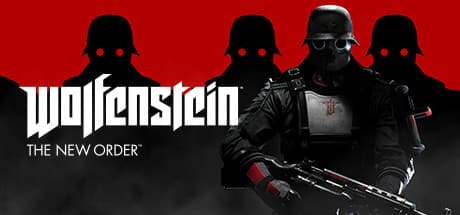
Wolfenstein: The New Order, developed by MachineGames and released on May 20, 2014, is a single-player-only first-person shooter set in a world where the Nazi regime won the Second World War. You play B.J.
Blazkowicz, the series' long-running protagonist, working from the inside to break the occupation apart. The structure is chapter-based: infiltrate a facility, city block, or fortress, clear a path inward, then face a boss or an oversized war machine at the end.
This is not an open world. Levels are discrete and linear, with side content limited to hidden rooms and collectibles.
The game keeps the sweep-the-room satisfaction that Wolfenstein 3D and Return to Castle Wolfenstein established, but it weights story far more heavily than its ancestors. Between missions you spend real time at a hideout, in conversation scenes that develop the resistance members and the texture of life under occupation.
If you came purely to shoot, those stretches will feel long.
Systems and mechanics
The defining design choice is that most levels support both stealth and a loud frontal assault. Commanders are stationed throughout each map, and if one spots you before you deal with him, he starts calling in waves of reinforcements.
Knife takedowns from behind and a silenced pistol let you remove commanders first and then clean up the rest at your own pace. Alternatively you can open fire immediately and fight the reinforcements as they arrive.
Replaying a level with the opposite approach genuinely changes how it plays.
Almost every weapon can be dual-wielded. Two assault rifles or two shotguns put out enormous volume, but reloading takes close to twice as long and accuracy drops noticeably.
A lean-from-cover mechanic is included, so the real skill is knowing when to overwhelm with two guns and when to drop to one and take precise headshots. Health does not fully regenerate: it recovers in tiers up to a threshold, and any overcharge above your normal maximum bleeds away over time.
Picking up health kits and armor plates is still part of the loop, which gives combat a slightly old-fashioned resource-management feel.
Perks are unlocked by completing in-game challenges rather than spending points. Kill a set number of enemies with the knife, take out groups with explosives, or eliminate targets while crouched, and the matching perk tree improves.
Whatever you naturally do becomes your build.
One more thing worth knowing: an early binary choice changes which character accompanies you for the rest of the campaign and which support ability you unlock — lockpicking or remote hacking. You only see one side per playthrough, which is clearly designed with a second run in mind.
Getting started
A middle difficulty is the safest first pick. Build the habit of hunting commanders first.
Each level contains a document that reveals commander positions on your map, so if you intend to play quietly, find that before engaging. Most hidden routes run behind walls or through ventilation ducts; metal grates you can approach and open are the usual tell.
Some collectibles sit in small rooms deliberately placed off the obvious path.
System requirements in practice
The published minimum specification lists 64-bit Windows 7 or Windows 8, an Intel Core i7 or equivalent AMD processor, 4 GB of RAM, a GeForce 460 or ATI Radeon HD 6850 graphics card, and 50 GB of available storage. The CPU figure looks unusually high for a 2014 title, and that reflects the id Tech engine's constant texture streaming, which leans on CPU and storage bandwidth.
The GPU requirement, by contrast, is modest — with a GeForce 460 as the stated reference point, a current integrated graphics solution has room to run this at 1080p.
The 50 GB install is the real practical hurdle. Read speed matters more here than raw capacity, so put the game on an SSD rather than a mechanical drive if you can.
When texture streaming cannot keep up, detail on walls and terrain arrives a beat late after you swing the camera — the familiar pop-in of this engine. It never disappears entirely, since it is close to intended behavior, but an SSD improves it clearly.
The 4 GB memory figure belongs to the Windows 7 era. On a modern OS with a browser open alongside, 8 GB or more is the realistic floor.
Note that no recommended specification is available in the data referenced here, so treat everything above as an interpretation of the minimum requirements. Check the store page for current details.
How players tend to judge it
Years after release, the game still holds strong support. Positive comments return again and again to the writing and staging.
The premise is absurd, but the game refuses to play it purely for laughs, giving real screen time to life under occupation and to the protagonist's interior life — players describe being surprised by something they did not expect a shooter to attempt. The second recurring praise is the feel of dual-wielding and the freedom to slide between stealth and brute force.
Weapons are differentiated in recoil and sound, and many players say the act of shooting is simply satisfying on its own.
The common criticisms start with linearity. If you want branching exploration or large open maps, this is not that.
Pacing in several later chapters draws complaints too, because the ratio of cutscenes and dialogue rises just when players want sustained combat. Enemy AI is competent rather than clever, and cover use is sometimes weak.
Technically, the texture pop-in mentioned above is the most frequently cited sign of age. Some players regret the absence of multiplayer, though that was a deliberate decision to commit fully to a single-player campaign.
Who it suits
- Players looking for a single-player FPS with a story they intend to finish
- Anyone who wants to choose, session by session, between quiet takedowns and dual-wielded aggression
- Players who care about weapon feel and want each gun to handle distinctly
- Anyone who prefers one dense campaign of a dozen-plus hours over dozens of hours of repetition
- Owners of modest graphics hardware who still want a shooter that looks presentable
Who should skip it
There is no competitive or cooperative multiplayer at all. If playing with friends is the point, this is not a candidate — pick something built around multiplayer instead.
The subject matter is heavy. Because the setting is life under Nazi occupation, camps, human experimentation, and executions appear directly and without softening, and the gore is unsparing.
If that is difficult for you, this will be a hard sit. Anyone hunting for a light-hearted shooter should look elsewhere.
Expectations about freedom are the third mismatch. Maps close off chapter by chapter and the explorable area is fixed, so players who want open-world wandering or deep build crafting will find it narrow.
Progression is a linear set of challenge-gated perks, not a system you optimize.
Fourth, language support. The data referenced here contains no information about supported languages, so I cannot confirm whether Japanese subtitles or audio are available.
Check the supported-languages section of the store page before buying — for some readers that single line decides the purchase.
Finally, installation. Confirm you can spare 50 GB, ideally on an SSD, before committing.
On a laptop with a tight drive that alone can be a reason to pass. If you can meet that condition, though, the GPU demands are low by current standards and getting it running is straightforward.


