Overview
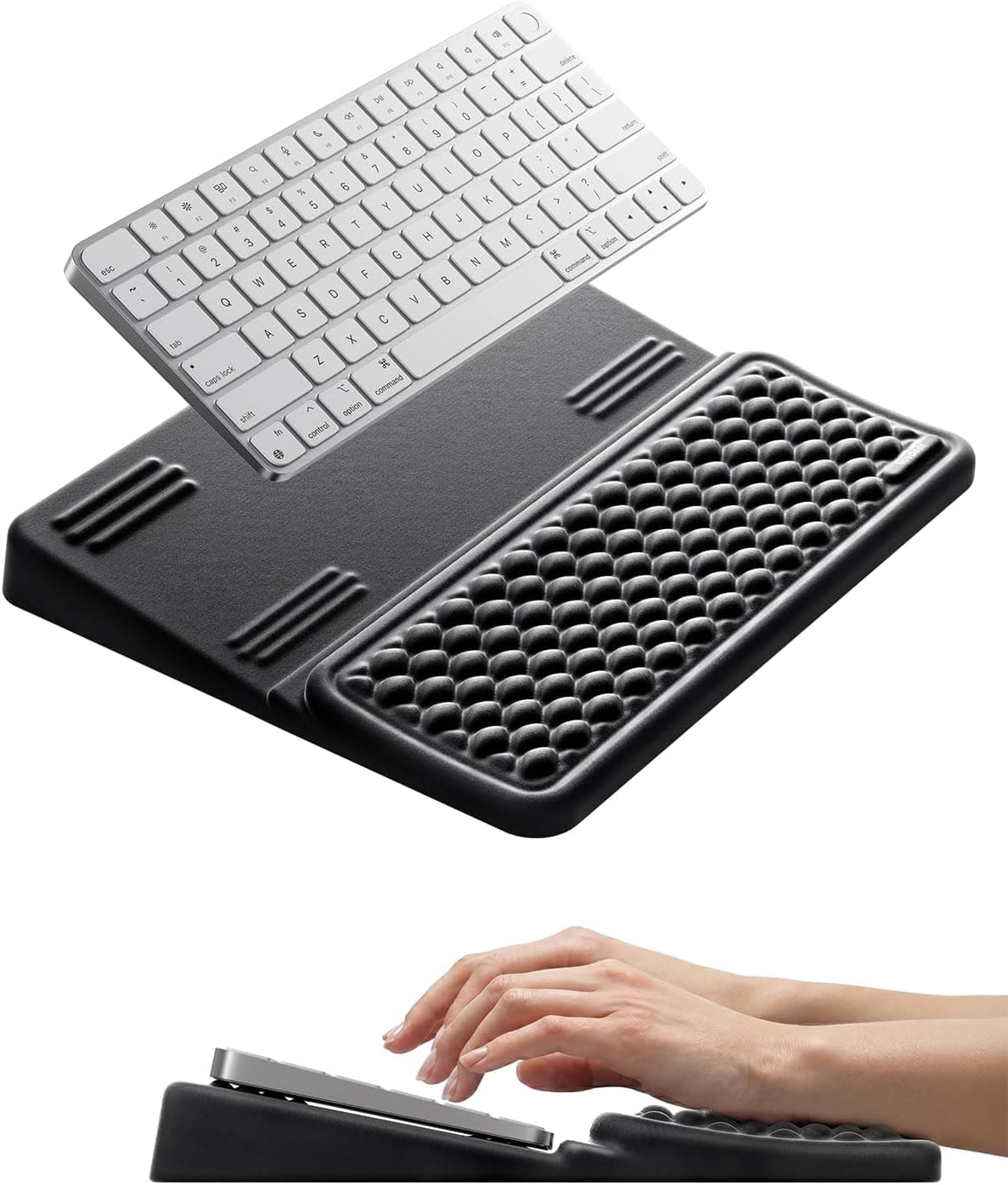
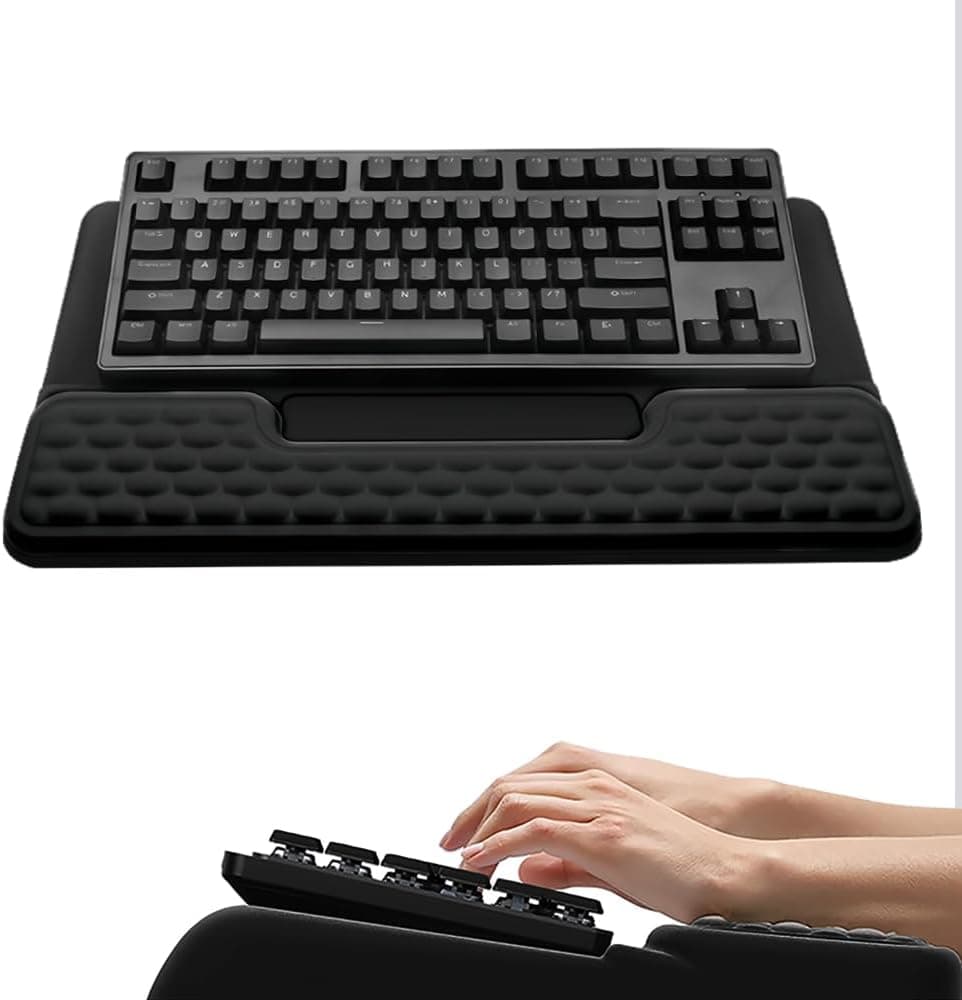
The TAODICO 152-Black is a keyboard tray with an integrated wrist rest: your keyboard sits on the raised platform, and your wrists rest on the memory-foam pad in front of it. It measures 45 x 24.5 x 2.5 cm, uses slow-recovery memory foam over a non-slip PU base, and offers two tilt angles — 12.5° and 3°.
On Amazon.co.jp it was listed at ¥3,099 as captured on 7 June 2026, with 27 reviews averaging 4.1 out of 5 stars (82% positive).
Both price and rating are point-in-time figures and will move.
This is squarely an entry-level product. It is not competing with arm-mounted forearm supports or premium wood and resin palm rests.
It is the first thing you buy when you want to fix your typing angle cheaply. That is a legitimate niche: very few products let you intervene in your wrist posture for around ¥3,000.
Choosing Between 12.5° and 3°
The two-stage tilt is the core of this product, and picking the wrong one turns a wrist-saving accessory into a wrist-straining one.
| Angle | Intended keyboard | Effect |
|---|---|---|
| 12.5° | Mechanical, high-profile, or anyone who used to prop up the keyboard's own feet | Raises the near edge so fingers drop onto keys; absorbs key-height difference |
| 3° | Low-profile, scissor-switch, slim membrane boards | Nearly flat; minimises wrist extension |
The generally accepted goal is a wrist that stays straight or angles very slightly downward. Tall mechanical keyboards push your wrist into extension as you reach for the keycaps, which is exactly what the 12.5° setting counteracts.
Use that same 12.5° under a slim keyboard and you bend the wrist the other way, concentrating load on the heel of the palm.
More tilt is not better — the correct angle is whichever one makes your wrist look flat.
To find it, sit down, let your arms hang, then bring your forearms to the desk without changing the shoulder position. Note where your hands naturally land.
The top surface of the wrist rest should sit at that height or a few millimetres below it.
Compatibility Guide
No cables, no power, no drivers — you put it on the desk and use it. Compatibility here is purely physical: will it fit your keyboard and your desk?
- 24.5 cm depth: enough for a typical keyboard body (roughly 13-15 cm deep on full-size boards) plus the wrist pad in front. If your desk is shallower than 45 cm, check clearance against your monitor stand before ordering.
- 45 cm width: full-size keyboards run around 44 cm, so they fit with almost no margin. Tenkeyless (about 36 cm) and 65% boards leave comfortable space on both sides. Gaming boards with an extra macro column or a volume knob may overhang — measure yours.
- 2.5 cm thickness: the most-missed detail. Adding this tray raises your entire keyboard by 2.5 cm. If your desk is already too tall and your elbows ride high, this product will make that worse, not better. Fix chair or desk height first.
- PU non-slip base: grips fabric desk mats well. On glass or glossy painted desktops it can creep forward under heavy typing.
The manufacturer's note is simply "compatible with most keyboards," which is fair for a product with no connector standards involved — but the dimensions above are worth checking against your own setup.
Product Info
| Item | Value |
|---|---|
| Dimensions | 45 x 24.5 x 2.5 cm |
| Material | Memory foam, PU base |
| Angle adjustment | Two-stage (12.5° / 3°) |
| Colour | 152-Black |
The price was ¥3,099 on Amazon.co.jp as captured on 7 June 2026.
Prices change frequently, so confirm the current figure on the product page. The eBay entry is only a search link with no confirmed price; once import shipping and handling are added, buying domestically is usually the simpler option at this price point.
Ratings stand at 4.1 out of 5 from 27 reviews (82% positive).
Twenty-seven is a small sample — it hints at a trend rather than establishing one. Read it with less confidence than you would a rating built on thousands of reviews, since unit-to-unit variation still dominates at this scale.
The package contains the pad only; confirm warranty terms with the seller.
How It Compares
Wrist rests fall into three families: standalone bars (wood, resin, gel), mouse-pad-integrated pads, and tray-style units like this one that the keyboard sits on top of.
The tray design's advantage is that the height relationship between keyboard and wrist rest can never drift. Standalone bars creep a few millimetres during use and create a ledge that digs into the heel of your palm; that failure mode is structurally impossible here.
You also get tilt without deploying the keyboard's own flip-out feet, which often feel unstable.
The trade-off is flexibility. A tray commits you to one keyboard position, and if you swap keyboards the fit may no longer work.
If you rotate through several boards, a standalone rest adapts better.
On materials, memory foam sinks deep and feels plush, but it is slower to recover and compresses permanently over time. If you prefer firm support, or if you type with floating wrists rather than resting them, wood or silicone suits you better.
Using It Well
Treat the pad as a parking spot between bursts of typing, not a permanent shelf for your wrists. Keeping constant contact concentrates pressure on one point and can create the very problem you bought it to solve.
Move from the forearm while typing; rest only when your fingers stop.
Then re-check your height. Because the tray lifts the typing surface, most people need to raise their chair by a few centimetres afterwards.
Adding the tray without adjusting anything else tends to push your shoulders up.
Also expect memory foam to feel firmer on cold mornings and softer once the room warms up — that is normal for the material, not a defect.
Best Use Cases
Good for office and remote workers who spend hours at a keyboard, and for gamers who feel wrist fatigue during long sessions. It helps most if you currently prop up your keyboard's feet and type with extended wrists, or if your desk sits low enough that your wrists drop below your elbows — those users feel the 12.5° setting immediately.
It also suits people who like a soft, sinking feel, and anyone who wants to test whether a wrist rest helps at all before spending more. Tenkeyless and 65% keyboard owners get the cleanest fit within the 45 cm width.
Before You Buy
The 2.5 cm of added height is the main trap. If your desk is tall, your chair is low, or your elbows sit above your wrists, this tray amplifies the underlying problem instead of solving it.
Sort out chair and desk height first — posture comes before accessories.
Full-size keyboards are a tight fit. At 45 cm wide, a standard full-size board (around 44 cm) leaves virtually no margin, and gaming models with side macro columns or knobs will overhang.
Measure before ordering.
Memory foam is a consumable. Body heat and daily pressure gradually flatten it; with heavy use, expect the rebound to fade within roughly a year.
At this price that is a reasonable trade, but if you want something that lasts several years, look at wood or resin instead.
Plan for cleaning. This surface is in constant skin contact and will absorb oil and sweat.
Check the product page for whether it can be washed — foam-cored pads hold water and can take days to dry, and using one before it is fully dry invites odour.
Weigh the small review count. An 82% positive rating is decent, but with 27 reviews a handful of bad units moves the average sharply.
If your unit arrives with an obvious fault — wobbling tilt, uneven foam, strong odour — contact the seller early rather than waiting it out.
Finally, read the listing data critically. Registered manufacturer, seller, model number, currency and store labels on listings like this are sometimes inconsistent — in the data behind this article, the price was labelled "Amazon US" while the link pointed to Amazon.co.jp with a yen price.
Before ordering, confirm from the product images and title, not just the text fields, that you are looking at the right item.
FAQ
Q. Will a full-size keyboard fit? A.
The tray is 45 cm wide and typical full-size boards are around 44 cm, so a standard one fits with almost no margin. Boards with extra key columns or knobs likely overhang — measure first.
Q. Should I use 12.5° or 3°? A.
Match it to keyboard height: 12.5° for tall mechanical boards, 3° for slim scissor or membrane keyboards.
If unsure, try both and keep whichever makes your wrist look straight.
Q. Will it fix my wrist pain? A.
No guarantees. A wrist rest is a postural aid; if the real cause is desk height, monitor position, or lack of breaks, address those instead.
Persistent pain or numbness warrants a doctor, not an accessory.
Q. What about my mouse hand? A.
This product covers the keyboard only. Pair it with a wrist-rest mouse pad, and try to match the height on both sides so your posture stays symmetrical.
Q. Can I wash it? A.
Check the listing — foam-cored pads vary. As a general rule, spot-cleaning is safer than immersion because the foam retains water.
Product Disclosure (Amazon)
- Manufacturer: TAODICO
- Seller: TUOJU
- Fulfilled by: Amazon
- ASIN: B0GGH3LG5B
- Note: This article covers a manufacturer-made product based on Amazon listing details.