Overview
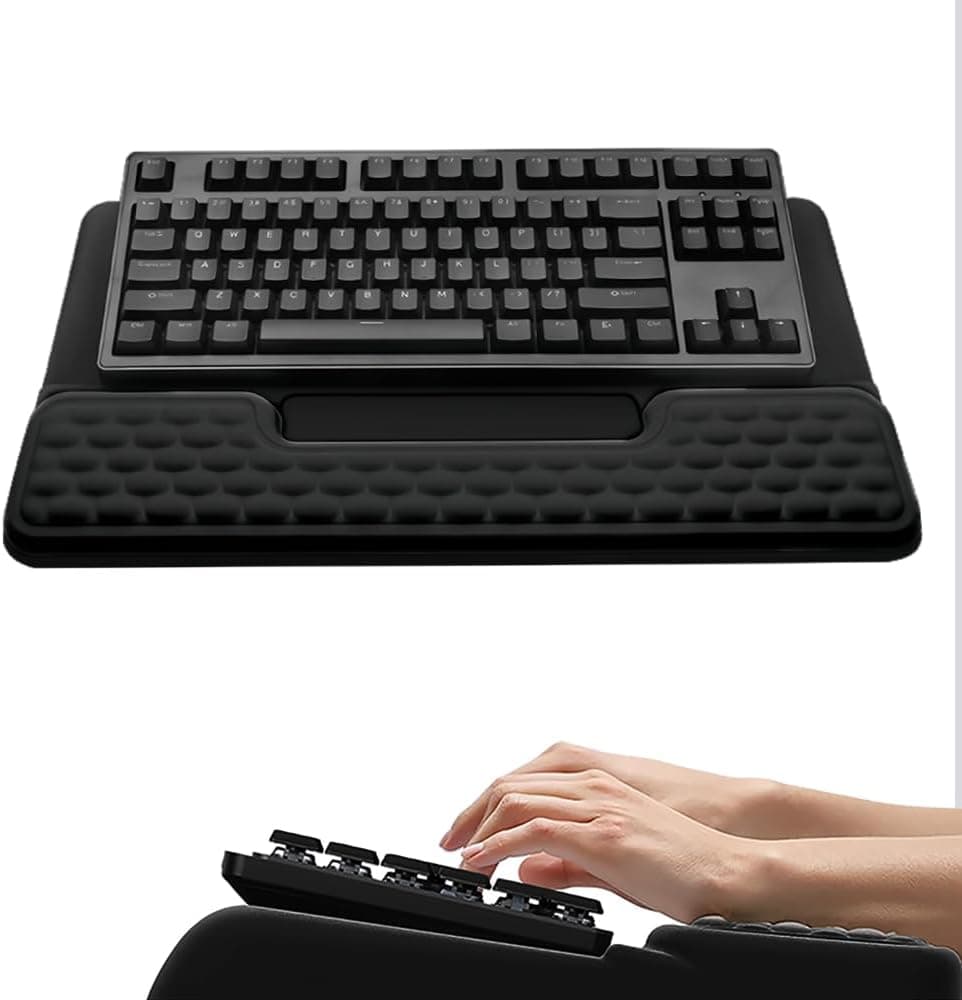
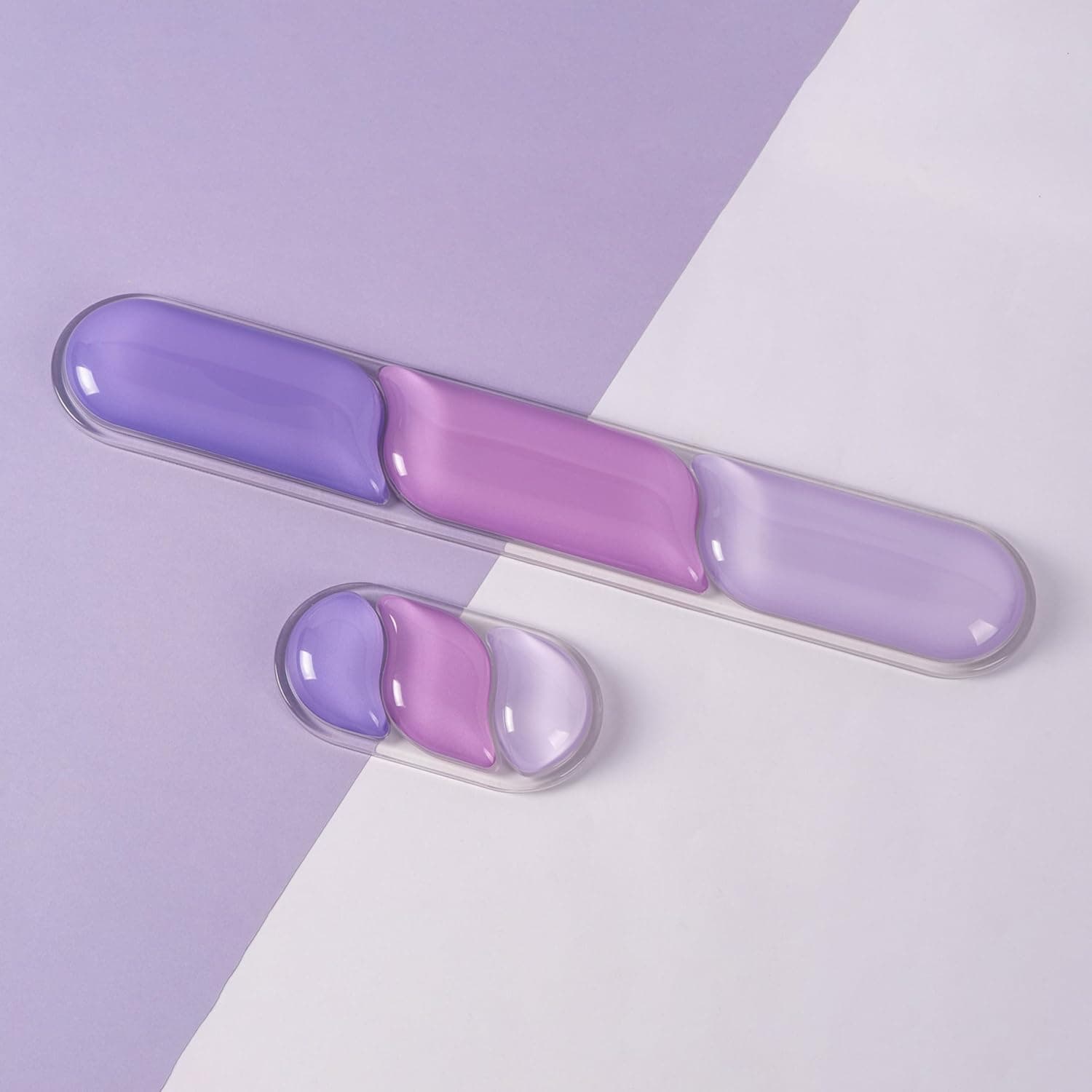
The EPOMAKER CloudGel Wrist Rest is a two-piece set: a long rest for keyboards (43.5 x 7.5 cm) and a short one for mice, both built from PVC and gel.
The short verdict: it makes sense if you've tried a memory-foam palm rest and found it either bottoms out under your weight or flattens after a few months. If you're already happy with a firm wooden or aluminum palm rest, there's little reason to switch.
Here is the concrete data. On Amazon.co.jp the product holds 4.3 out of 5 stars across 111 reviews — an 86% favorability figure, captured in May 2026.
A three-digit review count is a reasonable sample for a desk accessory, and it suggests this isn't a hit-or-miss product. But 4.3 is a "mostly satisfied with caveats" band rather than universal praise, and in this category the caveats almost always trace back to size mismatch or the material itself.
Five colors are offered — Clear, Blue, Green, Purple, and Pink. This article covers Purple.
No specification differences between colors are documented, so pick purely on looks.
Gel vs. Memory Foam: Which Family Fits You
The first decision in wrist rest shopping isn't brand or color — it's material family. Gel spreads the contact patch the moment you apply weight, distributing pressure instead of concentrating it.
Memory foam sinks slowly and then holds its shape, which suits work where your hands stay parked in one place.
Gel's weakness is push-back: some users dislike the slight rebound when swinging a mouse. Foam's weaknesses are long-term flattening and soaking up sweat.
This product sits on the gel side, so it fits people who want firm support that doesn't bottom out, and disappoints people who want a soft, enveloping feel.
EPOMAKER describes a silicone-feel surface over a gel core, but no hardness rating, thickness, or weight figure is published. If you want to compare compression numerically, check the product page for current specs.
As a general rule, gel rests in this price band compress a bit under a centimeter under finger pressure and spring back immediately.
Compatibility Guide
There is nothing to connect or configure. Compatibility here means one thing: does the size fit?
The number that matters is the long rest's 43.5 x 7.5 cm footprint, measured against your keyboard's width.
| Keyboard | Typical width | Versus 43.5 cm |
|---|---|---|
| 60% | approx. 28-30 cm | overhangs by 13-15 cm |
| 65% | approx. 31-32 cm | overhangs by ~11 cm |
| 75% | approx. 32-34 cm | overhangs by ~10 cm |
| TKL | approx. 35-36 cm | overhangs by 7-8 cm |
| 96% / full-size | approx. 43-45 cm | roughly flush |
Those widths are general figures; actual cases vary. The conclusion is clear: 43.5 cm lands most naturally in front of a 96% or full-size board. Smaller layouts still work — the excess simply extends toward your mouse or numpad area — but on a cramped desk that overhang becomes an obstacle.
If you run a compact board and want a flush look, a size-matched rest will satisfy you more.
The short rest is symmetrical, so left- and right-handed use are both fine. Thickness is not published, so height matching is a hands-on affair.
Ideally the top surface of a wrist rest sits level with or slightly below your keycaps at the home row. If it sits higher, your wrists extend backward and the rest actively increases strain.
This matters most with low-profile keyboards and laptops.
The rubber base grips wood and glass well, but placed on a cloth mousepad it tends to drag the pad along with it. If you play at low sensitivity with big arm sweeps, park the short rest off the pad instead.
Product Info
| Item | Value |
|---|---|
| Contents | Long + short, two-piece set |
| Material | Polyvinyl chloride (PVC), gel |
| Dimensions | 43.5 x 7.5 cm (long) |
| Color | Purple (also Clear / Blue / Green / Pink) |
The listed price on Amazon.co.jp was ¥4,460 as captured in May 2026 (ASIN B0FJLT8GLF, sold by Epomaker-JP, fulfilled by Amazon).
Wrist rests range from sub-¥2,000 plastic pieces to premium memory-foam units above ¥5,000, so a two-piece set at this figure sits mid-range. Accessories like this move with coupons and sales, so always confirm the current price on the product page — the figure above is a snapshot, not a guarantee.
An eBay search route also appears in the source data, but no concrete amount was captured there ("See listing"), so it offers nothing to compare against. Whether the long and short pieces can be bought separately isn't documented either; confirm before planning a second purchase.
Warranty terms are likewise unpublished — EPOMAKER's accessory policy may differ from its keyboard policy.
Getting the Positioning Right
A wrist rest isn't a place-it-and-forget-it device. Placement decides whether it helps.
Despite the name, do not rest the wrist joint itself on it. Nerves and tendons run through the underside of the wrist, and pressing them against a firm surface all day is exactly what you want to avoid.
Support the heel of your palm instead, keeping the wrist floating or barely touching.
Second, don't anchor your hands while typing. A rest is a place to pause between bursts, not a pivot.
Locking your palms down and moving only your fingers narrows your range of motion and creates a different kind of strain. The same applies in games.
Third, height. If the rest surface sits above your keycaps, your wrists bend upward and you've made things worse.
If you keep the keyboard's tilt feet extended, try folding them when you add a rest — it's a free adjustment with a large effect, and worth testing on day one.
How It Compares
Memory-foam keyboard stands with integrated rests support the forearm as well as the wrist, winning on contact area. The trade-off is footprint: they change your keyboard's height and demand more desk depth, which is a big change if you like your current setup.
For the mouse side alone, integrated wrist-rest mousepads solve a structural problem this set doesn't — the pad and rest can't slide apart. The CloudGel's advantage is covering keyboard and mouse together while keeping the mousepad you already own.
Desk-edge cushions and clamp-on armrests attack the problem from a different angle entirely, supporting the forearm and elbow. If your pain reaches the elbow or shoulder, addressing that first will do more than swapping wrist rests.
Choosing by where it actually hurts is the shortest path.
Things to Know Before Buying
Material lifespan is the main compromise. PVC and gel dislike direct sunlight and heat.
Left on a sunlit desk or in a closed, hot room, the surface can turn tacky or deform. Likewise, once the outer skin is cut, the gel inside can escape — keep it away from cat claws, blades, and sharp keyboard corners.
This is a property of the material, not a defect specific to this product.
Heavy sweaters may not enjoy it. Silicone and PVC surfaces don't absorb moisture the way a fabric-covered foam rest does, so palms can feel sticky in summer.
The flip side is hygiene: you can wipe the whole thing clean, which fabric rests never allow. Pick your trade-off.
Consider color transfer. Deeply pigmented plastics left in long contact with a white desk mat or light-colored desktop can leave marks.
If that worries you, choose Clear or put a thin sheet underneath.
Size mismatch is the classic return reason. 43.5 cm is plainly long for 60-75% boards and is a common source of low-star reviews.
Measure your keyboard before ordering and check it against the table above. The undocumented thickness and weight are additional unknowns you cannot fully resolve in advance.
Finally, don't take listing metadata at face value. Amazon product pages sometimes carry manufacturer, model, or dimension fields belonging to a different variant or product entirely.
Nothing looks contradictory here — manufacturer EPOMAKER, seller Epomaker-JP — but color and set contents change with the variant selector. Before confirming an order, check that the selected variant name, the product image, and the title all agree.
Best Use Cases
This set earns its price for:
- Full-size or 96% keyboard users who want a rest that lines up with the board rather than overhanging it.
- People burned by memory foam that bottomed out or flattened — gel resists both and rebounds faster.
- Anyone outfitting keyboard and mouse at once, since the two-piece set removes a second purchase decision.
- Low-maintenance setups, because a damp cloth cleans the whole surface.
- Color-coordinated desks, with five options to match keycaps or a mousepad.
Skip it if you use a 60% board, prefer the feel of fabric, or already have pain reaching your forearm and elbow — that last case needs a different category of product entirely.
FAQ
Q. Will it work with a 60% keyboard? A.
Yes, but 43.5 cm overhangs such a board by more than 10 cm.
That's harmless on a roomy desk; if you want a flush look, buy a size-matched rest instead.
Q. How thick is it? A.
Not published. The only stated dimensions are 43.5 x 7.5 cm for the long piece.
Since height matching matters, check the product page for the latest measurements.
Q. Can I wash it? A.
Wipe it with a well-wrung damp cloth. Diluted neutral detergent is usually fine; avoid alcohol and solvents, which can damage the surface.
Q. Does it suit laptops? A.
Yes, but laptop keyboards sit low, so a rest that's too tall bends the wrists upward. If the step up from the laptop's own palm area bothers you, a lower-profile rest fits better.
Q. Can I use only the mouse piece? A.
Yes — the two pieces are independent. If you truly only need one, though, compare against single-piece products first.
Q. How trustworthy are the ratings? A.
4.3 stars from 111 reviews (86% favorability, captured May 2026) is a solid sample.
That band typically means "most are satisfied, a minority hit a size or material mismatch" — read the low-star reviews and see whether their situation matches yours.
Product Disclosure (Amazon)
- Manufacturer: EPOMAKER
- Seller: Epomaker-JP
- Fulfilled by: Amazon
- ASIN: B0FJLT8GLF
- Note: This article covers a manufacturer-made product based on Amazon listing details.