The short version: this is an idle RPG you read
Lowmoor Idle RPG: An Adventurer's Chronicle asks for no clicks at all. You roll one adventurer, sign the ledger, and from that moment they descend, fight, gain rank, sell loot and re-equip themselves without you.
Your job is to read the log as it scrolls.
One line in the bundled README settles what this game is:
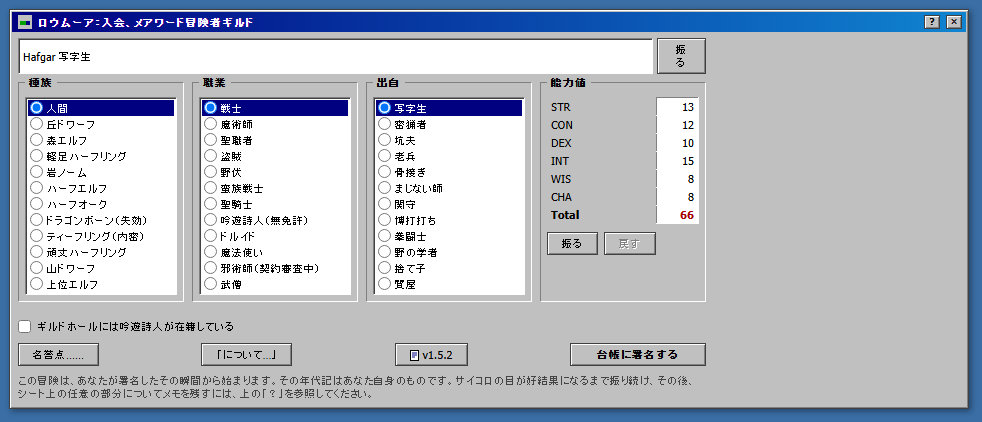
The adventure conducts itself; yours is the chronicle.
That is not a tagline. As this article shows, it is enforced as a constraint on every system in the game.
And once you sit with it, both the polish of the idle loop and the density of design behind it clearly exceed what a free release usually carries.
The best part, personally: it really is fully idle
Starting with what I most wanted to write about.
Fold it into a strip and float it over your work
Lowmoor has a Fold mode. Press the button in the title bar and the whole game collapses into a narrow strip that floats on top of whatever else you are doing.
It is built on Chromium's document Picture-in-Picture, so it stays above your other windows.
This is genuinely wonderful. A square Windows 98 frame in a 90s system font, parked in the corner of a code editor or a browser, is exactly the desktop-accessory feeling of that era.
You glance over between tasks, find your adventurer three floors down fighting something, and glance away again. It is one of the ideal shapes for an idle game.
The implementation is careful, too. Browser background tabs get their requestAnimationFrame starved, which normally freezes animation — so the game's animation clock follows the PiP window, requesting frames from whichever window is actually on screen.
Skip that and the strip stutters. Handling it is a real sign of care.
It runs while closed, for up to 24 hours
Whether the window is open, folded into a strip, or shut entirely, progress continues. Offline progression starts at four hours.
Each level of The Night Clerk on the Roll of Honour adds an hour, and twenty levels take it to 24 hours.
The implementation is not a shortcut either. Rather than approximating your absence with a closed-form estimate, it fast-forwards the real engine (fastForward(dt)).
What you come back to matches what would have happened had you watched.
You can turn the return report off, but even off, the log still carries a one-line summary. The reasoning is written into the source, and it captures the game's posture well:
Withholding the window must not withhold the news. Two hours passed behind other work and it had taken 583 beasts, seven ranks and 52,000 gold, and it said nothing about any of it. That is worse than the window it replaced.
And you can stop it completely
Make Camp stops the clock. Not a pause but a true halt: elapsed time is discarded and no absence report appears however long you leave it.
Idle games that let you deliberately not progress are surprisingly rare, and it is a good touch here.
First, the build itself is remarkable
Of 427.6 MiB installed, the game is 4MB
It is an Electron app. Steam's own depot info puts the installed size at 448,416,089 bytes (427.6 MiB) with a 189,730,160-byte (180.9 MiB) download, build 24870889, last updated 21 August 2026 at 21:14 UTC.
Yet the game itself is a single file — game/index.html inside resources/app.asar.
At 1.5.2 that was about 2MB across 26,469 lines; 1.6.0 took it to 3.97MB and 43,311 lines.
Even so, it accounts for 0.9% of the install.
The striking part: 1.6.0 doubled the game's code and the install barely moved. It measured about 425 MiB at 1.5.2 and 427.6 MiB now — a couple of megabytes, which is almost exactly what the game file gained.
The other 425 MiB has not changed at all.
- CSS: 1,580 lines
- JavaScript: 1,867,866 characters
- In-game prose: roughly 482,991 characters (5,401 unique strings)
- Static HTML body text: 7,196 characters
What that 425 MiB holds is exactly what unpacking 1.5.2 showed: roughly 270MB of Electron runtime and — remarkably — 150MB of Valve's official build tooling (steamcmd) shipped inside steam/builder/.
It was swept in at packaging time and is never referenced by the game code. Stray files in an Electron bundle are common enough, but it leaves the actual game at well under one per cent of the install, which is not a ratio you see often.
There is not one external image file
All of the art lives inside the HTML: 228 hand-drawn inline SVG line drawings plus 232 base64-embedded PNGs (about 0.96MB together).
Apart from two icons, there are no external assets at all. At 1.5.2 there were only 14 PNGs; 1.6.0 brought that to 232, which means the gradual migration from SVG line art to raster pieces — noted in the comment below — actually happened.
The source carries an /* ART-MAP:BEGIN */ marker and a tool that embeds files from art/monsters/ automatically, which reads as a gradual migration from SVG line art to raster pieces.
Browser, itch.io and Steam run the same file
The desktop README states the principle outright: the desktop build does not modify the game, and the repository's root index.html is the single source of truth for web, itch and desktop alike.
So all three distributions execute a byte-identical game file, and save codes carry between browser and desktop. The Electron wrapper adds exactly one thing, window.lowmoorBridge, exposing five members: achievements, rich presence, Steam Cloud, Fold, and the custom title bar.
The game calls them behind typeof checks, so in a browser the missing bridge simply falls through.
Update: 1.6.0 roughly doubled the game
This article was written from the 1.5.2 source.
On 21 August 2026 1.6.0 shipped, taking the game from 2.03MB / 26,469 lines to 3.97MB / 43,311 lines and the save schema from v13 to v17.
The fight is on the die now: attack rolls, damage dice, beasts with stat blocks, and kit in four named slots. Every trade gained a signature move, three pets arrived (a chest, a bone hound and a leech), and talent trees, equipment forging and per-chronicle preparations were added, along with three new menus — Armoury, Pets and the Memorial Wall.
Feats went 11 → 13, Guildhouse works 8 → 13, Roll of Honour rows 14 → 20. The bestiary stayed at 179, but 20 species were swapped out.
The author's own patch note ends: "An update too large for this window: the full patch notes are
the v1.6.0 post on Steam."
What is more telling is that the source does not call itself 1.6.0. Counting the internal version numbers scattered through its comments gives 37 distinct ones, the newest being v2.13.0.
The "1.6.0" on Steam bundles a long run of the author's own internal releases into a single public number — and between v2.12.0 and v2.13.0 alone, the default for who spends the talent tree's points flipped from automatic to manual.
This game is still visibly in motion.
Unless noted otherwise, the figures below are as of 1.6.0.
The scale of the content
For a free idle game, the measured figures are unusual.
| Element | Count |
|---|---|
| Monster species | 179 |
| Bestiary lore entries | 179 (2–3 sentences each) |
| Bosses | 31 |
| Boss-sequence stage definitions | 198 lines |
| Inline SVG artworks | 228 |
| Steam achievements | 100 |
| Feats | 13 (3 kept on your papers) |
| Hirelings | 21 varieties |
| Guildhouse works | 13 buildings |
| Skill-tree seals | 160 (8 schools × 20) |
| Writs | 8 |
| Random choice events | 35 |
| Guild festivals | 10 |
| Spells / knacks | 32 / 19 |
| Folk / trades | 12 / 12 |
| Roll of Honour rows | 20 |
The structure is two modules, six arcs, thirty floors. Module I, The Maw, runs a prologue plus Arcs I–V, each closing on a capstone boss.
Reaching the bottom unlocks Module II, The Mourning Vale, which carries four endings.
Expected play times are written into the source as well: Arc II about a day, Arc III about two days, Arc V about two days. Each chapter of the Mourning Vale runs 30 to 125 hours.
Long, even by idle standards.
The design philosophy binds every system
The Board of Feats states its governing rule in the source:
THE ONE RULE THE WHOLE BOARD IS BUILT TO. A feat is either a choice made once or a fact that is always true — decided once on this screen, or true forever without deciding. After that the chronicle runs on without asking. Lowmoor plays itself and the player watches. A feat that asks for a click every floor is therefore not a reward but a job, and a feat that cannot be built as a standing thing does not go on this board.
Four features were cut for breaking that rule, and the record of why survives in the source. Among idle games that call themselves idle and then demand dailies and taps, this degree of self-restraint is rare.
Three layers of permanent progression
The prettiest piece of the design. Three progression axes are separated with their roles written down:
PRESTIGE BUYS RATE, THE CHARTER BUYS SHAPE.
| Layer | Currency | What it buys | Persistence |
|---|---|---|---|
| Roll of Honour | Prestige | Multipliers for pace, experience and gold; offline allowance | Across all chronicles |
| The Long Charter | Skill points | The shape of play (crit, warding, finding, travel — 8 schools) | Per chronicle |
| Guildhouse Works | Gold (endowment) | 8 buildings across 41 stages | Across all chronicles |
| Board of Feats | Prestige + gold | 11 standing special rules | Unlocks are permanent |
The Roll of Honour monopolises paceMult, xpMult and goldMult, and the Long Charter touches none of them. That is why the statistics screen needs no column for them and why its numbers cannot start disagreeing with the engine.
The third layer, the Guildhouse, buys practice: what the house keeps, who walks with you, where the purse goes.
The sums show real restraint
This is the part I found most impressive. The Guildhouse ladder is grounded in purse sizes measured by actually running a simulator:
The purse a chronicle really holds is the rule the ladder is measured against: 36,802 gold at four hours, 345,588 at a day, 3,996,221 at three days, 61,251,341 at a week.
From that, the common ladder is 250 / 1,250 / 5,000 / 20,000 / 80,000 / 320,000, with the Cellar on its own ladder from 6,000 and the Barracks (a second hireling) at 500,000 and 5,000,000 — 41 stages and 12,961,750 gold in all.
And then, more importantly:
Where the audit put a ceiling, the worth of a stage did not climb with the sum. The bell is still four per cent of pace in total, the wain is still eight stone in total, the chapel's blessing still ends at 450 seconds, the infirmary's ills still stop at a floor of 0.4. Those levers were redrawn onto a longer ladder, not raised.
When the ladder grew from thirty stages to forty-one, the effect ceilings stayed put. Idle games that articulate their restraint against inflation this explicitly are hard to find.
Highlight 1: The Long Charter
The skill tree is framed as a draughtsman's plan pinned to the Guildhouse wall, drawn by generations of Guild surveyors.
- Eight quadrants (schools): Seeing, The Stroke, The Road, Mending, The Old Things, The Finding, Warding, The Fury
- Five concentric rings, signed outward from the centre
- 20 seals per quadrant, 160 in total, plus one Writ per quadrant
The Writs are powerful choices with real costs
| Writ | You gain | You lose |
|---|---|---|
| The Torchless Road | Finding +1.5 | Travel 1.2× (slower) |
| The Blunt Instrument | Attack ×1.22 | No clean strokes ever land |
| The Open Stair | Travel ×0.6 (much faster) | Carriage −4 |
| The Long Vigil | Mana well ×2 | HP regeneration ×0.5 |
| The Salted Door | Ills ×0.5 | Finding −1.2 |
| Omen-Marked | Pale beasts (rare foes) appear 4× as often | HP regeneration ×0.5 |
| The Unmoved | Wounds +3 | Carriage −5 |
| The Unspent Rage | Fury no longer scatters on a wound | A fury stack drops from 6% to 4% |
"Never crit again, in exchange for raw attack" is the kind of choice that changes a build's whole character.
The zero-player hold, an actual invention
Idle games have a classic design problem: players who never spend their skill points. Lowmoor's answer:
The Guild's own surveyor signs the next clause himself if the points sit in hand for a minute and a half. So a player who never opens this window still walks a coherent charter.
The tree grows sensibly even if you never open it once. Players who want to spend by hand flip a switch at the top of the window, and that choice is remembered on the machine.
"The player watches" is carried right down to here.
Where the points come from is equally principled:
The points come from the journey and not from the grind. Three for a rank, four for a capstone, three for a season at court, one per ten newly mastered beasts, one per five achievements. The chore pays nothing. The engine clears one every seventy seconds, and paying for those signed a third of the plan overnight.
Highlight 2: The Muster Board, the one online feature
An asynchronous global co-operative event inside an idle game. Its three governing rules are worth quoting directly.
1. The notice is the gate. No request is made and no account is minted until the player answers the prompt.
The answer lives in local storage and never enters the save: an exported code carries no account, and importing someone else's connects you to nobody.
2. The board is authoritative, and the game never depends on the board. Muster stage, standings and roster arrive over the wire, and any failure discards them wholesale.
If the board is down, blocked, or was never standing at all, the descent pays nothing for it.
3. Time is the contribution, and damage never is. One "watch" is one minute spent standing at the muster with the game open.
The board counts the beats it receives, not any number the client reports.
That third rule does a great deal of work. It makes the event structurally level-agnostic: an hour from a rank-one newcomer and an hour from a veteran 400 hours into the Vale are the same hour.
And there is no damage figure that could be forged in the first place.
The privacy handling is just as thorough. Nothing the player types is ever transmitted; the roster carries only the name the Guild rolled, which the player cannot write.
As the source puts it, there is no handle to police, nobody can impersonate anybody, and there is nothing to moderate. The device key is plain randomness — no canvas hash, no hardware probe, no fingerprinting of any kind — and the honest cost of that ("clear your storage and the key goes with it; another browser is another hand") is written down in the comments too.
The current campaign, "The goblins at Mereward", runs three stages, with the final boss at 4,320,000 HP — 108,000 member-minutes.
Highlight 3: the two voices
Lowmoor's prose imitates a tabletop RPG module from around 1981. Not "+3% crit chance" but "+3% clean strokes"; not "+8% movement speed" but "Walking legs run 8% shorter".
That voice is the work.
Then v1.4.1 ran into a problem, and the source records it honestly:
Three reporters on v1.4.1 could not read the first voice, and two of them quoted the same three lines back. Brevity was never the fault. Those lines are all short, the number leads, and there it stops. The words were the fault, and they were words only this game used.
The answer was the Simplicity switch. Lines that describe mechanisms are written twice, and an option chooses which one you read:
- Off (default): the game's own words. "+3% clean strokes." "Walking legs run 8% shorter."
- On: the plainest ordinary words. "+3% crit chance." "Travel is 8% faster."
What matters most is what the switch does not move:
Register 1 is untouched by the switch. The log reads "with one clean stroke" in either voice, the edge is still "of the clean stroke", and the honour is still A Hundred Clean Strokes. What the switch moves are the lines that only state a number.
The world is never diluted; only the lines that state numbers become plain. As a reconciliation of tonal consistency with accessibility, it is remarkably well judged.
And the two voices are not hand-written translations of one another at each call site: they are held as two parallel dictionaries, so adding one lever prints it in both voices at once, with a purpose-built verifier measuring both.
The texture of the world
An unusual amount of machinery exists purely for atmosphere.
- Weather in the deep: three kinds per group of floors, redrawn every 20 to 40 minutes. While it holds, a third of the ambient lines are drawn from that weather's pool — and each arc has exactly one beast you can only meet in one weather
- Guild festivals: ten of them, tied to real calendar dates. Cross one while you are below and word of the surface reaches you down the winch rope. Festivals you have stood through are recorded, and collecting all ten takes multiple years
- A recurring cast: Old Hesper at the winch, Master Pell at the counter, and others, each with their own dialogue pool and their own lines for when they are absent
- Region-specific counter dialogue: three lines per region, across six regions, for appraising that region's spoils
- Tavern rumours: constrained never to repeat the same fact within an hour
- Music: procedurally generated through the Web Audio API, with per-floor modes, boss motifs and 1.2-second crossfades. Buying The Minstrel's Fee on the Roll of Honour unlocks a second setting, a fourth higher, for every piece
- Hireling retirements: pack mules and pit ponies get proper names and individually written epilogues. A retired companion's name persists, and the ambient text of later chronicles remembers it
Accessibility and UX
Unusually thorough for the genre.
- Colour-vision support: an option that prints a footnote mark beside each rarity colour
- A high-contrast mode
prefers-reduced-motionrespected, plus a separate toggle for just the screen shake- Eight-step UI zoom (Ctrl +/−/0, Ctrl+wheel), remembered per machine
- An option to roll the d20 visibly on screen for ability checks
- Panel heights draggable, with arrow keys nudging 16px at a time
- Light and dark presentation
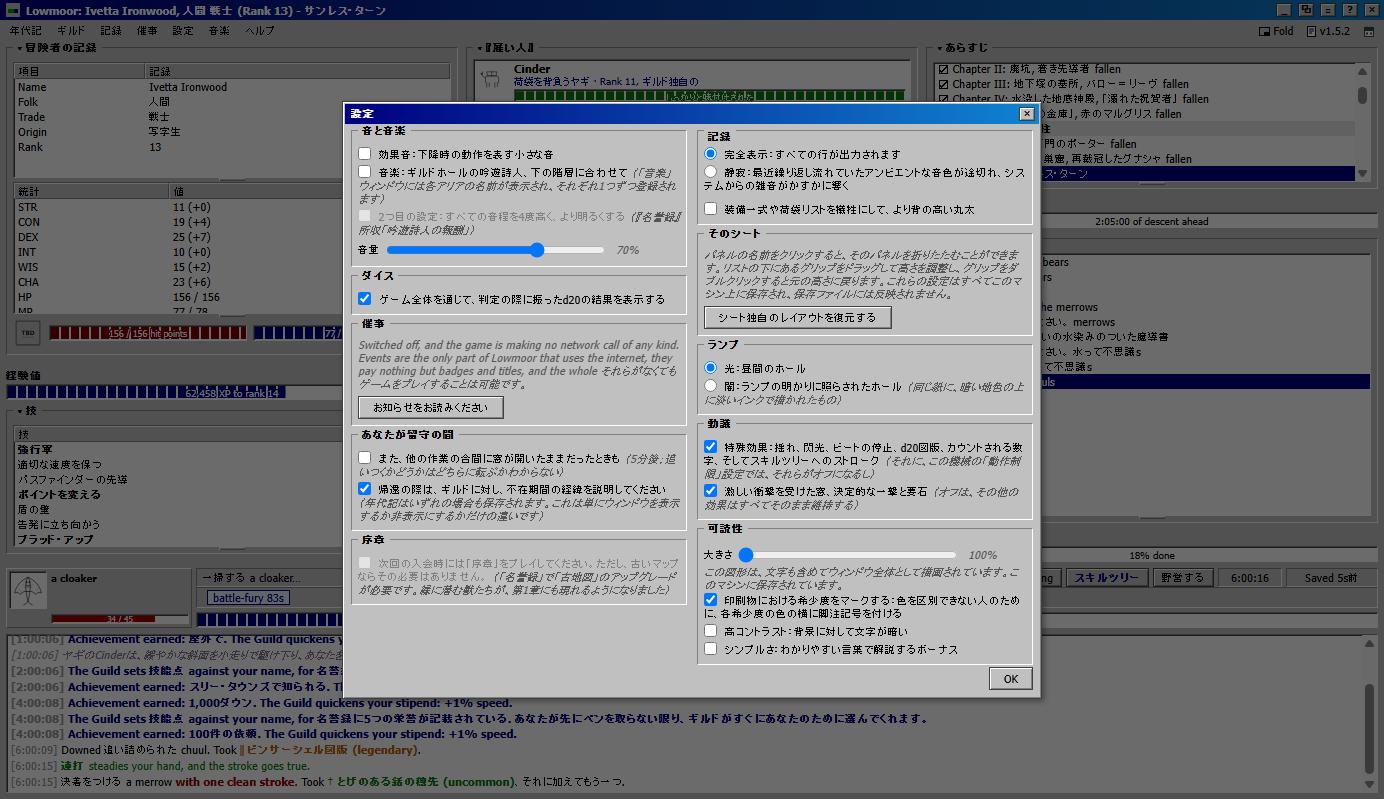
And on privacy: no account, no telemetry, no administrator rights, and zero network traffic until you explicitly accept the Muster Board. Even the store link is documented as assembling a URL on click and fetching nothing.
The undercurrent: the source is a development journal
This may be the game's real hidden feature. Of the JavaScript, roughly 471,904 characters are comments — and not // increment counter either.
They are a design document: why each number is what it is, which features were cut, and what the reasoning was.
Every number carries its justification
The Wain stands at four stages. A fifth was designed, costed at 1,200,000 gold, and struck out on 10 August 2026: the carriage allowance is spent by the fourth stage, so it carried no stone, and what it carried instead was one free round of the three counter blessings at enrolment. That pushed the blessing climb up against a purse that had already paid a fifth of the house.
Cuts keep their reasons
Four feats were rebuilt, each with its failure recorded:
| Cut feat | What was wrong with it |
|---|---|
| First stroke (one guaranteed crit per floor) | Once every few dozen kills; one log line was the whole of the evidence |
| Standing brief (an order on the noticeboard) | It only steered which name got chalked up; the posting filled on any kill regardless |
| A draught (turns aside the floor's first ill) | Ills arrive a few times an hour — a coin flip on whether it ever fired in that chronicle at all |
| The open hoard (the shape of capstone loot) | Built so as to be structurally worth zero gold. A choice worth nothing is a choice nobody makes twice |
Alongside it, a discipline is written down: IDs are save keys, so they are only ever appended, never renamed or inserted. Players who spent prestige on a row keep what they bought; only the row's name and effect changed.
It reports its own balance violations
THE BELL IS OVER THE BUDGET, AND IT IS THE ONE THAT IS. … It is the kind of pace lever the rule below forbids, decided openly with the arithmetic on the table, and written here rather than left for a later reader to discover in the ledger.
Past bugs are fenced off in comments
THE CEILING IS ONE FIGURE AND EVERY SITE READS IT. It was struck as 20 into the row's own max, and into
awayCap, and into the note on the absence report, and into the pension summary, and spelled 24 in the row's own prose. Four struck figures and one spelled one, for a single ceiling: they agree today, but nothing tied them together.
On top of that, the source references a set of home-grown verifiers — for the lexicon, for the charter, an economy simulator, a probe that measures the ladder against real purses, an achievement reconciler — and a set of design documents cited by section number throughout the code.
So this is a free, one-person release that nonetheless carries a specification, a prose style guide, an economy simulator and static verification tooling: a disciplined software project. It is a rare thing — a game that is interesting to play and more interesting to read.
The hand-drawn art carries a rule: no stroke is ever drawn twice
The Guildhouse picture is a single line drawing that gains a layer every time the house is endowed. The comment attached to that drawing table may be my favourite thing in the whole file.
The picture is drawn by a person with a mouse and not by a machine, so the errors in it are particular and not general: one window is square and true and the next never met its sill, the chapel's proportions are spoiled, an arc is two or three failed straight goes, the ground line breaks and picks up higher, and one or two strokes are left standing beside the second attempt that replaced them. What is drawn badly is drawn badly on purpose and in one named place; everything else is drawn as well as the pen can.
And then the conclusion:
Which is why NO STROKE IN THIS TABLE IS DRAWN TWICE. A hand that draws four casks draws four different casks: one round and true with a hoop at each end, one that ran wide and was never shut, one whose pen went round a second time because the first go was wrong, and one plainly worse than the three beside it. A path stamped out and translated is the one error a hand cannot make, and it is the signature of a machine wherever it appears.
One duplicated shape would break the premise that a person drew this — so the check for it is a purpose-built tool rather than a matter of eye.
The same comment keeps a failure it fixed. Depth is carried by stroke weight alone, in three bands: far at 0.8–1.1, middle at 1.2–1.6, near at 1.7–2.1.
For a while, 138 of the 184 strokes stood in the far band and only 8 in the near one, and an endowed yard "read as one grey mass at any distance".
"The figure a licence asks is written once"
Feats have unlock conditions, and that number appears both in the gate and in the prose that describes it.
THE FIGURE A LICENCE ASKS IS WRITTEN ONCE. The figure stood typed in
when()and again inlic()'s prose, so a re-priced licence could leave the row advertising the old mark over a gate that had moved, and nothing in the tool directory could see it.
A record of the most ordinary mistake there is — the same number typed in two places — kept with full ceremony.
The feat that killed itself
The most ironic entry. One feat unlocked by felling weather-specific beasts, and its effect was to make weather beasts you had not yet met appear more often.
It leaned on
LEGACY.everSeen, which never resets, against a world that holds five weather beasts in all, so the feat was dead for good the moment a player had met the five: the licence asks 25 weather beasts felled, which no one reaches without meeting every one of them, and the deed that licensed the feat was therefore the deed that killed it.
The rewrite then read a counter that also counts plates copied in by the Guild Library, so "a player who had endowed the Library carried a feat that had already stopped leaning at enrolment". Both failures are on the record.
"Three is the ceiling and not the payment"
A line about how many rows the away report may carry:
The world twin ran to 98 characters and spent them on a list of the three; it states the count. THREE IS THE CEILING AND NOT THE PAYMENT. Each of the three rows stands only where it has something to name… The rows were left as they are and the count is stated as a ceiling in both voices, since a row printed empty to make the figure true would be three lines of nothing.
An explicit refusal to print filler so that an advertised number comes out right.
What the opening three choices actually change
A word about starting. This is not a walkthrough. Spelling it all out would spoil it, so here is the shape of the system and a few combinations that look like fun.
Each of the three gifts carries exactly one lever
At enrolment you choose folk, trade and origin. There are twelve of each, and every one of them grants exactly one effect.
Human is experience; Hill Dwarf is how fast wounds knit; Wood Elf is travel; Mountain Dwarf is carriage. Among trades, Fighter is attack, Wizard is how often workings fire, Rogue is clean strokes.
Among origins, Scrivener is experience, Poacher is rarity, Pit-hand is carriage, Old campaigner is clean strokes.
So whether your three choices land on the same lever is what gives an adventurer their character. Multiplying levers (experience, gold, travel, hunting, HP knit, mana well, ills, attack, proc rate) compound; adding levers (carriage, crit, luck, wounds, rarity, rest, starting workings, starting gold) sum.
The origin list was built to fill the levers folk and trade left light
This is the elegant part. The source says so outright:
the origin: the life the Guild took you from, chosen at enrolment as a third gift beside folk and trade. Each keeps to a lever the folk and trades leave light, so an origin's gift stacks cleanly rather than piling a fourth hand on the same scale.
Checking it against the tables, that is exactly true. Where folk and trade both already carry a lever (travel, hunting, HP knit, mana well, ills, gold, wounds), the origins take up the ones only one of them carried — experience, rarity, carriage, crit, rest, procs, luck, attack, starting workings.
The result is that almost every lever has exactly one pairing that doubles it. That is not an accident of the tables; it is how they were laid out.
A few ways to open
If you want the colour of the loot to change. Only two gifts touch rarity: the folk Dragonborn (Lapsed) and the origin Poacher.
Stack them and the rarity roll gains a boost — and the mechanism is unusual. The roll walks down a weight table, and anything the boost pushes past the end of the table lands on the second-highest band, Storied. The source puts it plainly: "a boosted roll past the top of the table lands on legendary: the artefact band is never forced, only rolled true or divined up."
Which means the pair takes a few per cent of the drops that would have been perfectly ordinary and hands them to you as Storied pieces from the first floor down. The colour of your early log changes.
If you want to pull the story toward you. Choice events resolve on a d20 ability check, and the "luck" lever is added to the die itself, separately from your ability modifier.
It is carried by the folk Lightfoot Halfling and the origin Dicer. Take both and every check rolled for the rest of that chronicle rides a fixed step higher.
The number is small; what changes is which stories happen to you.
If you want to be hard to put down. Levers top out at two sources — except wounds, which has three: the folk Half-Orc, the trade Barbarian and the origin Foundling.
It is the only lever you can triple, and since it takes a flat amount off every blow, it is felt hardest early.
If you want to carry things. Mountain Dwarf plus Pit-hand.
Carriage matters in an idle game because it decides how often the descent stops to go and sell — quietly one of the most-felt levers there is.
And exactly one pairing that does nothing extra
The trade Warlock (Terms Pending) and the origin Toll-keeper both grant the same gift: CHA checks come one step easier. But the implementation asks only whether any gift eases that ability, so holding both still eases it by one step, not two.
Separately, though, CHA of 14 or more eases CHA checks by another step. So if you want to lean on CHA, taking one of those gifts and rolling the ability up to 14 does more than taking both gifts.
Abilities are straight 3d6, and you may re-roll forever
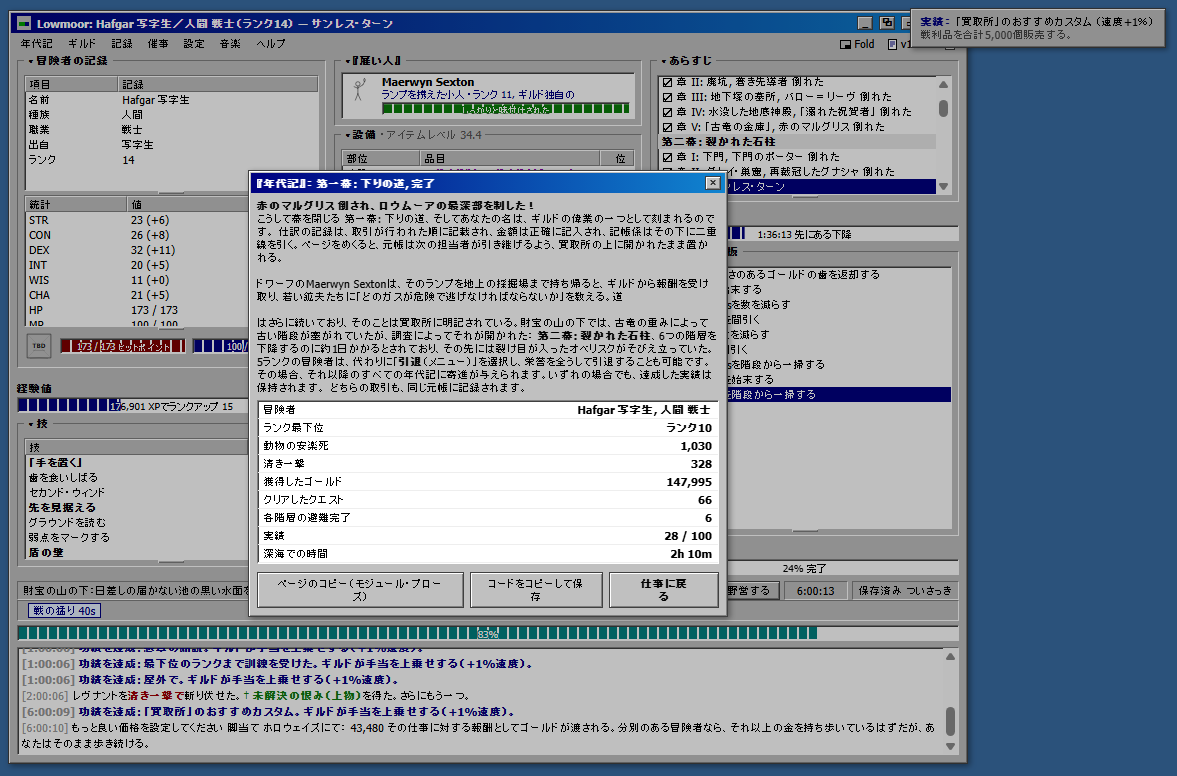
The six abilities are rolled 3d6 each, no arranging. The Roll button on the enrolment screen can be pressed as many times as you like, and the total changes colour on screen once it crosses certain marks (there is a green line, and another above it).
The Roll of Honour carries an upgrade called the examiner's word, and it fills from the lowest ability upward — "a word put in with the examiner is put in where the measurement went worst."
Nothing you pick can spoil the run
One last thing. The governing principle here is "prestige buys rate, the charter buys shape", and the Long Charter — the skill tree — is forbidden from carrying any experience, gold or speed key.
So the opening three choices do not set how fast you go; they set what kind of adventurer gets read about.
Which means no combination is a dead end. Start with a strange one.
Finding the remaining dozen-odd doublings yourself is more fun than being told.
Playing it in Japanese
Lowmoor ships in English only, and given the archaic register described above, even confident English readers will find it heavier going than ordinary prose.
So we built a Japanese localisation kit, free to download from this site. About 93% of the on-screen text becomes Japanese: the enrolment screen, the main sheet, the bestiary, achievements and the dialogues all read in Japanese.
- Ships an 8,856-entry translation memory, a 559-term glossary and 1,005 hand-written overrides
- No game files are included. The kit reads your own legitimate copy and builds the Japanese version locally
- Do not move a chronicle between builds. Neither the file format nor the schema number changed, but saves store folk, trade and equipment-slot names as literal values, so a chronicle begun on the Japanese build breaks if you return to English. Begin on one build and stay there
- Modification, redistribution and porting to other languages are all permitted. No permission, no reporting
- AI-assisted translation is actively encouraged — the kit itself was built with machine translation and AI
- Malicious use is forbidden: carrying malware, harming the author, or using it to deceive anyone falls outside what is permitted
It has been verified in practice. Driving Chrome automatically and capturing every exception and console.error through a full play session produced zero uncaught exceptions, zero replacement characters, zero template expressions leaking onto the screen and a successful save-code round trip, reaching floor 8 and rank 13 across six fast-forwarded hours.
Japanese accounts for 93% of the characters on screen. The verification script ships with the kit, so you can run the same checks after editing the translation.
The first build, incidentally, crashed every time. Equipment-slot names were also used as unquoted object keys in the data tables, so translating only the display side left the lookup undefined and the game died the moment a piece of gear dropped.
A textbook localisation failure, now guarded against in the patcher.
Some strings are deliberately left in English: 980 of them are template literals where JavaScript expressions and prose share one string, which machine translation would break. The patcher would rather leave English standing than print broken Japanese.
Help closing that gap is welcome — see the kit's page for details.
Who it's for
- Anyone who wants something quietly progressing in the corner while they work. The folded strip is an experience this game alone offers
- Anyone tired of dailies and tap-to-progress. This game genuinely asks for nothing
- Readers. There are 179 bestiary entries and a great deal of event prose waiting
- Anyone fond of tabletop RPG atmosphere, or of 90s desktop atmosphere
- Anyone interested in game design itself — the source stands up as reading material
Who might want to skip it
- Players who want the feedback of playing with their hands. There are no controls here
- Players who want spectacle. This is line drawings and text
- Players who want a short arc. Module II's chapters are designed around 30-plus hours each
Game info
A free-to-play title on Steam with single-player, 100 Steam achievements and Steam Cloud support. It asks for Windows 10 64-bit, any dual-core CPU from the last decade, integrated graphics and 4GB of RAM.
Browser and itch.io builds run the same game file.
English is the only supported language — the Japanese localisation kit on this site adds Japanese.