Overview
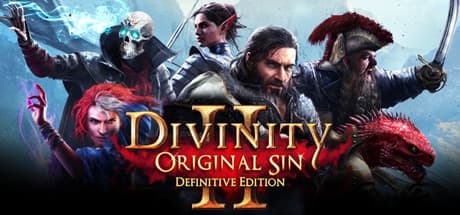
Divinity: Original Sin 2 is a party-based classic RPG (CRPG) from Larian Studios. It launched on September 14, 2017 and was later substantially revised as the Definitive Edition.
You begin as someone imprisoned for carrying the dangerous power of Source, shipped off to a fortified camp. The stated goal is to claim divinity, but most of the actual playing is a chain of immediate problems and how you get around them.
Progression is open-ended. Talk the guard down, bribe him, pickpocket the key, kill everyone, or teleport over the wall entirely.
Nearly every obstacle has several solutions, and each one ties into what happens later. Some players spend dozens of hours just leaving the opening area, because exploration and dialogue branches are that dense.
A full playthrough is commonly reckoned at around 100 hours, and considerably more if you clear side content.
Systems and Mechanics
The biggest thing separating this game from other RPGs is its armour system. Every combatant has physical armour and magic armour, and crowd control such as knockdown, freeze or charm simply does not land until the matching armour is stripped to zero.
You never lose a character to a random to-hit roll, but you do have to budget damage: who gets stripped first, and of which armour, is the tactical question. Losses come from bad party composition far more often than bad luck.
The second pillar is terrain and elemental interaction. Shock a puddle and the electrified area spreads; freeze it and it becomes a slipping hazard.
Ignite oil and it burns outward; poison clouds detonate. Blood and ooze persist on the floor as terrain for the next turn.
Combat becomes less about grinding down HP and more about rebuilding the battlefield. Elevation affects accuracy and range too, so taking the high ground before a fight starts can change its difficulty outright.
On the character side, race (human, elf, dwarf, lizard, undead) and origin change how the world reacts to you. You can pick a pre-written origin character or build your own, and the origins you skip can be recruited as companions.
Undead take damage from healing and recover from poison, so the race alone rewrites your assumptions. Classes are only starting templates; you can respec stats and skills at a mirror at any time, so there is no thirty-hour build regret.
Co-op supports up to four players, and the unusual part is that party goals are not required to align. If players disagree mid-conversation, you resolve it with a persuasion contest, and one player's quest can actively harm another's.
It feels less like cooperating and more like running politics inside one party. A competitive arena and a Game Master mode for running your own scenarios are included as well.
System Requirements
The published requirements are as follows.
| Item | Minimum | Recommended |
|---|---|---|
| OS | Windows 7 SP1 64-bit / 8.1 64-bit / 10 64-bit | Same |
| CPU | Intel Core i5 or equivalent | Intel Core i7 or equivalent |
| GPU | GeForce GTX 550 / Radeon HD 6XXX or higher | GeForce GTX 770 / Radeon R9 280 |
| RAM | 4 GB | 8 GB |
| Storage | 60 GB | 60 GB |
| DirectX | Version 11 | Version 11 |
These were written against launch-era hardware. A GTX 770 or R9 280 is a bar that modern integrated graphics clear comfortably, so on any PC bought in the last few years, GPU power is not what will hold you back.
The CPU is the more likely bottleneck: late-game and large fights add enemies and summons, and turn-processing waits depend on single-thread CPU performance more than on the GPU. Since the camera sits pulled back in an isometric view, stable frame delivery and short loads matter more to how it feels than pushing resolution.
RAM lists 4 GB as the minimum, but with a modern Windows desktop and a browser open, 8 GB is the practical floor. The easily overlooked line is storage: 60 GB free is listed for both minimum and recommended, so there is nothing to trim there.
The game also transitions areas and autosaves frequently, so simply installing it on an SSD rather than an HDD noticeably cuts load friction. Save files pile up quickly once you start testing branches or replaying, so leave headroom.
What Players Praise and Criticize
Years after release, user sentiment remains very strong. Praise tends to land in the same places: solutions are never single-track, the world reacts properly to player mischief, and each fight works as a fresh puzzle.
Details like the talent that lets you speak to animals, or entering town as an undead with your face covered, keep producing new discoveries on replays. Many players also note that the later story improved once full voice acting and heavy rewrites arrived with the Definitive Edition.
Criticism is just as consistent. The most common complaint concerns mid-game difficulty and information load: the second act in particular runs several quests in parallel across a huge map, and wandering into over-levelled enemies can wipe a party without warning.
Next is inventory management, which eats real time across gear updates, crafting materials and consumables for four characters. A long-standing note is that the final stretch is not as dense as the first two acts.
In short, admirers and detractors are describing the same trait — extreme density — from opposite sides.
Who It's For
- Players who treat turn-based combat as a problem to solve each time, not a chore
- People who would rather break a quest with a route they found than follow the intended path
- Anyone comfortable sinking long hours into a single game without abandoning it midway
- Groups who want a long campaign with friends, disagreements included
- Players chasing a tabletop "you can try anything" feeling in a single-player game
It suits people who respond to a defeat with "my composition and opening were wrong" rather than "I got unlucky." Failures here almost always trace back to a player decision, and there is always room to diagnose and fix them.
Caveats and Who Should Skip It
Skip it if you cannot commit time. Roughly 100 hours to finish is the usual estimate, and single fights can run past thirty minutes.
It does not fit a "half an hour tonight" habit, and if you step away for a while it is hard to remember what you were doing and pick the thread back up.
Skip it if you want to be led by the hand. Quest markers are sparse, and you are often expected to work out destinations from place names and dialogue notes.
Level guidance is minimal, so you frequently learn an area was too strong only after arriving. If the opening feels unfair, lowering the difficulty is a legitimate move — the story and branching are not reduced at all on the easiest setting.
Conversely, harder modes exist for players who want to push the crowd-control arms race, including one that locks you to a single save.
Know that the armour system may not suit you. Splitting your damage dealers between physical and magic tends to leave both armour bars half-stripped so no status effect ever lands.
The standard advice is to commit the party to one damage type, which runs against the instinct to build a balanced team, and a fair number of players bounce off exactly here.
Inventory and loot handling take patience. If sorting and selling feels like a tax, learn early to simply not pick things up.
On language support: available languages can differ by title and by when you buy. Check the store page's supported-languages table before purchase, including whether interface, audio and subtitles are each covered.
Store listings (languages, included content, edition differences) can change after an article is written, and the store display is authoritative if they disagree. On titles where similarly named editions sit side by side — the base game versus the Definitive Edition — confirm the title text and included content at the top of the page before buying.
Getting Started
The opening fortress is a tutorial and a difficulty spike at once. Rather than rushing the major encounters, level up through conversation and exploration first.
Level difference maps directly onto accuracy and damage here, so even one or two levels changes the shape of a fight. If an enemy feels impossible, that is a signal it is not your fight yet.
For skills, securing a Teleportation effect early changes how you read the world: pulling unreachable chests toward you, isolating enemy backline units, lifting an ally onto high ground. It never stops being useful.
Also designate one party member as your talker and invest their persuasion-related stat, then always let that character run conversations. Concentrating it on one character opens far more dialogue options than spreading it thinly across four.