Game Overview
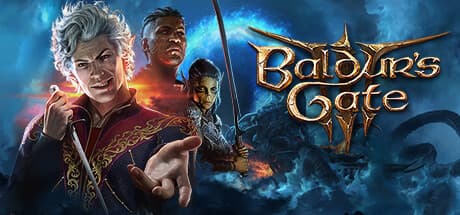
"Baldur's Gate 3" is a party-based RPG from Larian Studios, released in August 2023. It is set in the world of the tabletop RPG "Dungeons & Dragons," and its combat and skill-check rules are built on the 5th Edition ruleset.
Play alternates between two layers: in the field you move in real time to explore, talk, and steal, while combat switches to turn-based rounds resolved in initiative order. Persuasion attempts, trap disarming, and similar checks roll a d20 against your character's ability scores, so replaying the same scene does not guarantee the same outcome.
The story is divided into three acts, and both the setting and the balance of power between factions shift as the acts progress. A single playthrough commonly runs from several dozen hours up to the 100-hour range, so this is a game built for a long commitment.
Equally, it is not something to pick up when you want to reach a stopping point in an evening.
Where the Hours Actually Go
Knowing how the time is spent keeps expectations aligned. In practice, the two biggest slices are not fights themselves but the setup before them and the conversations around them.
Reading enemy placement, claiming high ground, handing out consumables, and arranging who acts first is effectively half the combat. Conversations branch heavily too, and it is common for a single settlement to eat well over half an hour.
That pace is a design choice, not a defect. Still, the distance you cover in an hour looks far shorter than in an action RPG, and players who need a sense of forward motion tend to feel that most in the opening hours.
Features and Systems
The core of this game is how systems multiply against each other. Cast lightning into a puddle and the shock spreads; set fire to oil and it burns outward.
Kick an enemy off a ledge and fall damage applies — and the same can be done to you. Because these interactions are resolved numerically rather than cosmetically, tactics can regularly overcome a level disadvantage.
Your party holds up to four characters including yourself. Each companion carries an independent agenda and history, and certain companions can be selected as "origin characters" to play as the protagonist.
Who you place at the center changes the dialogue options available in the very same scene.
Character creation uses D&D 5th Edition classes and races, and multiclassing lets you stack levels from a different class on each level-up. Builds range from pure melee to spell- and skill-check-focused setups, and the tools each class offers for recovering from a failed check differ meaningfully.
Another defining trait is that the story is designed around failure. Failing a persuasion or losing a companion usually does not end the game; instead it routes you onto a different branch that accounts for what happened.
That relative absence of "reload or lose out" pressure is unusual for this genre.
System Requirements Explained
The requirements listed on Steam are as follows.
| Item | Minimum | Recommended |
|---|---|---|
| OS | Windows 10 64-bit | Windows 10 64-bit |
| CPU | Intel I5 4690 / AMD FX 8350 / Snapdragon X Elite | Intel i7 8700K / AMD r5 3600 |
| GPU | Nvidia GTX 970 / RX 480 / Intel Arc A380 / Qualcomm Adreno X1 (4GB+ VRAM) | Nvidia 2060 Super / RX 5700 XT / Intel Arc A580 (8GB+ VRAM) |
| RAM | 8 GB | 16 GB |
| Storage | 150 GB | 150 GB |
| DirectX | Version 11 | Version 11 |
Given that the minimum GPUs — GTX 970 and RX 480 — are 2015-2016 era parts, the absolute bar is not high by modern AAA standards. Do not overlook that the recommended tier moves up to 8GB or more of VRAM, though.
On a 4GB card you should plan on lowering texture quality.
Memory and storage deserve the most attention. The 16GB recommendation should be taken at face value for a game of this type; on 8GB you will likely need to close other applications.
Storage is listed at 150 GB with an explicit "SSD required" note. HDD installation is not assumed, so confirm not only that you have the space but that the destination drive is an SSD.
Since 150 GB takes a serious bite out of a single SSD, checking free space before buying is effectively mandatory.
On the CPU side, the recommendation of an i7 8700K or Ryzen 5 3600 sets a six-core generation as the baseline. Turn-based or not, late-game encounters add more enemies and NPCs, stretching per-turn processing, so the CPU can matter more than the GPU there.
A build pairing a new GPU with an older quad-core CPU is the classic case that runs fine early and drags in the final act. If you are deciding which part to upgrade first, this game specifically argues for the CPU.
What to Turn Down First
There is an order to easing the load. Shadows and volumetric effects give back the most while changing the look the least.
Texture quality comes next, and it matters most on VRAM-limited cards — on a 4GB GPU, dropping textures one step is usually more stable than dropping resolution.
Late-game slowdowns, by contrast, are frequently CPU-side, and lowering image settings will not meaningfully shorten turn resolution there. Confusing the two leads to the familiar "I set everything to low and nothing improved" conclusion.
Exact gains vary by system, so treat this as an order of operations to test one at a time rather than a table of expected numbers.
Reviews and Reception
The game has held a very high standing on Steam over a long stretch since release. This is not a title that spiked on launch attention and faded; its standing has stayed level as time passed.
For the current picture, check the rating panel on this page or the store listing.
Positive impressions tend to highlight that choices genuinely propagate to the ending, the depth of the companion writing, and surprise that improvised, unconventional solutions usually work. Critical impressions tend to raise that branch handling grows heavier and rougher toward the endgame, that combat difficulty depends heavily on how well you understand your gear and spells, and that the numbers are hard to read without D&D familiarity.
These are less flaws than the flip side of the design. The more genuinely choices propagate, the more branches exist — and the more branches exist, the less uniformly polished their far ends will be.
The more faithfully the ruleset is reproduced, the more numbers a newcomer has to parse. Neither is the kind of problem that cutting content would fix.
About Co-op
Online co-op is supported, with each player controlling their own character through the same story. The catch is that conversational control tends to concentrate on one person.
Unless you decide in advance who handles negotiations, someone will spend long stretches watching dialogue.
Exploration also allows players to split up, so mismatched pacing creates waiting time at rejoin points, and one player clearing story beats alone leaves the other missing context. Treat it as a game built for partners who can commit to the same block of time.
For people who have such a partner, the sheer volume of dialogue turns into the main attraction.
How It Differs From Neighboring Genres
Even among turn-based games, this sits far from tactics titles like the XCOM line. There, optimizing combat itself is the subject; here, conversation, exploration, and companion relationships take up as much time as fighting or more.
Buying it for the battles alone means being surprised by how much of the runtime is spent not fighting.
If you have played the studio's earlier CRPG lineage, environmental interaction and elevation will feel familiar. What changed is that aligning with D&D 5th Edition reshaped action economy and resource management.
Charging in with the previous game's instincts is why many players stumble over spell slot budgeting early on.
Getting Started
Early-game trouble almost always traces to two habits. The first is pushing forward without resting.
Long rests are a resource, but they are also the trigger for companion conversation scenes — hoarding them skips major story beats outright. The second is trading blows head-on without using terrain and elevation.
Take the high ground, spread oil or water, shove enemies off ledges: those three habits alone visibly lower early difficulty.
If you are unsure about class selection, keep at least one character built to recover from failed checks. Without someone invested in lockpicking and trap disarming, the rewards available from exploration shrink noticeably.
It is also worth avoiding an aggressive multiclass plan on a first run — splitting levels before you understand each class's baseline makes it impossible to tell which choice is actually working.
Who It Suits
- Players looking for an RPG where dialogue choices leave marks on later events
- Players who enjoy sitting down and thinking through turn-based combat (no action reflexes required)
- Anyone curious about D&D or tabletop play — no rules knowledge is needed, but knowing them makes dice checks immediately legible
- Players who want one game to last, since changing race, class, and companions substantially changes what you see
- Friends who can reliably play in the same time slot and want a long-form cooperative campaign
Caveats and Who Should Skip It
The first issue is pace. Being turn-based, a single fight routinely takes tens of minutes, and conversations run long.
If you want brisk progress or short sessions, this is a poor fit. Whether you can reliably set aside at least an hour per session is the real suitability test.
The second is information density. Spells, status effects, saving throws, and gear-specific effects all resolve at once, so through the early and middle game it is easy to lose a fight without understanding why.
If you do not habitually read combat logs, this will be a source of friction — and if you enjoy parsing them, this is among the best options available.
The third is the temptation to reload. The story continuing past failure cuts both ways: it asks you to live with outcomes you did not want.
Players who cannot stand missing the optimal result will save-scum, and the pacing collapses under that. This game rewards players willing to carry some failures forward.
The fourth is the storage requirement. 150 GB plus a mandatory SSD is enough to require planning on laptops or small-SSD builds.
Running out of room after purchase is the single most common misstep here, so verify both free space and the drive type first.
Finally, check the store page before buying for the current state of Japanese language support and for the scope of the violent and sexual content. This is a title tagged with sexual-content, and that matters depending on who shares the screen with you.
Pre-Purchase Checklist
- Is the install target an SSD with 150 GB free?
- Does the GPU have 8GB or more VRAM (and if it is a 4GB card, are you fine lowering settings)?
- Do you have 16 GB of RAM, or can you close other apps on 8 GB?
- Is the CPU a six-core generation or newer (this shows up as late-game turn waits)?
- Can you set aside an hour or more in one sitting?
The first four are hardware questions, but the last one is the hardest to work around. Parts can be upgraded later; a schedule cannot.