Overview
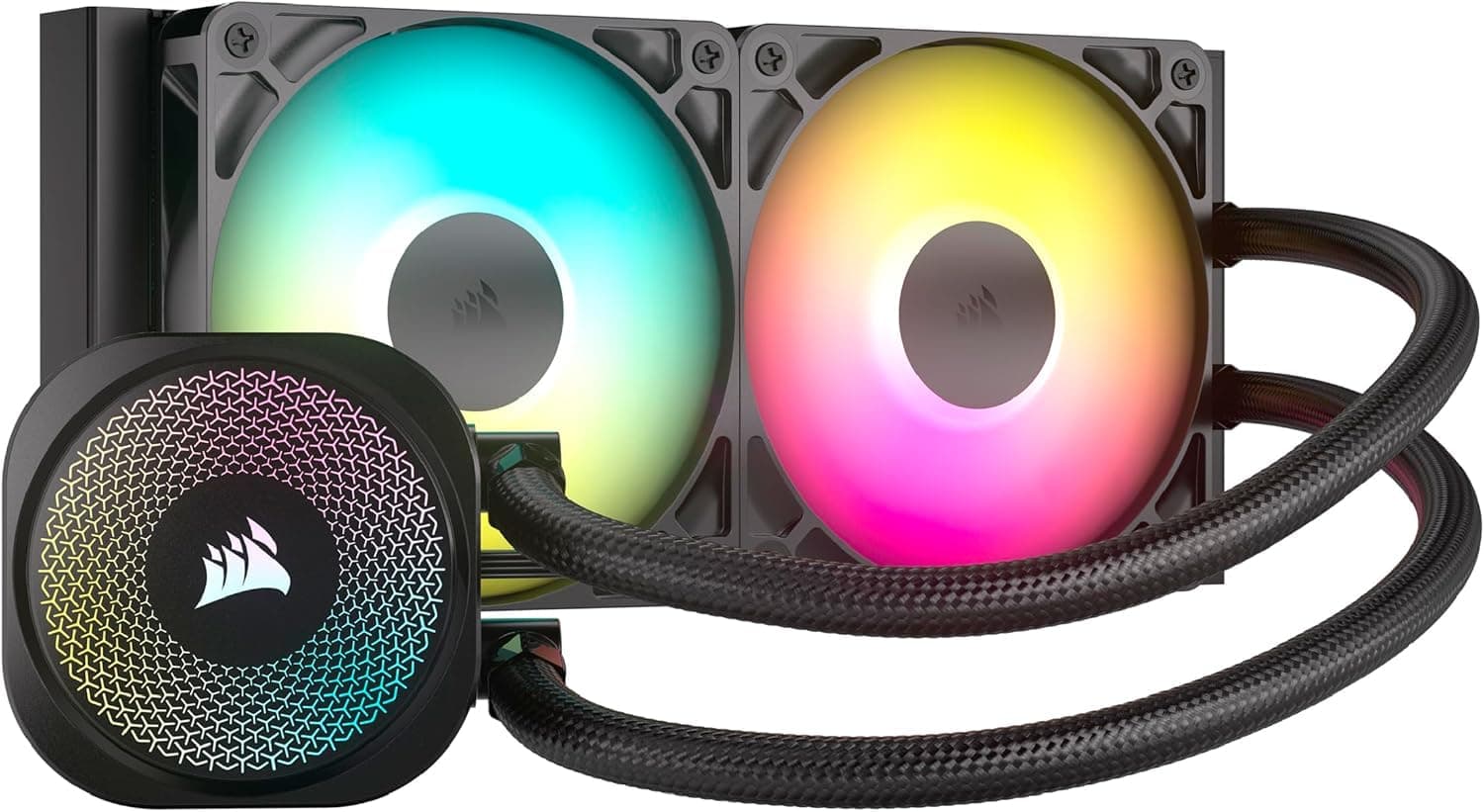
The CORSAIR Nautilus 240 RS ARGB is a 240mm all-in-one liquid CPU cooler. The short version: its real selling point is not raw thermal headroom but the combination of a 20 dBA pump and daisy-chained fans that plug straight into the motherboard.
There is no proprietary controller in the chain — one 4-pin PWM header and one +5V ARGB header, and you are done. That makes it a forgiving first AIO.
The flip side is equally clear. If you want per-fan software control or an LCD pump head as a centerpiece, this is not that product.
It is a straightforward, easy-to-live-with mid-range 240mm AIO.
Quick Fit Table
| Intended use | Fit | Why |
|---|---|---|
| Quiet mid-tower build | Excellent | 20 dBA pump, 36 dBA fans at full tilt |
| Ryzen 7000/9000, Core Ultra 200 daily use | Good | Native LGA1851 and AM5 support |
| Sustained overclocking under full load | Fair | 240mm radiator area becomes the ceiling |
| Small form factor cases | Fair | Radiator mounting space must be verified |
| Per-fan control from one software suite | Poor | No dedicated controller by design |
The table is directional. What follows is why each row lands where it does.
Compatibility Guide
Supported sockets are Intel LGA 1851 and LGA 1700, plus AMD AM5 and AM4. That covers Core Ultra 200 series, 12th–14th gen Intel, and both current and previous-generation Ryzen desktop platforms.
Anything outside those four — LGA 1200 and older, or HEDT sockets like sTRX4/sTR5 — is not supported. If a platform upgrade is on your roadmap, check that the next board stays inside this list.
Electrically there are two paths. The pump goes to a motherboard header (CPU_FAN is the normal choice), and both fans daisy-chain into a single 4-pin PWM header, with ARGB likewise collapsing into one +5V 3-pin header.
In practice that means two PWM headers and one ARGB header. Budget B-series and A-series boards sometimes ship with only three or four fan headers, so count them before you build if you already run extra case fans.
Also confirm the ARGB header is 5V 3-pin — boards that only offer 12V 4-pin RGB cannot drive this cooler.
On physical clearance, a 240mm radiator with fans attached typically lands around 28 cm wide plus a few centimetres of thickness; check the product page for exact figures. Most mid-towers with a dual-120mm mount in the front or top will take it, but top mounting is where builds go wrong — VRM heatsinks and tall DDR5 heat spreaders eat the gap.
Front mounting eases tube routing but competes with 3.5-inch bays and the intake path.
Cross-check two things in your case spec: supported radiator size and maximum radiator thickness at the top.
Installation itself is simple because thermal paste comes pre-applied to the convex cold plate. Remount it, though, and you will need to reapply — keep a spare tube on hand.
Product Info
Key specs: liquid cooling, 240mm radiator, two 120mm fans, up to 2100 RPM, 36 dBA fan noise, 20 dBA pump noise. The RS120 ARGB fans use AirGuide technology and magnetic dome bearings to hold static pressure while keeping noise down.
Read those numbers carefully. 36 dBA is the flat-out figure, not the everyday one. Under gaming or encoding loads your fan curve keeps RPM well below maximum, so perceived noise is lower.
The 20 dBA pump, by contrast, runs at a near-constant level regardless of load. Whether that steady low hum bothers you at night is the real deciding factor.
On pricing: ¥20,877 including tax at Amazon.co.jp as captured on 29 May 2026, and $71.20 on eBay US as captured on 9 July 2026.
Both are point-in-time values that move with sales and exchange rates — always confirm the current price on the listing. That puts it mid-range for a 240mm AIO: above dual-tower air coolers, clearly below LCD-equipped flagship AIOs.
User rating sits at 3.9 out of 5 (78% positive) — from just 5 reviews.
That sample size supports no meaningful conclusion about reliability. Choose on specs and fit, not on the star average.
Warranty is the manufacturer's standard 5 years, which matters more than usual here: an AIO contains a pump, a moving part that degrades with time.
Competitive Comparison
In the same class you will weigh higher-end 240mm units such as the ASUS ROG Ryujin III 240 with its 8th-gen Asetek pump, or CORSAIR's own iCUE LINK Titan 240 RX. What separates the Nautilus is that it needs no hub or proprietary controller.
iCUE LINK rewards you for buying into the ecosystem; the Nautilus simply coexists with whatever third-party case fans and ARGB gear you already own.
Air cooling deserves a look too. Dual-tower coolers like the Thermalright Peerless Assassin family cost clearly less and have no pump to fail.
In mid-to-high sustained loads, a 240mm AIO and a top dual-tower air cooler are genuinely competitive. You still pick the AIO for the clear space around the socket, the ability to dump heat straight out of the chassis, and the look.
If pure value is the goal, air wins.
Want more headroom? Step up to 360mm — but that raises the demands on your case considerably, so choosing 240mm because it actually fits is a perfectly sound call.
Best Use Cases
- Quiet-build enthusiasts — a 20 dBA pump and a 36 dBA ceiling suit anyone who does not want to notice their PC while working. Soften the fan curve and everyday noise drops further.
- New LGA 1851 / AM5 builders — native support means no extra mounting kit for Core Ultra 200 or Ryzen 9000 systems.
- Anyone who wants simple cabling — one fan cable and one ARGB cable keeps the back of the tray clean, even on a first build.
- Buyers who weigh warranty — five years is real insurance on a product with a pump.
- Builds with tall RAM or large GPUs — no big heatsink over the socket means fewer clearance fights.
Before You Buy
Start with the review count: five. A 3.9 average at that sample size can swing on a single bad unit.
Treat long-term failure rates as unknown at this point, and buy from a seller whose return process you would be comfortable using in the first weeks.
Mismatched ARGB headers are among the most common AIO mistakes. This cooler wants a +5V 3-pin header.
Plugging it into a 12V 4-pin RGB header will not just fail to light — it can damage hardware. The connectors look similar, so read the silkscreen on the board.
If you are short on headers or the standard differs, budget for a proper splitter or hub.
Radiator placement is the classic post-purchase surprise. Plenty of cases advertised as "240mm compatible" support it only at the front, with a single 120mm slot up top.
For top mounting, check clearance against RAM and VRM heatsinks; for front mounting, check tube routing against drive bays. Compare against real photos of the case interior.
Do not assume an AIO always beats air. A 240mm radiator is not generously sized for a high-end CPU held at full load for hours.
For stock-clocked and gaming workloads it is fine; for sustained all-core work, look at 360mm.
Calibrate your software expectations. Direct motherboard connection means control lives in your UEFI or board utility.
If you want independent per-fan curves managed in one unified suite, an ecosystem product will satisfy you more.
Finally, listing metadata itself is sometimes wrong. Manufacturer names, model numbers, ASINs, and even prices occasionally point at a different product.
When you open the listing, confirm the product image, title, and spec table all describe the same cooler, and ask the seller before buying if anything looks off.
FAQ
Q. Will it fit LGA 1200 or older Intel CPUs? A.
The listed sockets are LGA 1851, LGA 1700, AM5, and AM4 only. Assume anything else is unsupported.
Q. How many motherboard headers do I need? A.
Two 4-pin PWM headers (pump and the daisy-chained fans) and one +5V ARGB header. Leave room for case fans on top of that.
Q. Do I need to buy thermal paste? A.
No — paste is pre-applied to the convex cold plate. You will need to reapply if you ever remount the block.
Q. How quiet is a 20 dBA pump in practice? A.
Quiet on paper, but it is a steady tone that runs regardless of load. Expect it to blend into case-fan and GPU noise, and to be audible in a near-silent room.
Q. Should I choose 240mm or 360mm? A.
Go 360mm if your case takes it comfortably and you run long, heavy loads. Otherwise 240mm balances fit and noise without leaving you short.
Q. What is the warranty?
A. Five years from the manufacturer — meaningful coverage for a product with a pump inside.