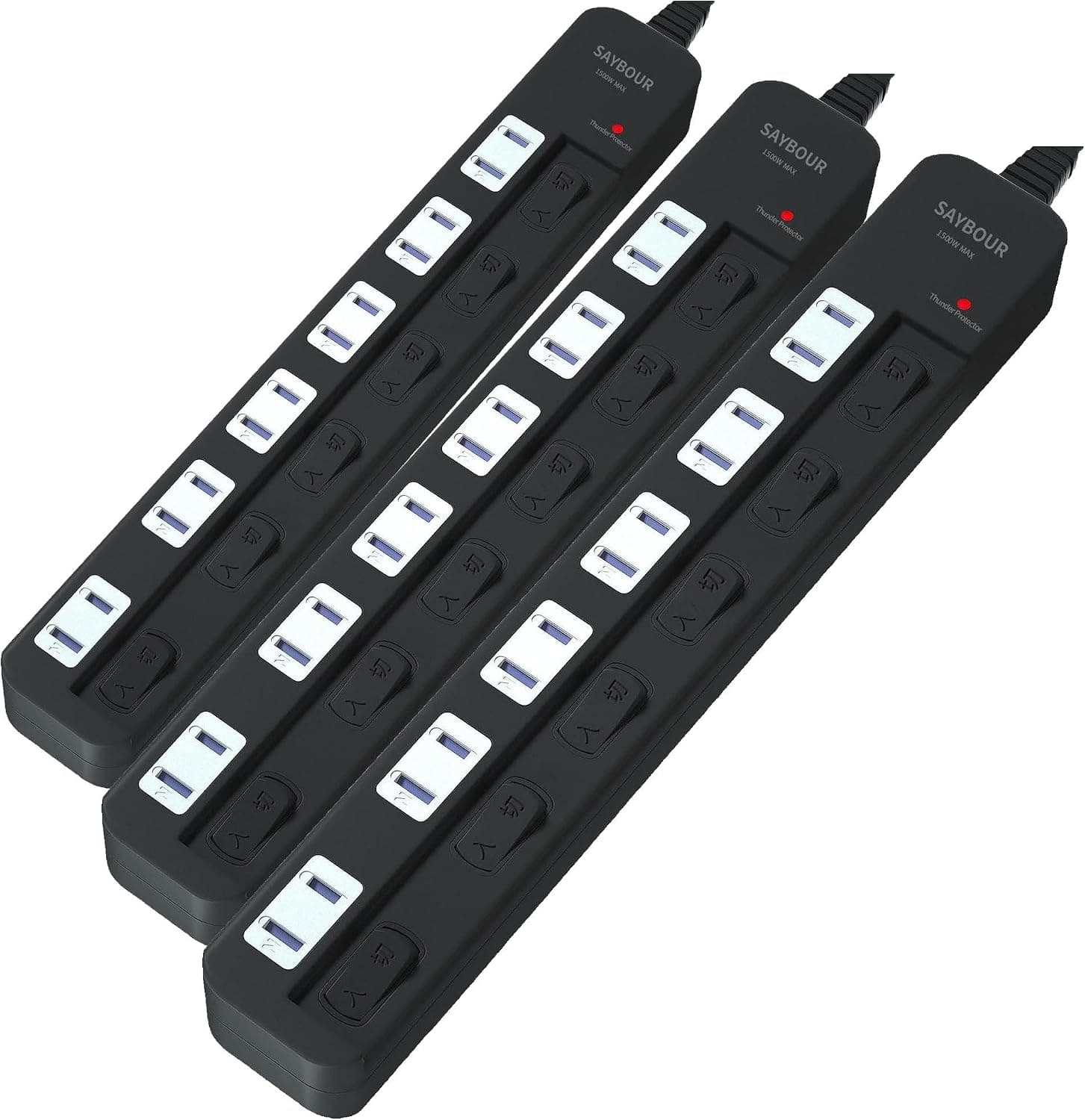
The Sanwa Direct 700-TAP036 packs seven outlets, a 5-meter cord, 3-pole grounded plugs, surge protection, magnets and a master switch into one strip. This article goes past the spec sheet and into what actually trips people up.
Overview
Here is the conclusion first. If your wall outlet is far from your desk and you want to tidy cabling around a steel desk or rack, this is an easy recommendation.
If you want just one strip, or you expect the master switch to kill all seven outlets, it is not for you. Two reasons: the "(× 4)" in the listing title indicates a four-pack, and the master switch controls only five of the seven outlets — the other two are always live.
Reception is solid. As of the data captured on 27 May 2026, Amazon.co.jp showed 204 reviews averaging 4.4 out of 5, roughly an 88% favorable score.
For a power strip, 204 reviews at 4.4 means nothing fundamental is wrong with the build.
It also means the compromises below — the two always-on outlets, the limits of magnet mounting — are real.
Key Points First
| Item | Value | How to read it |
|---|---|---|
| Outlets | 7 | Enough for a PC, two monitors, speakers and chargers |
| Cord length | 5 m | Reaches across a room; too long for short runs |
| Plug type | 3-pole | Grounded; a 2-pole wall outlet needs an adapter |
| Surge protection | Yes (varistor) | For induced surges; not direct strikes |
| Master switch | Yes (5 outlets) | Two outlets stay live — the biggest caveat |
| Magnets | Yes (2 points) | Steel only; useless on wood or aluminum |
| Swing plug | Rotates 180° | Helps in tight gaps behind furniture |
| PSE certification | Obtained | Meets Japan's electrical safety law |
The table looks like an everything-included product, but what decides day-to-day usability is the switch coverage and the cord length, not the outlet count. If three or more devices must stay powered at all times, this switch layout will fight you.
Compatibility Guide
The electrical baseline: this strip targets Japanese AC100V outlets (50/60 Hz) and uses a 3-pole plug. If your wall outlet is 2-pole, it will not fit directly.
A 3-to-2 adapter makes it physically fit, but the moment you convert, grounding is lost. Connect the adapter's ground wire to a wall ground terminal — often found on air-conditioner outlets or outlets near water.
Running ungrounded means neither the surge protection nor leakage safety behaves as designed.
The strip's own sockets accept ordinary 2-pole plugs as well, since the third pin is the ground. The anti-slip socket design means some plugs need a slight twist to seat.
That is by design, and it keeps plugs from being yanked out by a stray foot — but it also makes the strip a poor choice where you need to pull a plug fast in an emergency.
On total load: Japanese power strips are conventionally designed around a 1500 W (15 A) ceiling, but the rated figure for this model is not in the supplied specification data, so check the product page. As a rough guide, a desktop PC (roughly 200–400 W in real use) plus two 4K monitors (roughly 30–60 W each) plus speakers and chargers leaves headroom.
Heat-producing appliances — microwaves, hair dryers, kettles, kotatsu, oil heaters — routinely exceed 1000 W on their own and should never go on a strip like this.
Physical fit matters too. Five meters usually means surplus cord, and leaving that surplus tightly coiled while under load is the one habit to avoid, because coiled cable traps heat.
Lay it in a loose figure-eight or run it through a cable tray. The two magnets attach to steel desk legs, rack uprights and steel drawer sides; on a wooden top or an aluminum frame they do nothing, so plan on hook-and-loop straps or a tray instead.
The 180-degree swing plug earns its keep when furniture sits flush against a wall — with only a few centimeters of clearance, that mechanism decides whether the strip fits at all.
PC-style compatibility (CPU socket, memory standard, PCIe generation) does not apply to a power strip. Only four checks matter: outlet shape, grounding, total wattage, and the material of the mounting surface.
Product Info
The seller is Sanwa Direct, the official store of Sanwa Supply. The referenced Amazon.co.jp price was ¥8,320 as captured on 27 May 2026.
Prices move often and can drop further during sales, so confirm the current figure on the product page before buying — the number here is a snapshot, not a guarantee.
What matters is that this price appears to cover a four-pack, as the "(× 4)" in the title suggests, not a single unit. If so, that works out to roughly ¥2,080 per strip, which is a fair rate for seven outlets, a 5 m cord, surge protection, magnets and a master switch.
The flip side: if you need one strip, you end up storing three. Verify the pack quantity before ordering.
The other reference source, eBay, returned only a search link with no price.
The strip carries PSE certification under Japan's Electrical Appliance and Material Safety Act. Warranty coverage centers on initial defects.
Surge protection is varistor-based; clamping voltage and maximum surge current are not present in the supplied data. Such figures are frequently undisclosed in this category, so treat it as ordinary household-grade protection against induced surges.
How It Compares
The closest match on "5 m cord plus magnets" is Panasonic's grounded 15 A anti-slip OA tap in the 4-outlet configuration (WCH2454H). That one drops to four outlets and has no switch, but comes from a wiring-devices maker with a reputation for rugged builds.
The choice is outlet count versus switching versus brand assurance. Seven-plus devices and a desire to cut power in one motion favors the 700-TAP036; a setup already covered by four outlets favors the simpler model.
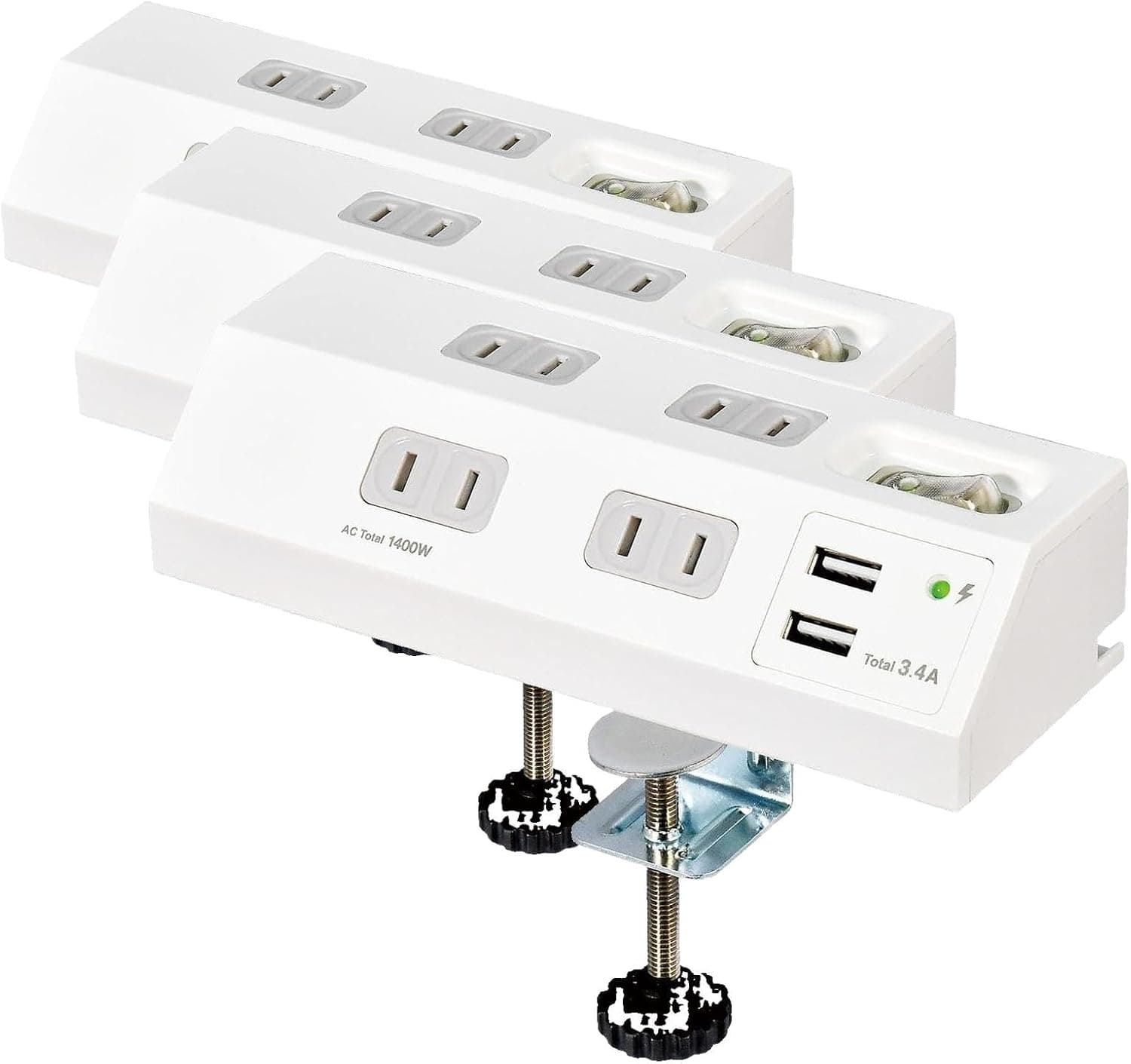
If desk-surface handling matters more, a clamp-mounted strip with built-in USB ports (such as ELPA's desk tap) is worth considering. The 700-TAP036 has no USB ports, so phone and earbud charging costs you one outlet for a USB charger — meaning your effective outlet count is under seven.
One caution: the "power strip" category mixes in North American products. Anything labeled 1625 W, ETL listed, or using NEMA plugs is built for 120 V North American wiring and is not intended for Japanese wall outlets.
Filter for regional spec first, then compare features.
Installation and Cable Routing
The practical problem is what to do with five meters of cord. The approach that works: run it from the wall along the inside of a desk leg, fix the strip with the magnets, and park the surplus in a cable tray under the desk.
Cord on the floor snags vacuums and robot cleaners, which stresses the strip even with anti-slip sockets. Lifted off the floor, cleaning is a single pass.
On a standing desk, leave enough slack that raising the top does not pull the cord taut. Five meters helps, but if you anchor the slack too tightly the cord tensions at full height and peels the magnets off, dropping the strip.
Raise the desk to its highest position first, then decide where to fix everything.
Plan the switch assignment as well. Devices that must stay on — router, NAS, recorders, Wi-Fi access points — go in the two unswitched outlets.
Devices you want fully off overnight — monitor, speakers, printer, desk lamp — go in the five switched outlets. Skip this step and you will eventually kill a NAS mid-write with the master switch.
Best Use Cases
This strip suits:
- Anyone whose wall outlet sits far from the desk and who would rather not stack an extension cord and a strip. Five meters spans most rooms diagonally.
- Setups that have reached six or seven peripherals — desktop, monitors, speakers, printer, chargers. Spare outlets mean no second strip when you add gear later.
- Steel desks and steel racks, where the two magnets keep the strip off the floor and cleaning simple.
- Equipment with grounded plugs — some PC PSUs, professional gear, metal-chassis audio — that you want to plug in without an adapter.
- People outfitting several rooms or sites at once; the four-pack format is an advantage when you were buying in bulk anyway.
- Anyone cutting standby draw at bedtime or when leaving home — provided no more than two devices need constant power.
Things to Check Before Buying
1. The master switch does not cover all seven outlets. It controls five; two stay live.
If "master switch" made you expect an all-off button, you will be disappointed. If you always have something that must stay powered, the two live outlets are actually the sensible design.
For guaranteed all-off, look for a fully switched or per-outlet model instead.
2. It is a four-pack. Missing the "(× 4)" changes how the price reads entirely.
The referenced ¥8,320 looks steep for one strip but works out to about ¥2,080 each across four. Match the pack size to what you actually need first.
3. Do not over-trust the surge protection. Varistor-based protection targets induced surges from nearby lightning, not direct strikes.
Varistors also degrade every time they absorb a large surge, and the degradation is invisible. In lightning-prone areas, plan on replacement every few years, or pair genuinely important gear with a UPS.
Surges arriving via LAN or coaxial cable are not stopped by a mains-side surge protector at all — an easy thing to overlook.
4. Magnets are not universal. They will not hold on wooden tops, aluminum frames or plastic racks, and even on steel, thick paint or dust cuts holding force.
Filling all seven outlets with heavy plugs and AC bricks adds weight and leverage, so when mounting vertically, arrange things so nothing delicate sits underneath.
5. No high-draw appliances. Microwaves, hair dryers, kettles, kotatsu, oil heaters and space heaters do not belong on this kind of strip.
Exceeding total capacity leads to heat, deformation and, at worst, fire. Keep it to PC peripherals and AV gear.
6. Listing metadata can disagree with itself. In the referenced pricing data, the seller label read "Amazon US" while the link pointed to Amazon.co.jp with a yen price.
Mismatches like this happen during automated collection. When you open the product page, confirm with your own eyes that the seller, model number, pack quantity and photos all line up before you press buy — especially the pack-quantity-to-price relationship, since getting it wrong shifts your sense of the cost by 4×.
7. If you do not need 5 m, it is a downside. With the outlet right beside the desk, you now have four-plus meters of cord to hide.
For runs of one or two meters, a shorter model ends up tidier.
FAQ
Q. Can I use it in a room with only 2-pole outlets? A.
Yes, with a 3-to-2 adapter — but grounding is lost at that point, so connect the adapter's ground wire to a wall ground terminal. Ungrounded, neither the surge protection nor the safety behavior works as designed.
Q. Does the master switch cut all seven outlets? A.
No. It controls five; two are always live.
Assign devices you never want cut — router, NAS — to those two.
Q. What is the total wattage limit? A.
The rated figure is not in the supplied specification data, so check the product page. Japanese strips are conventionally designed around a 1500 W ceiling.
Either way, keep hair dryers and microwaves off it.
Q. Will my gear definitely survive a lightning strike? A.
No. Varistor protection addresses induced surges, not direct strikes.
Protect critical data with a UPS and regular backups.
Q. How is it rated? A.
As captured on 27 May 2026, Amazon.co.jp showed 204 reviews averaging 4.4 out of 5 — about 88% favorable, meaning no widespread complaints about the basics.
Review counts and scores shift daily, so check the page for current figures.
Q. Any alternative to magnets on a wooden desk? A.
Heavy-duty hook-and-loop straps or an under-desk cable tray. Where magnets cannot help, having a tray ready before installation keeps the strip off the floor and the routing clean.