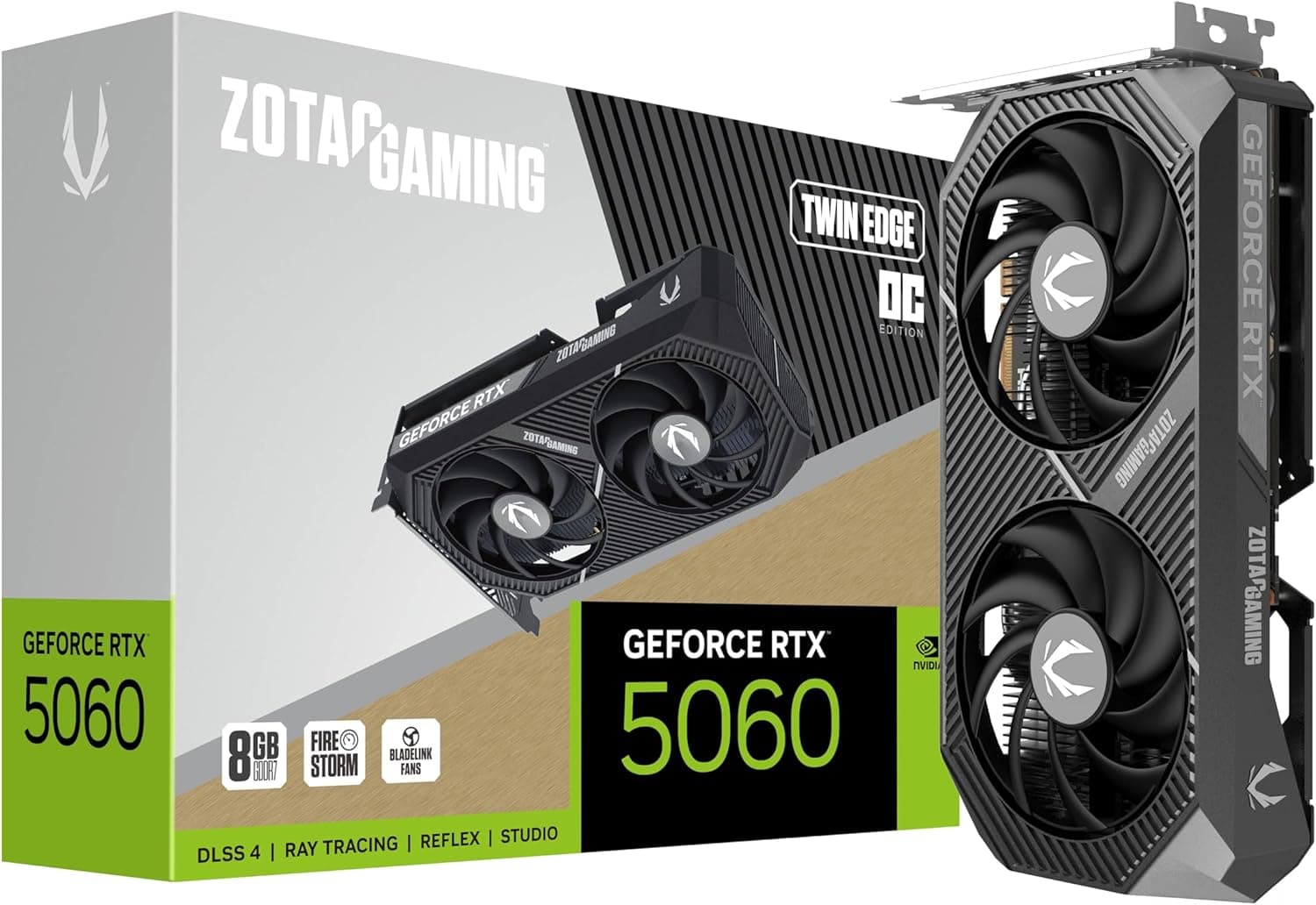
This article covers ZOTAC Gaming GeForce RTX 5060 Twin Edge OC DLSS 4 8GB GDDR7 128ビット 28Gbps PCIE 5.0 ゲーミンググラフィックスカード SFF-Readyコンパクトカード ZT-B50600H-10A。.
Overview
The ZOTAC Gaming GeForce RTX 5060 Twin Edge OC brings NVIDIA's latest Blackwell architecture to the midrange segment, delivering solid 1080p and 1440p gaming performance in a compact, SFF-friendly package. It packs 8GB of GDDR7 memory on a 128-bit bus, with PCIe 5.0 support and DLSS 4 for enhanced image quality and frame generation. With a TDP of just 145W, this card draws power from a single 8-pin PCIe connector, making it an easy upgrade for existing systems. The dual 90mm BladeLink fans and composite heatpipe cooler keep temperatures in check while maintaining low noise levels. Outputs include three DisplayPort 2.1b and one HDMI 2.1b, supporting up to 8K displays and VR headsets. Positioned as an entry-to-midrange graphics card, the RTX 5060 Twin Edge OC is ideal for gamers targeting high refresh rates at 1080p or solid 60fps+ at 1440p with DLSS. Its compact 220.5mm length and 2-slot design make it a prime candidate for small form factor builds.
Compatibility Guide
Form factor: 2-slot, 220.5mm length — fits most mATX and ATX cases, but check maximum GPU length for ultra-compact ITX cases. Interface: PCIe 5.0 x16, backward compatible with PCIe 3.0/4.0 slots with negligible performance loss. Power: Single 8-pin PCIe power connector; recommended system PSU of 550W or higher. Memory: 8GB GDDR7 on a 128-bit bus at 28Gbps, providing 448GB/s bandwidth — sufficient for 1080p high-refresh and 1440p gaming.
Product Info
The ZOTAC Gaming GeForce RTX 5060 Twin Edge OC was launched as part of the NVIDIA Blackwell series. Its retail price is around ¥69,000 in Japan (~$450 USD). ZOTAC offers a standard 2-year warranty (extendable on some regions). It is available through major retailers and online stores. Market positioning: entry-to-midrange. The 8GB VRAM and 128-bit bus target 1080p and 1440p resolutions rather than 4K. However, DLSS 4 can push 4K performance in many titles. The low 145W TDP and single 8-pin power requirement make it a versatile choice for budget and SFF builds.
Best Use Cases
1080p high-refresh gamers: Perfect for competitive eSports titles and AAA games at 1080p with DLSS 4 boosting frame rates well above 144fps. 1440p balanced gamers: Achieves stable 60fps+ at 1440p with medium-to-high settings and DLSS Quality mode. Great for a well-rounded gaming experience. Small form factor (SFF) builders: The compact card length and low thermal output allow it to fit in many ITX cases where larger cards cannot. The metal backplate adds structural rigidity. DLSS 4 early adopters: Users who want to experience Blackwell's new ray reconstruction and frame generation features without investing in a high-end RTX 5070 or 5080. Who should avoid: Users needing 4K ultra settings with high frame rates, or creative professionals requiring more than 8GB VRAM for video editing or 3D rendering. ## Alternatives
AMD Radeon RX 7600 XT: Similar pricing and VRAM capacity. The RTX 5060 leads in ray tracing and has DLSS 4, while the RX 7600 XT can offer slightly better raw rasterization in some titles. Consider your gaming library's preferred API. NVIDIA GeForce RTX 4060 (previous generation): The RTX 5060 brings Blackwell architecture, GDDR7, and DLSS 4 — a clear generational upgrade for roughly the same price. Only consider the RTX 4060 if you find it at a significant discount.
Things to Consider
VRAM limitation: 8GB may feel constrained in upcoming AAA titles at 1440p with ultra textures. DLSS can help, but longevity might be a concern for some users. PCIe 5.0 is not essential: Current games don't benefit from PCIe 5.0 over 4.0, so older motherboards work fine. Case clearance: Although compact, the 220.5mm length may still be a tight fit in ultra-compact cases like the Cooler Master NR200 (vertical orientation). Always double-check your case's GPU clearance. Performance vs. competing cards: The RTX 5060 offers better ray tracing and upscaling than AMD's RX 7600 XT, but raw compute performance in OpenCL/Vulkan may favor the AMD card. Choose based on your primary use case. ## FAQ Q: What power supply do I need for the RTX 5060 Twin Edge OC? A: The card has a 145W TDP and requires a single 8-pin PCIe power connector. For the whole system, we recommend a PSU rated at 550W or higher. Q: Can this card handle 4K gaming? A: Yes, but not at maximum settings with high frame rates. With DLSS 4 Performance mode, many titles become playable at 4K, especially eSports and older AAA games. For modern AAA titles, expect around 30-45fps at native 4K ultra. Q: Should I upgrade from an RTX 4060 to this card? A: The performance uplift is modest in raw terms, but DLSS 4 features and GDDR7 memory provide a smoother experience. If you encounter VRAM limitations or want frame generation, upgrading makes sense. Otherwise, you can wait for a larger generational jump
Product Disclosure (Amazon)
- Manufacturer: ZOTAC
- Seller: Amazon US
- Fulfilled by: Amazon US
- ASIN: B0GK8NKHKG
- Note: This article covers a manufacturer-made product based on Amazon listing details.
![MSI GeForce GTX 1660 Ti GAMING X 6G グラフィックスカード [国内正規流通品] V375-040R](/_next/image?url=https%3A%2F%2Fm.media-amazon.com%2Fimages%2FI%2F71N843L00dL._AC_SX300_SY300_QL70_ML2_.jpg&w=1920&q=75)