Overview
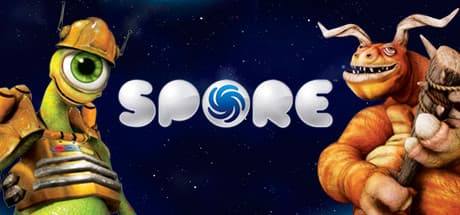
SPORE™ was developed by Maxis™, published by Electronic Arts, and released on Steam on December 19, 2008. It is often described with a pile of genre tags, but its real structure is unusual: five separate games played back-to-back inside a single save file.
You begin as a single cell, then move through Creature, Tribal, Civilization, and finally Space, where the whole galaxy becomes your playground.
The moment-to-moment play changes completely at each stage. Cell is a mostly 2D eat-or-be-eaten game, Creature is 3D exploration and combat, Tribal is a small-scale RTS, Civilization is a strategy layer of cities and vehicles, and Space is an open-ended sandbox of exploration, trade, and planet-shaping.
Earlier choices — carnivore or herbivore, aggressive or friendly — carry forward into your abilities and how other species react, so a full playthrough writes a history for your species.
Features and Systems
The heart of the game is the Creature Creator. You stretch a spine like clay, attach eyes, mouths, legs, hands, and decorations wherever you like, and the game derives walking animation and stats directly from that part layout.
Longer legs mean speed; a biting mouth means attack power. Visual play and stat design are the same action, which is still rare.
Creators also exist for buildings, vehicles, and spaceships. From Tribal onward, the huts and tanks you designed actually move around on screen, so the later you get, the more the world is visibly yours.
The other pillar is content sharing: many of the rival and neutral species in your galaxy come from creatures uploaded by other players, so two people never meet quite the same cast. How much of this online sharing is active today depends on service status — check the Steam store page and community posts for the current situation.
The Space stage adds terraforming: adjust a planet's temperature and atmosphere, seed plants and animals, and turn a dead rock into a habitable colony. That is the real endgame.
Other stages end in hours; Space effectively does not end.
System Requirements
The minimum requirements listed on Steam are below. As a 2008 title, it is extremely light by modern standards.
| Item | Minimum |
|---|---|
| OS | Microsoft Windows® XP (Service Pack 1) / Vista |
| CPU | 2.0 GHz Intel Pentium® 4 or equivalent |
| GPU | 128 MB video card with Pixel Shader 2.0 support |
| RAM | 512 MB (768 MB for Vista) |
| Storage | At least 4 GB, plus at least 1 GB more for creations |
| DirectX | Latest version of DirectX 9.0c or higher |
The storage line also notes additional requirements for machines using built-in graphics chipsets under Windows. No recommended spec is published on Steam, so none is listed here.
In practice, a 128 MB / Pixel Shader 2.0 GPU bar means any current integrated graphics (Intel UHD / Iris Xe, AMD Radeon Graphics) clears it comfortably.
With a 512 MB memory requirement, even an 8 GB office laptop satisfies the stated conditions. Budget roughly 5 GB of storage in total.
The concern is compatibility, not performance. Targeting Windows XP / Vista and DirectX 9, it can misbehave on modern Windows: wrong resolution, no windowed mode, crashes on first launch.
The usual fixes are Steam launch options, compatibility mode, and display settings. Multi-monitor and high-refresh setups tend to be the trouble spots for this generation, so confirm it launches on a single 60 Hz display first.
The UI also carries 4:3-era assumptions. On ultrawide or 4K panels, text gets small and elements stretch.
If you play on a high-resolution monitor, accept some UI awkwardness.
Review Trends
Steam user sentiment has stayed high over a long period, which is unusual for a game this old.
Positive reviews return again and again to the Creature Creator. "The animal I imagined stands up and walks" is still hard to replicate elsewhere, and many say the editor alone justifies the purchase.
The stage-by-stage genre switching is also praised for keeping things from going stale, and the game comes up often as something to play with kids or as an approachable take on evolution.
Negative reviews focus on shallowness. Tribal and Civilization have few real options as strategy games, and most players see through them in a couple of hours.
In Space, repeated events in your own territory — raids, requests for help — turn into tedious travel, and that is where people stop. There is also lasting disappointment about the gap between the pre-release promise of a serious evolution simulator and what shipped: a creative toy themed on evolution.
Technical complaints from running an old game on modern hardware also appear. When reading reviews, separate dissatisfaction with the design from launch problems on current systems.
Who It's For
- Players who love designing how things look; the editor alone can absorb hours.
- Players who enjoy shifting genres — cell-eating, RTS, and space exploration in one package.
- Players drawn to sandbox management; terraforming and colony work are the long game.
- Families looking for something to play with children; simple controls, shareable theme.
- Anyone on modest hardware who needs a game that runs on a laptop.
Getting Started
The Cell stage takes about half an hour and is essentially a tutorial, but your carnivore/herbivore/omnivore choice echoes later, so pick a direction early. Prioritize mouth parts for an aggressive run or social parts for a diplomatic one, and Tribal onward gets easier.
In Creature stage you repeatedly befriend or wipe out other nests. Skipping the DNA detours narrows your options later, so take them.
Tribal and Civilization, by contrast, are fine to rush — the game's center of gravity is the Space stage, so if the mid-game starts feeling like chores, drop the difficulty and push through.
Caveats and Who Should Skip It
Skip it if you want deep strategy. Tribal and Civilization have far fewer options than a dedicated RTS or 4X.
Unit variety and tactical depth are thin; treat them as a stage for watching your own creations fight. Buying it for challenge here will disappoint.
Skip it if you want a realistic evolution simulator. Swapping parts to change stats is a creative tool, not a model of biology.
It does not serve a scientific-accuracy use case.
Be careful if you need hundreds of hours of replay. A full run from cell to galaxy is not especially long, and outside the Space stage a second playthrough offers little new.
Longevity depends entirely on how much the creators and Space hook you.
Modern compatibility is not guaranteed. As noted, this targets the Windows XP / Vista era.
The dividing line is whether you're willing to troubleshoot launch failures, resolution problems, and windowed mode yourself. If editing config files and launch options sounds unpleasant, read community reports before buying.
Japanese language support cannot be confirmed here. Supported languages are listed in the store page's language table — check it before buying, and note that interface and text support are sometimes listed separately.
Check which edition you are buying. Separately sold expansion content exists, and bundle versus standalone listings can lead to overlap or gaps.
Confirm the contents on the store page first.
Store listings — languages, included content, system requirement text — do occasionally go stale or contain errors. Since you will look at the same page, verify the images, title, and edition name yourself before checkout.
For current user sentiment, check the rating panel on this page or the Steam store listing.