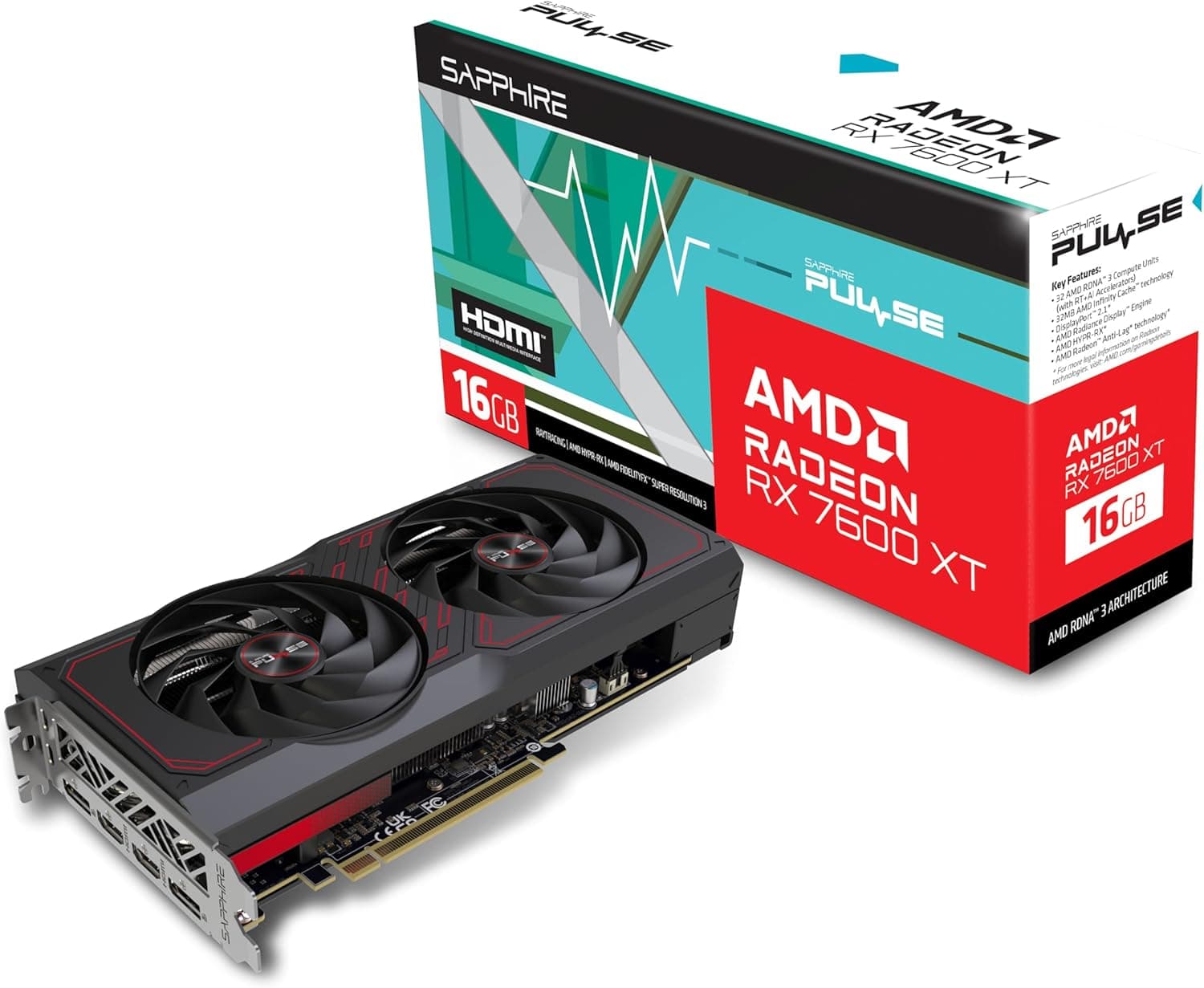
This article covers Sapphire 11339-04-20G Pulse AMD Radeon RX 7600 XT ゲーミンググラフィックスカード 16GB GDDR6 AMD RDNA 3.
Overview
Sapphire's Pulse series has long been recognized for delivering a well-balanced combination of cooling performance and cost-effectiveness. The Sapphire 11339-04-20G Pulse AMD Radeon RX 7600 XT Gaming Graphics Card continues that tradition, featuring AMD's RDNA 3 architecture and a generous 16GB of GDDR6 memory — a standout specification in the mid-range segment. This card is designed to handle 1080p and WQHD gaming with ease, while the 16GB VRAM buffer provides headroom for texture-heavy modern titles and light creative workloads. The GPU is an AMD Radeon RX 7600 XT, built on the 6nm Navi 33 die, with boost clocks reaching approximately 2.7 GHz. It delivers solid rasterization performance that competes directly with NVIDIA's GeForce RTX 4060, but with double the video memory. Positioned firmly in the mid-range tier, the RX 7600 XT offers a compelling value proposition for users who prioritize VRAM capacity over ray tracing prowess. At a street price around ¥128,000, it sits slightly above typical mid-range pricing, but the 16GB memory makes it a future-proof choice for gamers and creators alike.
Compatibility Guide
The card uses a PCI-Express 4.0 x16 interface and is backward compatible with PCIe 3.0 slots, though a slight performance penalty may occur on older platforms due to reduced bandwidth. Its form factor is 2.2 slots thick with an ATX-length PCB of approximately 260mm. Most mid-tower cases will accommodate it, but compact Mini-ITX builds require careful measurement. Power delivery requires a single 8-pin PCIe power connector. The recommended PSU wattage is 500W or higher; a 600W unit is advisable for systems with a power-hungry CPU. Video outputs include two HDMI 2.1 ports and two DisplayPort 2.1 ports, supporting up to four simultaneous displays. High-refresh-rate WQHD and 4K monitors are fully compatible.
Product Info
The Sapphire Pulse RX 7600 XT launched in early 2024. It is built around the AMD Navi 33 GPU on a 6nm process, featuring 2048 stream processors, 32 ray accelerators, and 64 ROPs. The 16GB GDDR6 memory runs on a 128-bit bus, delivering approximately 288 GB/s of bandwidth. Total board power (TBP) is rated at 165W, keeping thermal output manageable for a mid-range card. Market positioning is squarely mid-range. It outperforms entry-level cards significantly while avoiding the high price and power draw of flagship models. The 16GB VRAM is the defining differentiator at this price point, making it ideal for users who want extra memory headroom without stepping up to a more expensive GPU. The card typically comes with a 2-year manufacturer warranty. It is widely available through major online retailers, with pricing hovering around ¥128,000.
Best Use Cases
WQHD gaming at high settings: This card delivers smooth 60+ fps performance in most modern titles at 2560×1440 resolution. The 16GB VRAM ensures that high-resolution texture packs and future games won't quickly run into memory limits. It is an excellent choice for gamers who plan to keep their GPU for several years. However, those targeting 4K at maximum settings should look at higher-tier options. Light creative work (video editing, 3D modeling): The 16GB VRAM provides a noticeable advantage over 8GB cards when working with video previews or small-to-medium Blender projects. While not suitable for professional-grade rendering, it handles hobbyist-level creative tasks with ease. * VRAM-conscious value seekers: Compared to the RTX 4060's 8GB, the RX 7600 XT offers double the memory for a similar price. If you play modded games, use high-resolution texture packs, or simply want to future-proof against rising VRAM demands, this card is a smart investment. ## Alternatives
NVIDIA GeForce RTX 4060 (8GB): The direct competitor at the same price tier. The RTX 4060 excels in ray tracing and offers DLSS 3 frame generation, but its 8GB VRAM is a limiting factor for modern titles at higher settings. Choose the RTX 4060 if ray tracing and upscaling matter most; choose the RX 7600 XT if VRAM capacity is your priority. AMD Radeon RX 7700 XT (12GB): A step up in both price (about ¥20,000 more) and performance. The RX 7700 XT features more shader cores and a wider 192-bit memory bus, delivering noticeably higher frame rates at WQHD. If your budget allows, the RX 7700 XT is a stronger performer, though the RX 7600 XT still wins on raw VRAM size.
Things to Consider
The 128-bit memory bus is narrower than higher-tier cards like the RX 7800 XT (256-bit), which can impact texture loading speeds at higher resolutions. For 4K gaming, a card with a wider bus is recommended. Ray tracing performance lags behind NVIDIA's offerings at the same price. If ray-traced effects are important to you, an RTX 4060 or RTX 4060 Ti would be a better fit. At approximately 260mm in length, the card may not fit in very compact cases. Alway
Product Disclosure (Amazon)
- Manufacturer: SAPPHIRE
- Seller: New Oriental Technology
- Fulfilled by: New Oriental Technology
- ASIN: B0CTD21LW1
- Note: This article covers a manufacturer-made product based on Amazon listing details.