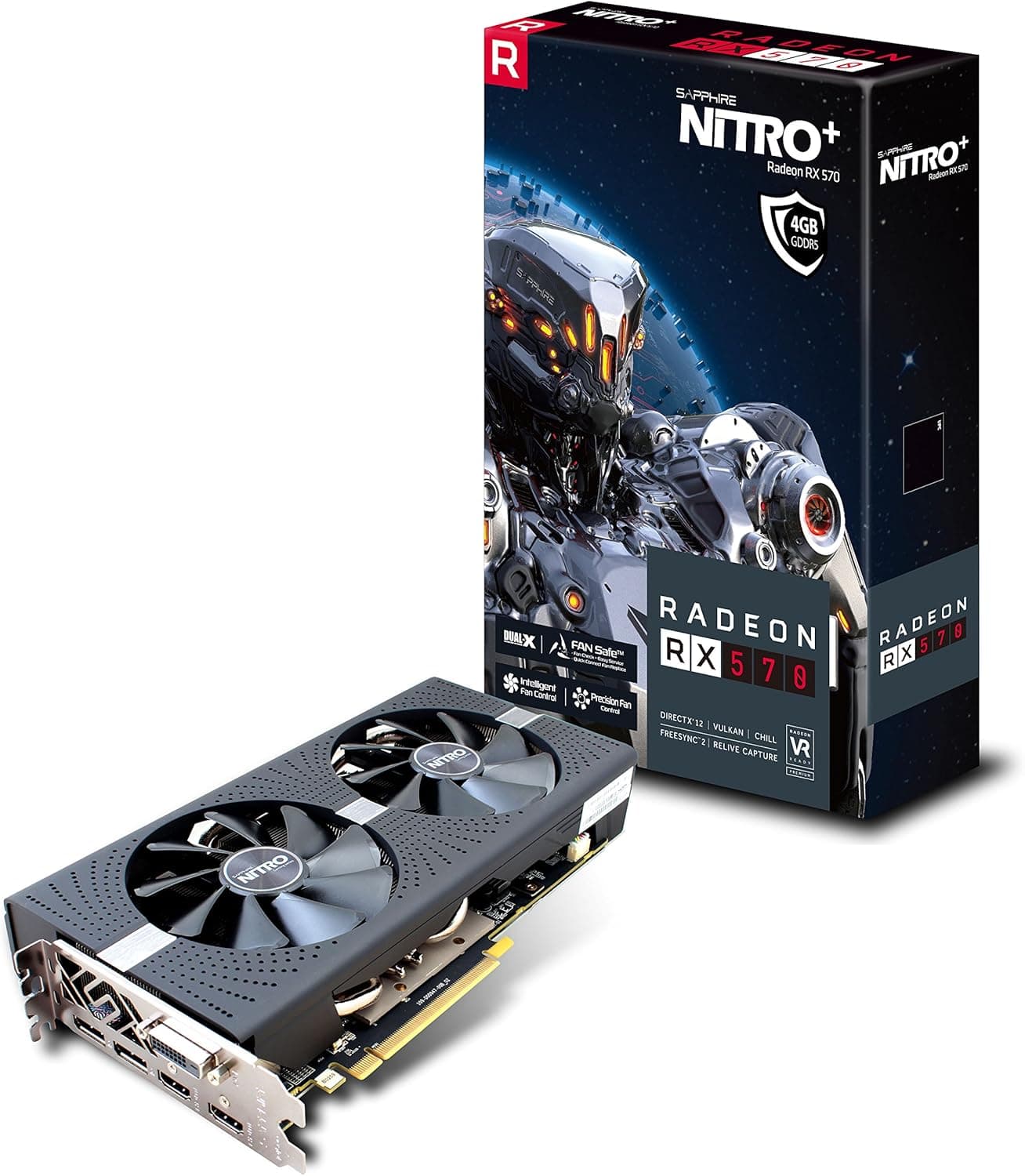
This article covers Sapphire 11266-14-20G Radeon NITRO+ RX 570 4GB GDDR5 DUAL HDMI DVI-D DUAL DP バックプレート付き UEFI PCI-E グラフィックカード.
Overview
The Sapphire 11266-14-20G NITRO+ RX 570 4GB GDDR5 is a mid-range graphics card built around the AMD Radeon RX 570 GPU, featuring 4GB of GDDR5 memory on a 256-bit bus. It comes with a custom dual-fan cooler and a metal backplate, offering better thermal performance and structural rigidity compared to reference designs. Connectivity includes two HDMI ports, one DVI-D, and two DisplayPort outputs, giving plenty of flexibility for multi-monitor setups. Released in 2017, this card remains a solid option for budget-conscious gamers who primarily play at 1080p resolution. It handles eSports titles and older AAA games with ease, though it struggles with the latest demanding releases. Its modest 150W TDP means it doesn't require a high-end power supply, making it a good choice for affordable builds. Market positioning sits at the lower end of mid-range. It competes with the GeForce GTX 1060 3GB and the earlier RX 470, offering a slight edge in memory bandwidth thanks to its 256-bit bus. However, it is notably outperformed by more recent entry-level cards like the RX 6600 or RTX 3050.
Compatibility Guide
This card uses a PCI Express 3.0 x16 interface and is compatible with all modern motherboards, including those with PCIe 4.0 slots (backward compatible). Power connector: One 8-pin PCIe power connector is required. Verify your power supply has the necessary cable. Recommended PSU: The manufacturer recommends at least 450W, but a quality 500W unit provides better headroom for the whole system. Memory: Onboard 4GB GDDR5, not expandable. Suitable for 1080p gaming but may limit texture detail in newer titles. Form factor: Dual-slot width. Ensure your case has enough clearance, especially if other PCIe cards are installed. * Outputs: 2× HDMI 2.0b, 1× DVI-D, 2× DisplayPort 1.4. No analog outputs.
Product Info
The Sapphire NITRO+ RX 570 4GB launched around 2017 and is now primarily available through second-hand channels or clearance stock. Warranty depends on the seller, and used units often come without any coverage. This card targets the budget-to-mid-range segment. It competes directly with the GTX 1060 3GB and RX 470 4GB, offering a slight performance advantage over the latter and more VRAM than the former. However, compared to modern GPUs, it lacks hardware ray tracing and advanced DirectX 12 features. Physical dimensions are typical for a dual-fan card. The backplate provides additional rigidity and helps with heat dissipation. The dual fans are relatively quiet under load, though the cooler design is not as efficient as newer solutions.
Best Use Cases
- 1080p eSports Gaming This GPU excels in games like Valorant, League of Legends, Counter-Strike 2, and Overwatch 2 at 1080p resolution. You can expect high frame rates (often 100fps+) with medium to high settings. It's not ideal for those aiming for 240Hz+ refresh rates, as newer GPUs offer higher efficiency. 2. Budget Secondary PC or HTPC Build If you're building a secondary gaming rig or a home theater PC on a tight budget, the RX 570 offers good value. Its low power draw and compact size make it easy to fit into smaller cases. However, it's not suitable for 4K gaming or modern VR titles. 3. Multi-Monitor Productivity Setup With five video outputs, this card can easily drive three to four monitors simultaneously for office work, web development, or data monitoring. It handles basic 4K desktop usage but cannot game at 4K with playable performance. ## Alternatives
Direct competitors in the same price tier include the NVIDIA GeForce GTX 1060 3GB and the AMD Radeon RX 470 4GB. Vs. GTX 1060 3GB: The RX 570 offers a wider 256-bit memory bus and 4GB VRAM versus 3GB, giving it an edge in texture-heavy games. However, the GTX 1060 often has slightly lower power consumption and better driver optimization for some older titles. Vs. RX 470 4GB: The RX 570 is essentially a higher-clocked refresh of the RX 470, offering about 5–10% more performance. Pricing on the used market is often similar, so the RX 570 is generally the better buy unless you find an extremely cheap RX 470. In the current market, both cards are outclassed by entry-level options like the AMD Radeon RX 6600 or NVIDIA RTX 3050, which offer newer features like hardware ray tracing and more efficient architectures. If your budget allows, these newer cards are a better long-term investment.
Things to Consider
This card lacks support for modern DirectX 12 Ultimate features, including hardware ray tracing and mesh shaders. Games that require these features (e.g., Cyberpunk 2077 using ray tracing) will not run at acceptable performance levels. The 4GB VRAM is a significant limitation for gaming in 2026. Newer AAA titles often exceed 4GB at 1080p high settings, forcing you to lower texture quality or resolution. For 1440p gaming, this card is not recommended. Used c