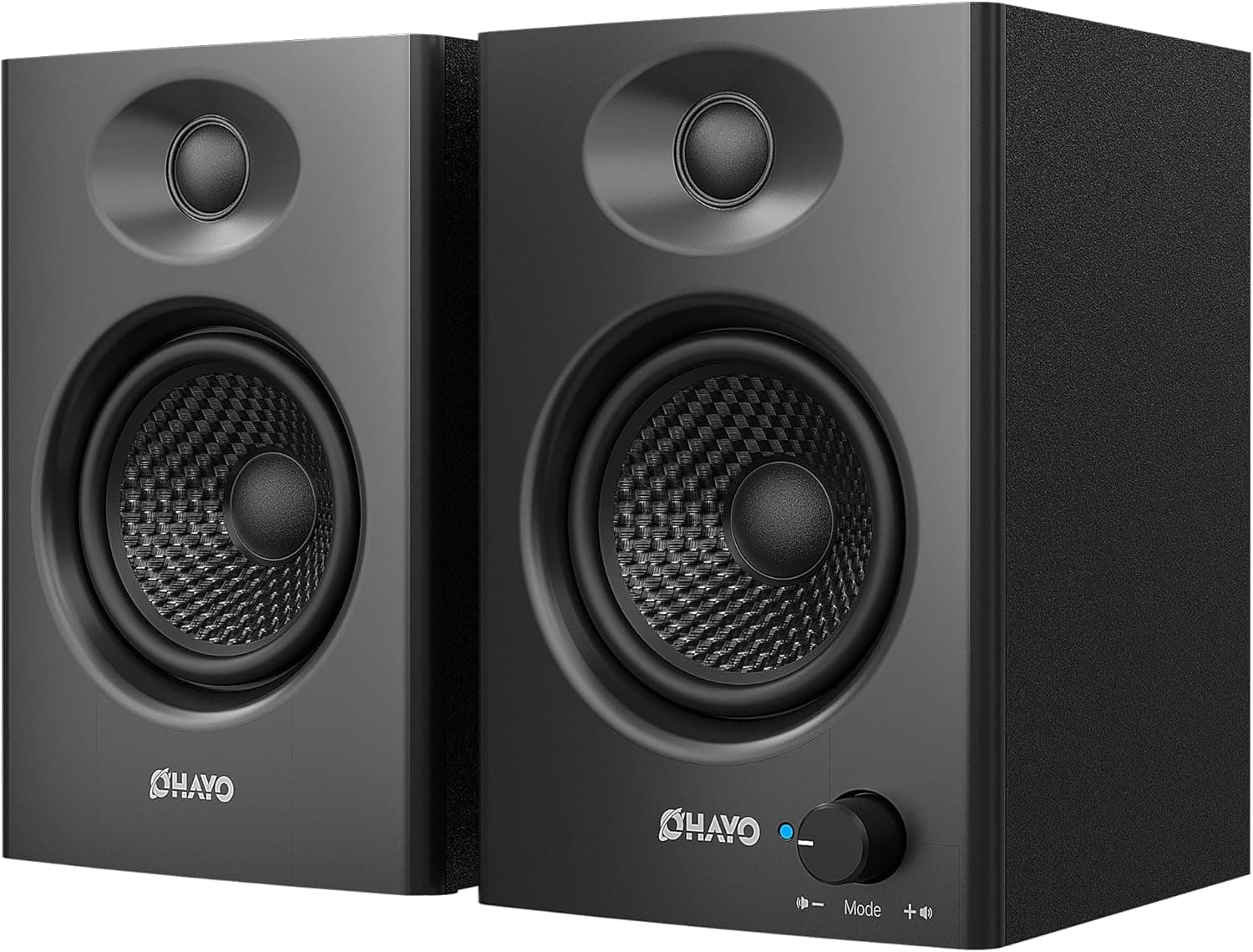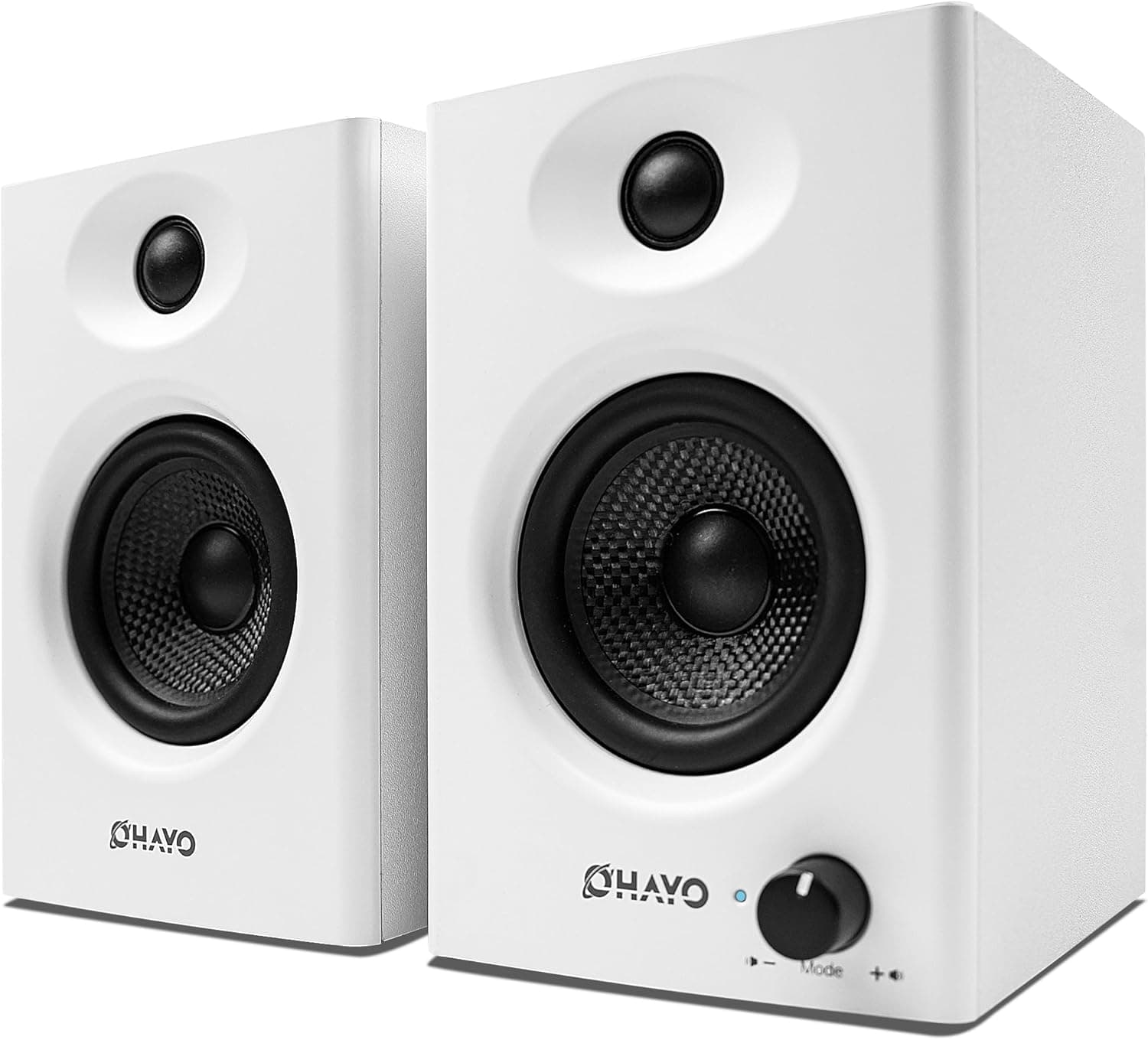
The OHAYO 60W Computer Speakers for Gaming and Music (listed as the C6) are USB-powered 2.0ch active bookshelf speakers.
This article goes beyond the spec sheet to explain how to read the "60W" figure, which setups actually let these speakers perform, and who should skip them entirely.
Overview
The OHAYO C6 is a 2.0ch active bookshelf speaker set rated at up to 60W total output.
It supports Bluetooth 5.3 for wireless streaming and is powered over USB (5V/2A or higher recommended).
Two wired inputs — 3.5mm stereo aux and RCA — cover PCs, TVs, consoles, and phones.
The white finish sits naturally on a light-colored desk or beside a white monitor.
Positioned as an entry-to-mid option, its real job is replacing built-in monitor or laptop speakers. On Amazon it holds 4.4 out of 5 stars across 822 reviews (roughly an 88% positive score, captured 2026-05-29) — a stable record for a lesser-known brand at this tier.
But as explained below, the power delivery method imposes a hard ceiling, so buying it expecting "60W means loud" will end in disappointment.
What the 60W Figure Actually Means
This is the single most important thing to understand. The unit is USB-powered with a recommended supply of 5V/2A.
Five volts times two amps is 10 watts of input power. When roughly 10W goes in, there is no physical route to 60W of continuous acoustic output (RMS).
The 60W on the box is best read as a peak or combined-channel marketing figure.
This is not unique to OHAYO — it is a labeling convention across nearly the entire USB-powered desktop speaker category, closer to legacy "PMPO" numbers than to RMS ratings. Practically speaking, expect volume that is more than sufficient for nearfield listening at 50cm to 1m at a desk.
Filling a whole room at party volume is not what these are for.
Power quality also directly limits volume. A PC's USB ports guarantee only 5V/0.5A (USB 2.0) or 5V/0.9A (USB 3.x), and some ports deliver no more than that.
If you hear distortion at higher volumes, or get dropouts and Bluetooth disconnects, stop using the PC port and plug into a USB charger that reliably supplies 5V/2A or more. A large share of complaints in this product class trace back to exactly this.
Compatibility Guide
Wired input is 3.5mm stereo aux plus RCA.
The 3.5mm jack works with virtually any PC, laptop, or console headphone output, TV earphone jack, or phone with a headphone port.
RCA is for standalone DACs, non-amplified sources, and the red/white audio outputs on some TVs. No RCA cable is included, so buy one in advance if that is your intended path.
Bluetooth is version 5.3.
The version number affects connection stability and power efficiency, but latency is determined by the codec (SBC / AAC / aptX), and the supported codecs are not stated in the published specs. For competitive FPS or rhythm games, where audio-video sync matters, plan on the 3.5mm wired connection instead.
For video and music playback, Bluetooth should be fine.
Power compatibility is as described above: USB-A at 5V/2A or higher. No AC adapter is needed, which is a genuine benefit if your power strip is full or you run a minimal, monitor-arm-based cable setup.
No drivers or utilities are required — Windows, macOS, Linux, and consoles all work by simply selecting the audio output. Physically, these are bookshelf-sized, so flanking a 27-inch monitor consumes real desk width.
Measure your space before ordering.
Product Info
Key specs: 60W maximum output (total), 2.0ch active bookshelf design, 3.5mm stereo aux and RCA inputs, Bluetooth 5.3, USB power (5V/2A or higher recommended), white finish.
Pricing was ¥21,651 on Amazon as captured on 2026-05-29, and $116.39 on eBay US as captured on 2026-07-08.
Both are point-in-time figures that move with sales, exchange rates, and seller turnover — always check the product page for the current price. Reviews stood at 822 with a 4.4-star average as of 2026-05-29.
The package typically contains the left and right speakers, a USB power cable, a 3.5mm audio cable, and a manual.
RCA cables are not included. Warranty terms vary by seller, so confirm them before buying; marketplace listings often mean store-level support rather than manufacturer warranty.
| Spec | Value | What it means in practice |
|---|---|---|
| 60W max (total) | Best read as a peak figure | Plenty for nearfield, not for filling a room |
| Bluetooth 5.3 | Stability and efficiency | Latency depends on codec; wire it for gaming |
| 3.5mm / RCA | Two wired inputs | RCA cable sold separately |
| USB 5V/2A+ | No AC adapter | PC ports may under-deliver power |
As the table shows, this product is about improving desk audio without adding cables — not about the size of the wattage number.
How It Compares
PC speakers vary widely in intent. RGB-equipped compact models like the Edifier G1000 II target gaming desks where looks matter and space is tight.
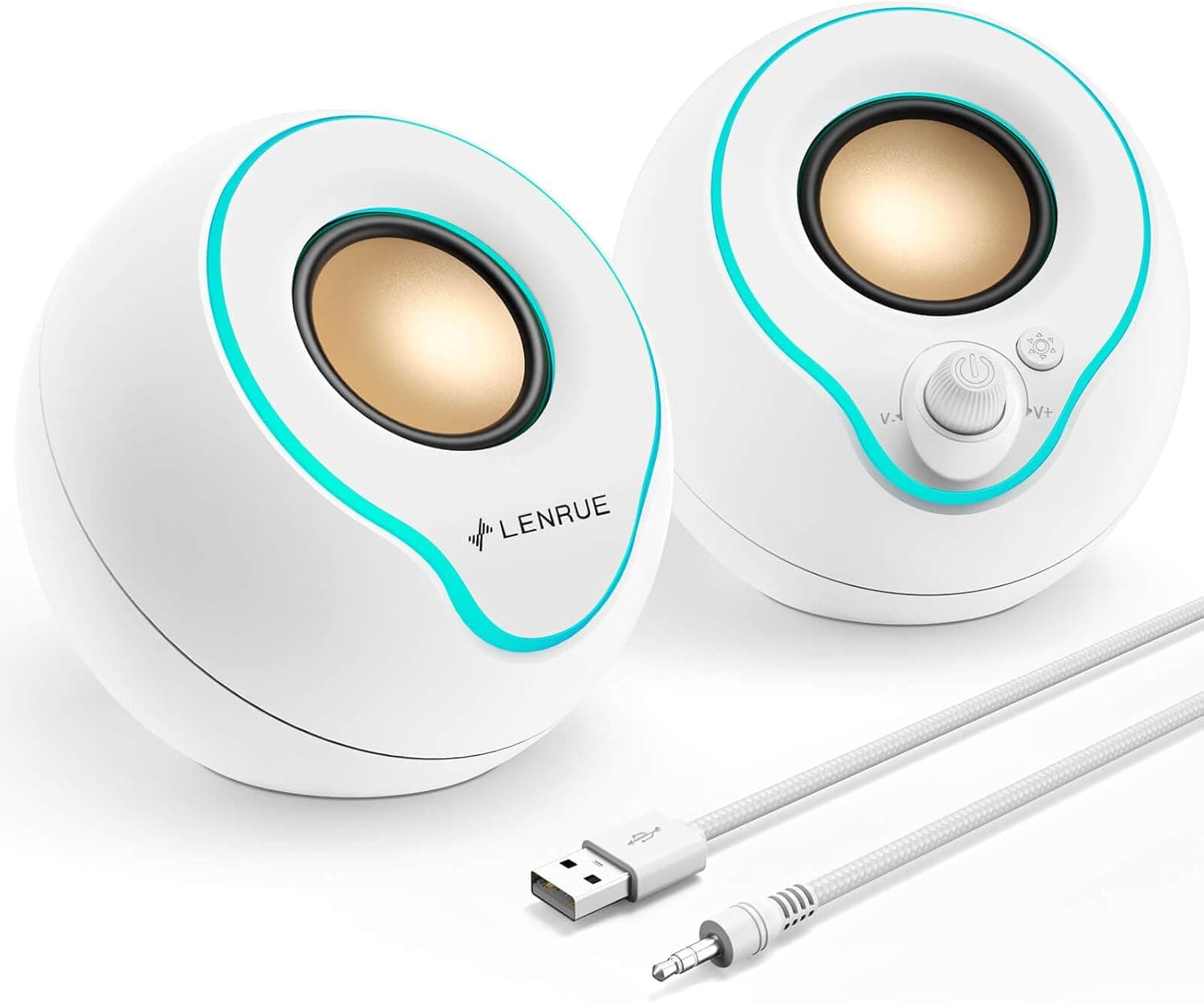
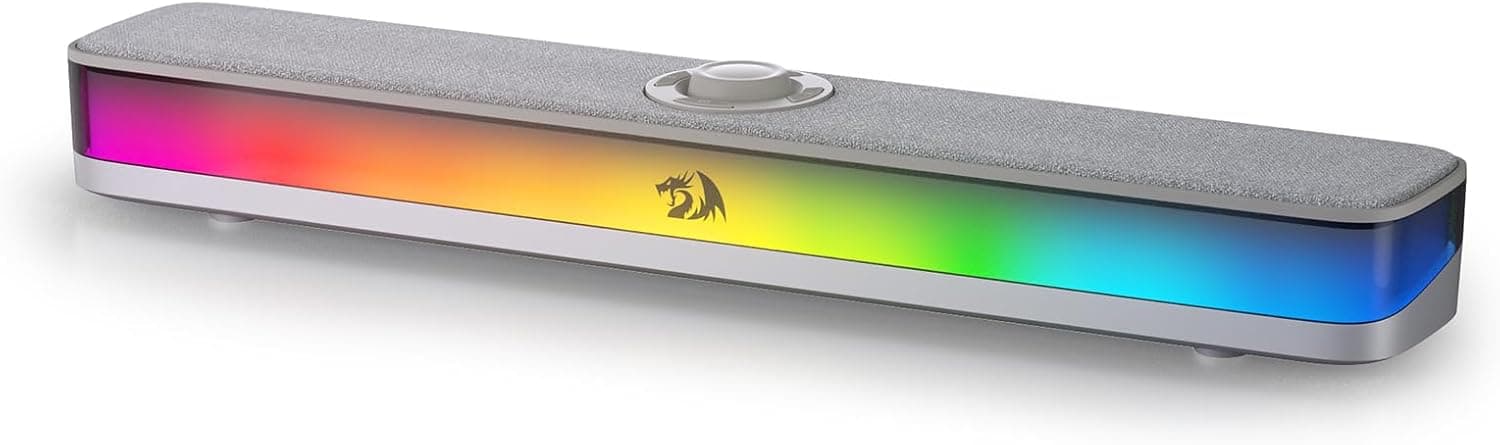
Slim USB-C models such as the LENRUE G11, or soundbar-style units like the Redragon GS515, fit into the narrow gap under a monitor. The OHAYO C6 is a larger bookshelf design, which structurally allows more cabinet volume.
The decision rule is simple: if you have desk depth and width to spare and want low-end body, go bookshelf. If space and aesthetics come first, go soundbar or compact.
If you do not care about lighting, put the RGB premium toward something else. Note that this site also carries an article titled "OHAYO 60W Computer Speakers for Music and Gaming" — an almost identical name that is likely the same series under a different listing, or a sibling model.
Match the ASIN and product images before ordering.
Best Use Cases
- You want fewer cables on your desk — no AC adapter; one USB cable and one input cable finish the job. If your power strip is full, that alone can justify the purchase.
- You are upgrading from built-in monitor speakers — the improvement is obvious to anyone. A safe first step up.
- You share one speaker set between PC and phone — wired for work, Bluetooth for breaks, no re-cabling required.
- Your desk is color-matched in white — white options are surprisingly scarce in this price bracket.
If raw sound quality is your top priority, look elsewhere. The same budget spent on a model with a clearly stated RMS rating will measure and sound better.
Things to Check Before Buying
1. Do not take 60W at face value. Continuous 60W is not achievable from a 5V/2A USB supply.
Buy this for the convenience of USB power and the breadth of inputs, not for the wattage claim.
2. Direct PC USB connection can be unstable. Distortion at volume and bass-driven dropouts usually mean insufficient power.
A 5V/2A USB charger will likely fix it — but doing so erodes the "no AC adapter" advantage. Understand that trade-off before you buy.
3. Avoid Bluetooth for gaming. With no published codec list, lip-sync offset cannot be predicted.
If gaming is your main use, plan on the 3.5mm wired path.
4. RCA cable is sold separately. If RCA is your main route, order the cable at the same time or you will be stuck on delivery day.
5. Seller, warranty, and listing accuracy. This is a marketplace listing; the seller and fulfiller are not the manufacturer, so support routes through the store, and price and stock vary by seller.
Also note that the collected pricing data is labeled "Amazon US" while pointing to a yen-denominated Amazon.co.jp page — a labeling mismatch.
Amazon listings occasionally show manufacturer names, model numbers, or ASINs that do not match the actual product. Verify the product images, title, and ASIN (B0DTNX7VLW) yourself before ordering.
6. Sound preference cannot be judged remotely. A 4.4 rating suggests few outright defects, but says nothing about whether you will like the tuning.
Check the return policy before you order.
FAQ
Q. Does it really output 60W? A.
Given USB 5V/2A (10W) input, continuous 60W is not realistic; treat it as a peak or combined figure. Volume is ample at a desk but insufficient to fill a room.
Q. Can I power it from a PC USB port? A.
It depends on the port. Even USB 3.x guarantees only 0.9A, so if you hear distortion or dropouts at volume, switch to a 5V/2A or higher USB charger.
Q. Is audio latency a problem for gaming? A.
Over 3.5mm wired, latency is effectively zero.
Because Bluetooth codec support is unstated, use the wired input for FPS and rhythm games.
Q. Can I connect a TV or game console? A.
Yes, if the device has a 3.5mm output or RCA audio output.
Devices with only HDMI or optical output need a separate audio converter.
Q. Is an RCA cable included?
A. Generally no — only the 3.5mm cable and USB power cable. Buy an RCA cable separately if you need one.
Q. How much does it cost? A.
¥21,651 on Amazon as of 2026-05-29 and $116.39 on eBay US as of 2026-07-08.
Prices move often, so check the product page for current pricing.
Product Disclosure (Amazon)
- Manufacturer: OHAYO
- Seller: Dshop11
- Fulfilled by: Dshop11
- ASIN: B0DTNX7VLW
- Note: This article covers a manufacturer-made product based on Amazon listing details.