Overview
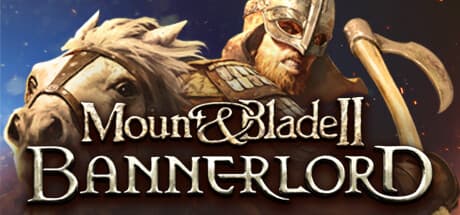
Mount & Blade II: Bannerlord is a medieval sandbox developed and published by TaleWorlds Entertainment. After a long early-access period, it left 1.0 on October 25, 2022.
It follows Mount & Blade: Warband, but character progression, combat, and kingdom management were all rebuilt.
Play alternates between two layers. On the campaign map you move your party icon across Calradia, escort caravans, chase bandits, and trade between villages and towns.
The moment you engage an enemy, the game drops into the battle layer, where you command your troops and also fight in the line yourself — swinging a sword, loosing arrows, riding down routers. That back-and-forth is the whole rhythm of the game.
There is no authored story. You start as a nobody with a handful of followers, hunt bandits, save money, recruit more troops, and then decide for yourself whether to serve a lord, work as a mercenary, or raise your own banner.
Because nothing tells you what to do, plenty of players stall out in the first few hours.
Features and Systems
Directional combat. Attacks and blocks resolve in four directions; you pick yours with mouse movement and match your shield or blade to the incoming swing.
Mashing loses. On horseback, your mount's speed adds to the damage, so managing angle and momentum is itself a skill.
Troop command. Units divide into infantry, archers, cavalry, and horse archers.
You select groups with number keys and issue formations — line, shield wall, wedge — and movement orders. Simply taking the hill first, keeping archers behind the infantry, and swinging cavalry into a flank cuts your casualties dramatically.
This is why the game still works if you are not good at action games.
Clan and kingdom management. Companions become clan members, you marry, and children grow into party leaders.
Owning a fief means taxes, recruitment, construction, and loyalty; wars and peace deals are decided by council votes. Personal swordplay and running a state live in the same save file, which is the core of the series.
Economy and smithing. Every town has its own goods and prices, so caravan trading is a real income path.
Smithing lets you break down materials to learn parts and forge your own weapons — and it has long been considered strong enough to break early-game money balance.
Mods. Official modding tools exist and the Steam Workshop scene is very active, from UI fixes to total conversions.
Updates can break mods, so if you rely on them, pin a specific version through the Steam beta tab.
System Requirements
| Item | Minimum | Recommended |
|---|---|---|
| OS | Windows 7 (64-bit only) | Windows 10 (64-bit only) |
| CPU | Core i3-8100 / Ryzen 3 1200 / Snapdragon X Elite | Core i5-9600K / Ryzen 5 3600X |
| GPU | UHD Graphics 630 / GTX 660 2GB / Radeon HD 7850 2GB | GTX 1060 3GB / Radeon RX 580 |
| RAM | 6 GB | 8 GB |
| Storage | 60 GB | 60 GB |
Listing Intel UHD Graphics 630 as a minimum GPU is unusual, and the note adds that integrated graphics need an extra 2 GB of system RAM. In other words, at low settings the game will boot on an office machine with no discrete card.
But load here is driven by troop count, not resolution. The campaign map and town scenes are light, and a GTX 1060 3GB handles them comfortably.
Once a field battle or a siege with hundreds of soldiers starts, AI pathfinding and physics bottleneck the CPU and framerates drop hard — something a stronger GPU will not fix.
Practically, the battle size slider is the setting that matters most. If you stutter, lower it before touching resolution or shadows.
With CPU headroom to spare, raising it changes how the battles look entirely. The recommended 8 GB of RAM gets tight with mods; 16 GB is the comfortable number.
Storage is listed at 60 GB, so check your SSD before buying.
What Players Praise and Criticize
The recurring positive is that nothing else does this. First-person melee, army command, fief administration, and a trade economy rarely coexist in one seamless world.
Earning mercenary pay, converting it into troops, and eventually storming a castle to plant your own banner reads as a chain of your own decisions rather than a script. The game has held a strong reputation over a long period and remains actively played since its 1.0 release.
Criticism is just as consistent. Quest writing is thin, and many contracts feel like variations on "carry these goods" or "discourage these bandits." The late game stalls: the bigger your realm, the more it turns into chores, with wars and peace treaties cycling without resolution.
AI behavior, especially troops jamming up during sieges, is a standing complaint, and comparisons to Warband's mature mod ecosystem come up often.
So the skeleton of the experience is what people love; the writing and the endgame are what they don't. For current user sentiment, check the rating panel on this page or the Steam store listing.
Getting Started
- Do not pick fights with lords. Your starting party will be wiped by regular troops. Hunt bandits and small raider parties first.
- Train troops instead of buying them. Recruit villagers, win fights you can win, and promote them. Wounded troops recover, so the medicine skill pays off early.
- Pick one income stream. Caravans, smithing, the arena, or a mercenary contract — commit to one. Splitting your attention leaves you unable to cover party wages.
- Raise your clan tier before going independent. Fiefs carry upkeep and a duty to defend. Take a castle you cannot hold and the rest of your campaign is damage control.
Who It's For
- Players who want to build a character's life out of their own decisions rather than follow a plot.
- Anyone drawn to Total War-scale command who also wants to stand in that battle line.
- People who enjoy poking at economy, diplomacy, and administration systems to find the optimal play.
- Players who buy games expecting to mod them and stay for hundreds of hours.
- Fans of strategy-leaning simulation; if historical grand strategy already appeals to you, watching Calradia's map redraw itself will feel familiar.
Caveats and Who Should Skip It
Skip it if you want a story. There is no defined protagonist, no crafted dialogue, no emotional climax.
The world is provided; meaning is your job. If you need the game to tell you what to do next, you will lose interest early.
It takes time. Going from lone adventurer to founding a kingdom is a long haul.
If you want to be done in thirty-minute sessions, the campaign pacing will fight you.
The midgame grind is real. More fiefs mean repeated rebellion suppression, caravan defense, and reacting to declarations of war.
Whether that reads as meaningful administration or as repetition splits opinion cleanly — and if it reads as repetition to you, stopping is more sensible than pushing on.
Siege performance depends on your CPU. As above, a GPU-heavy, CPU-light build will underperform.
Check that your processor is roughly in the Core i5-9600K / Ryzen 5 3600X class before buying. On laptops, power settings and cooling headroom matter too.
Verify language support on the store page. Whether a given language is fully supported or interface/subtitles only can change with updates, and the data behind this article cannot confirm it.
The language table at the bottom of the store page is the reliable source.
Store listings and aggregator pages also disagree with reality more often than you'd expect. Confirm DLC availability and multiplayer status on the official store page yourself before you buy.