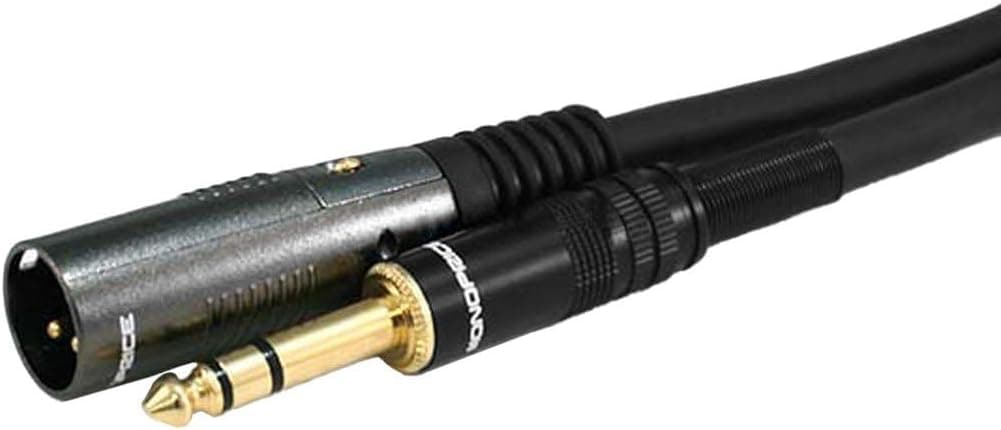
The Monoprice Premier Series 6ft XLR Male to 1/4in TRS Male cable pairs 16AWG conductors with gold-plated contacts and a braided shield. This guide goes past the spec sheet and into the mistake buyers actually make with this cable: the connector direction.
Overview
This is a 1.8 m (6 ft) balanced audio cable with a 3-pin male XLR on one end and a 1/4-inch (6.35 mm) male TRS on the other.
The full published spec set is: 16AWG conductors, gold plating, braided shielding, and a lifetime warranty.
The short version: it suits anyone sending a balanced signal from a 1/4" TRS output into an XLR input — mixer to powered speaker, interface to outboard preamp or recorder. It is the wrong cable for anyone trying to plug a microphone into an interface, for reasons covered below.
Amazon.co.jp reviews stood at 4,854 ratings and 4.7 out of 5 stars (roughly 94% positive) as captured on 6 June 2026.
Connectivity & Compatibility
The listed compatibility note is simply "balanced audio equipment with XLR or 1/4" TRS inputs." The practical detail matters more.
Check the gender first. XLR is a polarised connector: a male plug mates only with a female socket.
Equipment XLR inputs are almost always female, while a microphone's own output is male. So this cable's male XLR end plugs happily into gear inputs but will not physically connect to a microphone body. To run a mic into an interface you need a standard XLR-female-to-XLR-male mic cable, or an XLR-female-to-TRS-male if your interface only offers TRS.
Product blurbs sometimes blur this and describe cables like this one as "for microphones" — verify the gender of both of your own jacks before ordering.
| TRS end plugs into | XLR end plugs into | Typical use |
|---|---|---|
| Mixer 1/4" balanced output | Powered speaker XLR input | Live and home monitoring |
| Interface TRS line output | External preamp / recorder XLR input | Gear-to-gear line runs |
| Keyboard or DI balanced out | Mixer XLR input | Stage wiring |
Check the 1/4" socket too. Quarter-inch jacks come in TRS (3-conductor, balanced) and TS (2-conductor, unbalanced — the guitar standard).
A TRS plug will fit a TS jack, but the ring shorts to the sleeve, the cold leg collapses, and you end up with an unbalanced connection: it works, yet the noise immunity is gone and some gear drops output level. This is not a guitar or pedal cable.
Wiring convention is worth knowing for troubleshooting: XLR pin 2 is hot, pin 3 is cold, pin 1 is ground, mapping to tip, ring, and sleeve respectively. Vintage pin-3-hot gear inverts polarity, but essentially all current equipment is pin-2-hot, so this rarely bites.
1.8 m is a desk-scale length. It covers interface-to-monitor or rack-internal runs.
It does not cover a stage run to front of house or a speaker across the room. Balanced lines happily run tens of metres, so if you need distance, buy the longer part number rather than chaining cables — every extra junction adds noise and intermittent-contact risk.
About 16AWG. That is unusually thick for a signal cable; plenty of mic cables sit at 20–24AWG.
Thick conductors mean low resistance and real resistance to abuse, but they also mean a stiff cable with a large bend radius. Behind a cramped rack or folded sharply under a desk, that stiffness is a genuine annoyance.
If flexibility matters more than ruggedness, a thinner mic cable is more pleasant to live with.
Product Info
| Spec | Value |
|---|---|
| Length | 1.8 m / 6 ft |
| Wire gauge | 16AWG |
| Connectors | XLR male to 1/4" TRS male |
| Shielding | Braided |
| Contact plating | Gold |
| Warranty | Lifetime |
On pricing: the Amazon listing showed ¥3,480 as captured on 6 June 2026, and the eBay listing showed $10.81 as captured on 14 July 2026.
Both are point-in-time figures that move with sales, exchange rates, and stock. Always confirm the current price on the product page.
That gap is worth thinking about. Monoprice is a US direct-sales brand, and the eBay figure is closer to its home-market street price.
The Japanese listing price plausibly carries import, local stocking, and marketplace fees. Honestly assessed, the domestic price leans expensive for what the cable is — though fast local delivery and an easy returns path have real value.
If you are not in a hurry, compare per-unit cost against equivalent domestic balanced cables before committing.
Reviews stood at 4,854 ratings and 4.7 of 5 stars (about 94%) as of 6 June 2026.
For a cable, clearing 4,000 reviews while holding 4.7 is a useful signal about unit-to-unit consistency and low DOA rates.
Note that such scores may be aggregated across regions, so they are not purely a verdict on locally stocked units.
The lifetime warranty is a genuine differentiator in a category usually treated as consumable. Claiming it, however, involves practical friction: proof of purchase, which seller handles it, and who pays shipping.
Buying through a third-party domestic seller does not guarantee the same terms as buying direct. If the warranty is your main reason to buy, read the warranty text on the listing first.
Best Use Cases
- Home studio and DTM users linking gear. Interface TRS line out into monitor or outboard XLR in is exactly what this cable is for, and balanced transmission keeps hum away even when the run passes near a PC or display.
- Players sending a keyboard or DI to a mixer on stage. Thick conductors and a braided shield earn their keep where cables get stepped on and coiled nightly.
- Streamers and podcasters building out a desk. Use it for the mixer-to-speaker or mixer-to-recorder leg, not for the microphone itself.
- Anyone who wants a rugged spare. Running one cable short mid-session is a common failure; a well-reviewed spare is cheap insurance.
It is a poor fit if you need a mic cable, a run longer than about 5 m, or a limp cable for tight rack dressing.
Things to Check Before Buying
1. Connector direction is the big one. The male XLR end cannot plug into a microphone.
If you arrived here searching for a "mic cable," this is almost certainly not the part you need. Look at the two jacks you actually want to join and confirm male versus female before ordering.
2. A TRS plug in a TS socket throws away the balancing. Guitar amps, most pedals, and some consumer gear use unbalanced TS jacks.
Sound still passes, but noise rejection drops to that of an ordinary instrument cable.
3. 1.8 m is shorter than people expect. Fine on a desk; short once the cable follows the floor and a wall. Measure the real path first.
4. 16AWG is stiff. Gauge buys durability, not suppleness.
Dress the cable with a little slack so its weight and springiness do not pull sideways on the jack — side load kills sockets long before it kills cable.
5. Listing metadata can disagree with itself. In the collected data here, the price entry is labelled "Amazon US" while the link points to Amazon.co.jp and the currency is yen (¥3,480, captured 6 June 2026).
Automatically gathered listing details can carry mismatches like this, and seller, fulfiller, quantity (single versus two-pack), and length can likewise fail to match the description. Confirm the product image, title, and quantity yourself before ordering — this series ships in many length and connector variants, and it is easy to check out with the wrong dropdown selection.
6. Do not buy it expecting better sound. Gold plating is about corrosion resistance, not magic conductivity: it keeps contacts reliable over years.
Swapping a working cable for this one will not make your mixes sound better. Its value is in not picking up noise, not failing, and being consistent unit to unit.
FAQ
Q. Can I use it between a microphone and an audio interface? A.
No. A microphone's output is male XLR and so is this cable's XLR end, so they cannot mate.
Use a standard XLR-female-to-XLR-male mic cable, or XLR-female-to-TRS-male if your interface has only TRS inputs.
Q. Can the 1/4" end go into a guitar amp? A.
It fits, but it is not recommended. Guitar jacks are unbalanced TS, so the ring shorts out and the balanced design is defeated.
Use a proper instrument cable instead.
Q. Can I join two of these if 1.8 m is too short? A.
Possible but not advisable — each junction adds noise and intermittent-contact risk. Buy a single cable of the length you need.
Q. How should I read 4,854 reviews at 4.7? A.
That was the figure captured on 6 June 2026. Holding 4.7 across 4,000-plus cable reviews suggests low defect rates and good consistency, though scores may be pooled across regions.
Q. Is the lifetime warranty actually usable? A.
The manufacturer does advertise a lifetime warranty, but the handling desk and shipping costs depend on where you bought it. Check the listing's warranty wording if you purchased through a third-party seller.
Q. Are those prices still current? A.
Every price here is point-in-time (¥3,480 captured 6 June 2026; $10.81 captured 14 July 2026).
Cable pricing shifts with stock and exchange rates, so check the product page.
Product Disclosure (Amazon)
- Manufacturer: Monoprice
- Seller: Miraizu Market【適格請求書発行事業者】
- Fulfilled by: Amazon
- ASIN: B001UJEKZ6
- Note: This article covers a manufacturer-made product based on Amazon listing details.
![Cable Matters [Intel認定] 編組 40Gbps アクティブ Thunderbolt 4 ケーブル 6.6フィートホワイト 100Wの充電電力供給と8Kビデオ - Thunderbolt 3](/_next/image?url=https%3A%2F%2Fm.media-amazon.com%2Fimages%2FI%2F61EmRQMWxCL._AC_SL1500_.jpg&w=1920&q=75)