Overview
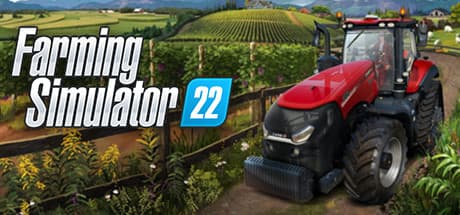
Farming Simulator 22, developed and published by Giants Software, launched on 22 November 2021. In practice the game is one loop repeated endlessly: cultivate, sow, fertilise and lime, harvest, haul, sell — all of it timed against weather, seasons and your cash flow.
Very little dramatic happens. Instead, your results come down to logistics: the harvester's tank fills up and no trailer is in position, rain delays the harvest and yields drop.
Three regions are represented — the Mediterranean coast of southern France, the large-field farmland of the American Midwest, and the hilly European Alps. Each favours different crops and field shapes.
The French map leans on perennials like grapes and olives, the Midwest on large-scale wheat, corn and cotton, and the Alps on slopes better suited to livestock and grassland. Your starting map meaningfully changes how you earn money early on and which machines you need.
Features and Systems
Two systems sit at the centre of the game: seasons and production chains. With seasons enabled, each crop has a planting window and a harvest window; miss them and yields drop or planting is blocked outright.
Winter largely halts fieldwork, so you need off-season work lined up — forestry, animal care, machinery upkeep. Difficulty settings let you change the number of days per month, so you control how heavy the seasonal pressure feels.
Production chains let you add value instead of selling raw crops. Turn wheat into flour at a mill, flour into bread at a bakery; turn milk into cheese.
You buy the facilities, place them on your land, and either supply them with your own trailers or pay for hauling. Once you reach this stage, the game shifts from farm work to logistics and inventory management.
Prices for each commodity fluctuate over the year, so timing your sales matters too.
There are over 400 licensed machines and tools from real agricultural brands, and even among tractors, horsepower, working speed and towing capacity differ. Expensive is not automatically correct: oversized machinery is a heavy depreciation burden on small holdings and awkward to manoeuvre in tight fields.
Repetitive jobs can be handed to AI workers, letting you handle only the decisions — hauling, purchasing, planning. On PC, mods are easy to install, covering extra maps, machines and system overhauls; how long the game lasts for you depends heavily on that ecosystem.
System Requirements
The minimum requirements listed on Steam:
| Item | Minimum |
|---|---|
| OS | Windows 10 Home (x64) |
| CPU | Intel Core i5-3330 / AMD FX-8320 or better |
| GPU | GeForce GTX 660 / Radeon R7 265 or better (min 2GB VRAM) |
| RAM | 8 GB |
| Storage | 35 GB |
| DirectX | Version 11 |
Both the Core i5-3330 and the GTX 660 are more than a decade old. In other words, an ageing office PC with a discrete graphics card added later stands a reasonable chance of launching the game.
A 2GB VRAM floor is unusually low for a modern title.
That said, minimum specs describe the floor, not comfort. Recommended specs were not included in the data available here, so no claim is made about them.
In practice the load spikes when you run many vehicles at once on a large map, employ several AI workers, or stack high-resolution texture mods. Those all push memory and VRAM, so a system with exactly 8 GB of RAM may struggle once mods enter the picture.
If you plan to play long-term, 16 GB of RAM and 4 GB or more of VRAM are safer targets.
The 35 GB storage figure covers the base game; mods add to it. Install on an SSD if you can, since it affects loading and map transitions.
As the official note states, the requirements table cannot cover every configuration, and some setups may hit issues regardless.
Review Trends
The game has held a strong reputation on Steam over a long period. Check the ratings panel on this page or the Steam store for current figures.
Positive comments cluster around the fidelity of the machinery, the calming texture of the work itself, and the satisfaction of getting a production chain running. "I put on music and just ploughed for hours" is a recurring sentiment — this game eats time.
Splitting roles in multiplayer and the depth of the mod scene also come up repeatedly.
Criticism concentrates on three points. First, the tutorial is thin: attaching implements, working widths, fertiliser types — none are explained well enough in-game.
Second, AI workers misbehave, getting stuck at field edges or taking odd routes. Third, series veterans often describe it as an expansion rather than a sequel.
Many players also find the volume of add-on content confusing when working out what the base game actually includes.
Who It's For
This suits people who enjoy planning for its own sake. How do you route the harvester and trailer?
Which machine size fits this field? In what order do you buy processing facilities?
If optimising that yourself sounds fun, the material never runs out. It also lands well with anyone interested in real agricultural machinery or in vehicle operation itself.
It also fits players looking for a game with no win condition and no timer. Nothing rushes you, so thirty minutes a night is a perfectly viable way to play.
Sharing a farm with friends — one harvesting, one hauling — makes it a good pick for long voice-chat sessions.
Caveats and Who Should Skip It
The first few hours can feel genuinely dull. You start short on money and machinery, so your options are limited to contract work for small change or ploughing a small field.
If you want stimulation, story, combat or clear objectives, this will almost certainly disappoint. There is no real narrative; the goals are ones you set yourself.
The UI and terminology are also a barrier. Until you understand implement types, working widths, the differences between fertiliser, lime and weeding, and how silos relate to sale points, you will spend a while unsure what to do next.
Official help pages and community guides speed this up considerably. If you prefer to figure games out by feel without reading anything, look elsewhere.
Finally, tolerance for repetition decides everything. Driving back and forth across a field takes real time, and whether that reads as meditative or as tedious chores flips the verdict entirely.
Time acceleration and AI workers help, but the fundamental pace stays slow. If you want a sense of achievement in short sessions, a faster-paced simulation title will serve you better.
Before buying, check the supported languages list on the store page — interface and audio support can differ. Also note that the base game is sold alongside multiple add-ons and edition variants, so confirm the exact product name and edition before checkout.
Store listings occasionally read inconsistently against actual contents, so cross-check the title against the description of what's included.
Getting Started
Don't rush into buying extra fields; keep to what your current machinery can service. While money is tight, contract work for neighbouring farms — ploughing or harvesting jobs — is a steady income source, and it doubles as practice with the equipment.
Machines can be leased rather than bought. Large harvesters you only need a few times a year are often better leased early on.
Wait until plain crop sales turn a reliable profit before touching production chains; buying processing facilities out of order leaves them idle because you can't supply enough raw material.
Co-op Play
Alongside single-player, the game supports multiplayer and online co-op, including cross-platform play between PC and consoles. Several players share one farm, with money and equipment as common assets.
Dividing labour raises efficiency dramatically, but it requires agreement up front: who has purchasing authority, who works which field. Skip that conversation and you get accidents — funds drained unexpectedly, two people ploughing the same field.
The host machine also carries the load for other players, so whoever has the strongest system should host.