The Eightwood compact WiFi antenna 4-pack exists to solve one problem: stock antennas that are too long for where you want to put the device. This article covers how to avoid the connector-polarity mistake that trips most buyers, what a modest 2.15dBi gain actually means in daily use, and the situations where you should not buy this at all.
Overview
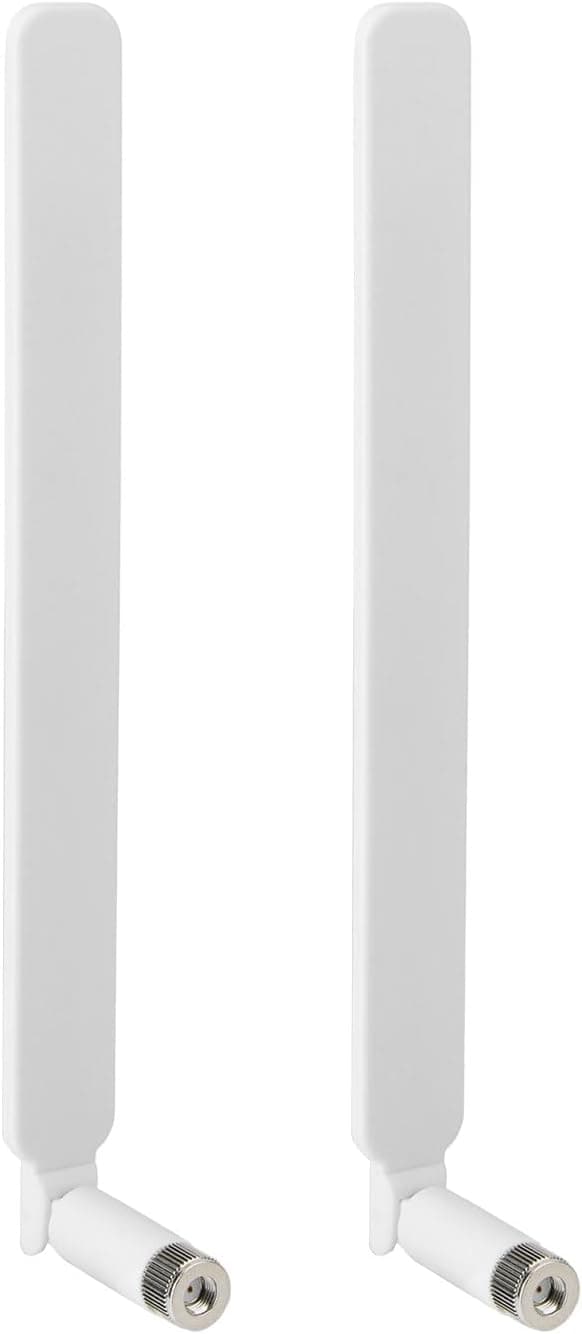
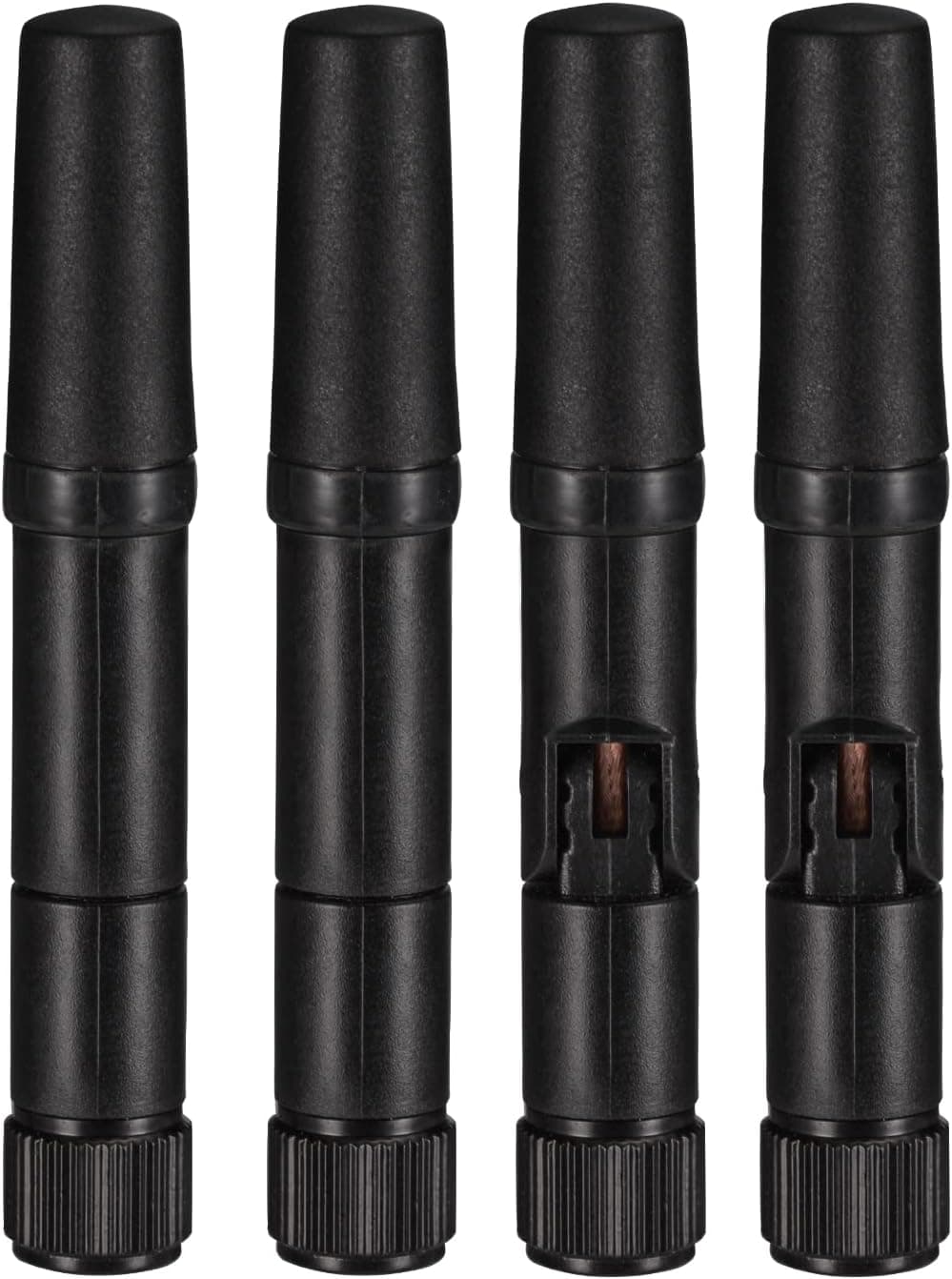
This is a set of four dual-band antennas covering 2.4GHz and 5GHz (listed as 5.8GHz in the spec sheet), terminated in an RP-SMA connector.
Each antenna is 67mm straight and 47mm when folded to 90 degrees — far shorter than the typical 15cm stock router antenna. That makes them suited to the back of a desktop PC, a shelf in an AV rack, or anywhere depth is tight.
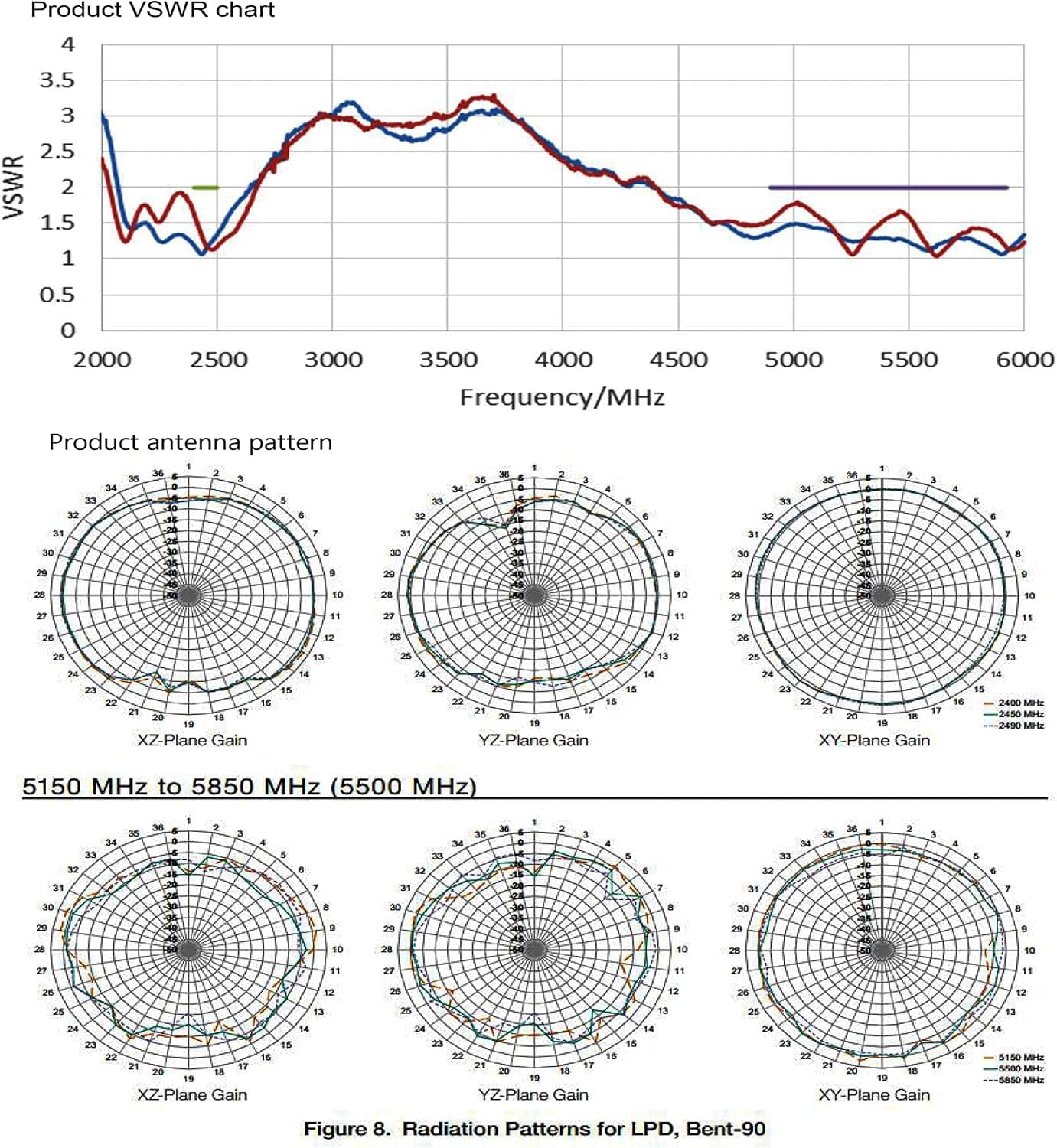
The key point about its character: this is an antenna for reducing bulk, not for increasing range. The 2.15dBi gain matches the theoretical figure for a plain dipole (2.15dBi = 0dBd), which is the baseline for an omnidirectional antenna.
It does not squeeze radiation into the horizontal plane the way high-gain antennas do, so it is fine within a room or floor, but it is not a range solution.
Amazon.co.jp reviews sit at 4.6 out of 5 from 44 ratings (roughly 92% positive) as captured on September 1, 2026.
That is a small sample, but for a replacement part it suggests there is no widespread problem with antennas that physically don't fit or fail on one band.
Compatibility Guide
Check connector polarity first. These antennas are RP-SMA male: the shell threads are male, but there is no center pin.
That means the device side must be an RP-SMA female jack with a pin standing in the center. Published compatibility notes for this product are contradictory — some say "for RP-SMA male devices," others say "for RP-SMA female devices." Ignore the wording and inspect the hardware: if your device's jack has a pin in the middle, it is RP-SMA female and this antenna fits.
Most consumer WiFi gear follows that convention:
| Device | Typical jack | Likely fit |
|---|---|---|
| PCIe WiFi card (Intel AX200/AX210 class) | RP-SMA female | Usually fits |
| Motherboard rear I/O WiFi jack | RP-SMA female | Usually fits |
| Home router with detachable antennas | RP-SMA female | Usually fits |
| USB WiFi adapter with detachable antenna | RP-SMA female | Usually fits |
| Some industrial / LTE routers | Standard SMA female (no pin) | Does not fit |
The last row is where people get burned. SMA and RP-SMA share thread diameter and pitch, so the antenna screws on happily while the center conductors never make contact — you get a mechanically solid connection that passes no signal.
If your device is cellular or ham-radio adjacent, standard SMA is much more likely.
On the standards side, dual-band coverage means these work with 802.11a/b/g/n/ac/ax.
Bluetooth also lives at 2.4GHz, so combo cards that share one antenna chain work normally.
However, 6GHz is not in the spec. If you run a Wi-Fi 6E or Wi-Fi 7 card and actually use the 6GHz band, swapping to these antennas leaves that band's performance unguaranteed.
This is easy to overlook.
Electrically: 50Ω impedance, 50W maximum input, vertical polarization, omnidirectional pattern. 50Ω is the WiFi standard so matching is a non-issue, and 50W is enormous headroom against consumer WiFi transmit power (around 0.1W), so it will never be the bottleneck.
One physical note: because they are short, multiple antennas end up close together on a router or card. Where possible, vary the angles — one vertical, one folded to 90 degrees — rather than aligning them all identically.
It looks less tidy but helps MIMO stream separation.
Product Info
| Item | Value |
|---|---|
| Frequency | 2.4GHz / 5.8GHz |
| Gain | 2.15dBi |
| Impedance | 50Ω |
| Connector | RP-SMA male (no male pin) |
| Height | 67mm straight / 47mm at 90° |
| Max input power | 50W |
| Directivity | Omnidirectional |
| Polarization | Vertical |
| Package | 4 antennas |
The price was ¥3,650 for the four-piece set as captured on September 1, 2026 — about ¥910 per antenna. Accessories like this move constantly with sales and coupons, and this article will not be updated in step, so always confirm the current price on the product page before ordering.
Buying the set is normally cheaper than four singles, so the value scales with how many devices you plan to convert.
The box contains the four antennas and nothing else: no extension cables, adapters, or magnetic bases. Installation is finger-tight by hand, no tools.
Stop as soon as it seats; using pliers damages RP-SMA threads on the antenna or the jack. Warranty follows the manufacturer's terms, so check the seller's listing for specifics.
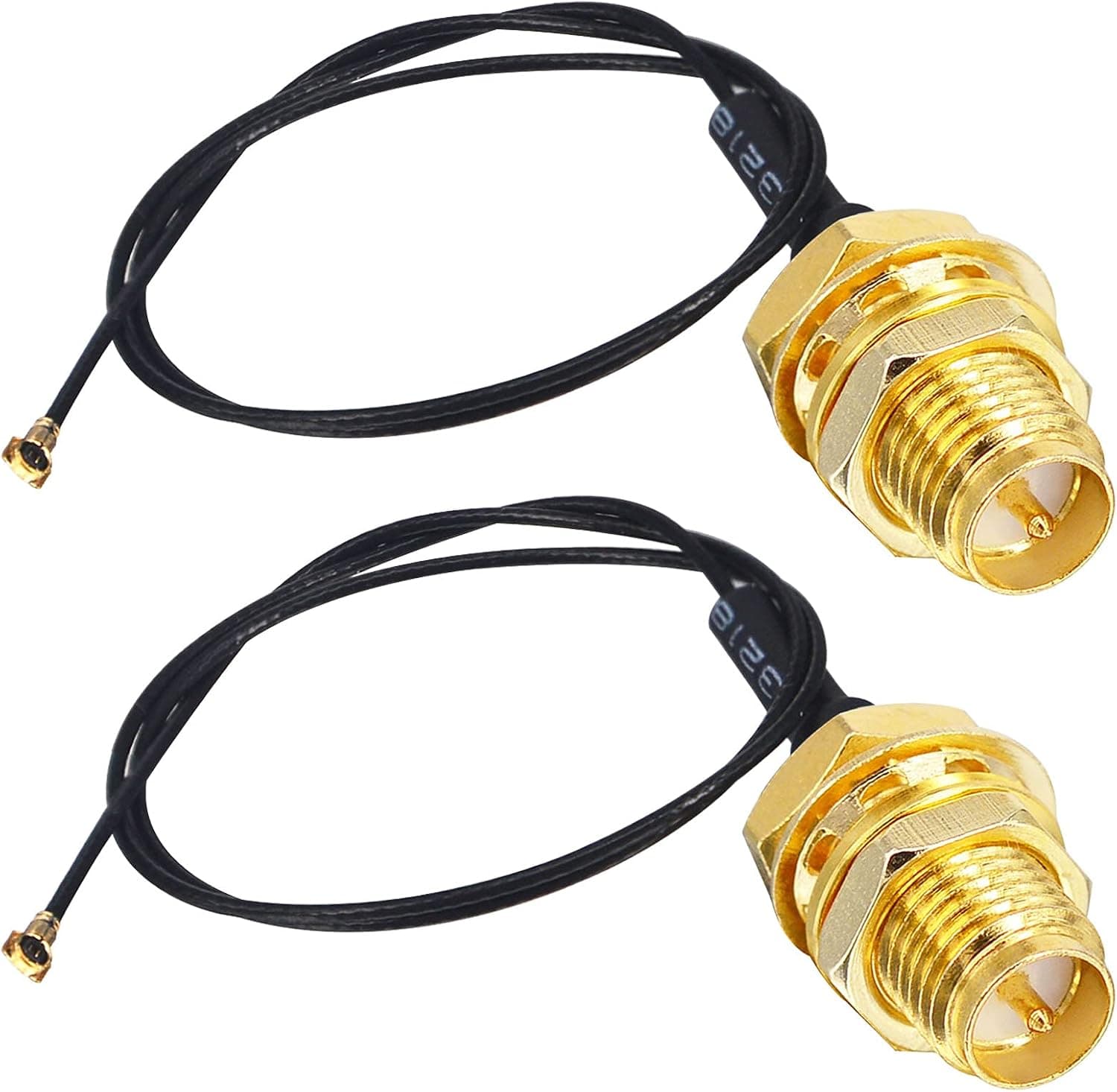
Positioning is clearly entry-level replacement hardware. It is a different product class from 8–10dBi high-gain antennas or MHF4/IPEX pigtail kits that relocate the antenna outside a chassis.
Choose by goal: those for signal, this one for getting the antenna out of the way.
What Actually Changes With Shorter Antennas
The immediate win is physical. Pushing a desktop against a wall, sliding a router onto a bookshelf, closing an AV cabinet — the "a few centimeters short" installs simply work.
Small annoyances go away too: antennas snagging when you swap cables, or getting knocked out of alignment during cleaning.
Signal, on the other hand, should be assumed not to improve. 2.15dBi is baseline omnidirectional and slightly below many stock antennas rated 3–5dBi.
Within a room you likely will not notice, but in a distant room where the link was already marginal, throughput may drop a tier.
So the sensible approach is to swap one antenna first, run a speed test, then convert the rest. Having four in the box makes that trial easy.
Because 5GHz attenuates faster than 2.4GHz, any regression will show up on the 5GHz far side first.
Notes Before Buying
1. Polarity mix-ups are the number one failure. SMA and RP-SMA look nearly identical, and threading on is not proof of compatibility.
Look for the center pin. This antenna has no pin, so the device must have one.
2. Do not buy this expecting better coverage. At 2.15dBi it is not a high-gain part.
For "the signal won't reach upstairs" or "the next room is slow," the right answers are an 8dBi-class antenna, a mesh system, or a repeater. No antenna swap doubles your range.
3. 6GHz (Wi-Fi 6E/7) is out of scope. The listed bands are 2.4GHz and 5.8GHz only.
4. Short means less placement flexibility. Long stock antennas usually articulate at two points so you can aim around obstructions; a 67mm antenna has a limited range of motion and sits closer to metal chassis and rack panels, where shielding hurts more.
5. Listing data can disagree with the physical item. Amazon spec fields and variation mappings are often wrong, and pages for this kind of antenna frequently mix SMA and RP-SMA versions plus different quantities.
Before ordering, confirm from the product images, title, and selected variation that you are getting RP-SMA male, four pieces. Price shown at checkout may also differ from the figure quoted here.
6. You may not need four. A two-antenna router leaves two spares.
If you have no second device in mind, compare per-unit cost against a two-pack.
How It Compares To Other Antenna Types
Within the same "WiFi antenna" category, three distinct goals lead to three different products:
- Compactness — 2–3dBi small RP-SMA antennas like this one. Installation improves; performance stays flat.
- Range and penetration — 8–10dBi high-gain antennas. Bigger, and because they flatten the pattern horizontally, coverage to the floor above or below can get worse.
- Placement freedom — MHF4/IPEX pigtail kits or magnetic-base external antennas that move the radiating element out of a metal enclosure entirely.
This product only answers the first goal. If your problem is the second or third, buying it will not help.
Best Use Cases
- Desktop builders whose long rear antennas get in the way. Cable access and wall clearance improve, and if the router is on the same floor there is little practical downside.
- Anyone fitting a router or access point into a shelf or AV rack. 67mm (47mm folded) may clear a shelf the stock antennas could not — provided the antennas are detachable and RP-SMA female.
- Users converting several devices at once. Four pieces covers a PC (two) and a router (two), and lets you test one before committing.
- Repair cases where an antenna broke or went missing. Usually faster and cheaper than sourcing an OEM part, with no practical difference once the standard matches.
It is a poor choice if you need more coverage, use the 6GHz band, or are building an outdoor point-to-point link.
FAQ
Q. Will it fit my router? A.
If the router's antenna jack is threaded with a pin in the center (RP-SMA female), yes. Fixed internal antennas or jacks without a center pin will not work.
Q. Will my WiFi get faster? A.
Generally no. 2.15dBi is baseline gain, equal to or slightly below typical stock antennas.
The benefit here is size, not speed.
Q. Does 5GHz really work? A.
Yes, dual-band 2.4GHz/5.8GHz is in the spec.
Note that 5GHz suffers more from obstructions, so it degrades before 2.4GHz at distance.
6GHz is not supported.
Q. Does this affect Bluetooth? A.
Bluetooth uses 2.4GHz, so combo cards sharing the antenna keep working.
Effective range may shrink slightly, but rarely enough to matter in the same room.
Q. Are tools required?
A. No. Thread it on by hand and stop when it seats. Over-tightening damages the threads or the device jack.
Q. Can I use only some of the four? A.
Yes, and that is the recommended approach — swap one, measure throughput, then convert the rest once you confirm no regression.
Product Disclosure (Amazon)
- Manufacturer: Eightwood
- Seller: Amazon US
- Fulfilled by: Amazon US
- ASIN: B0B42FR25T
- Note: This article covers a manufacturer-made product based on Amazon listing details.