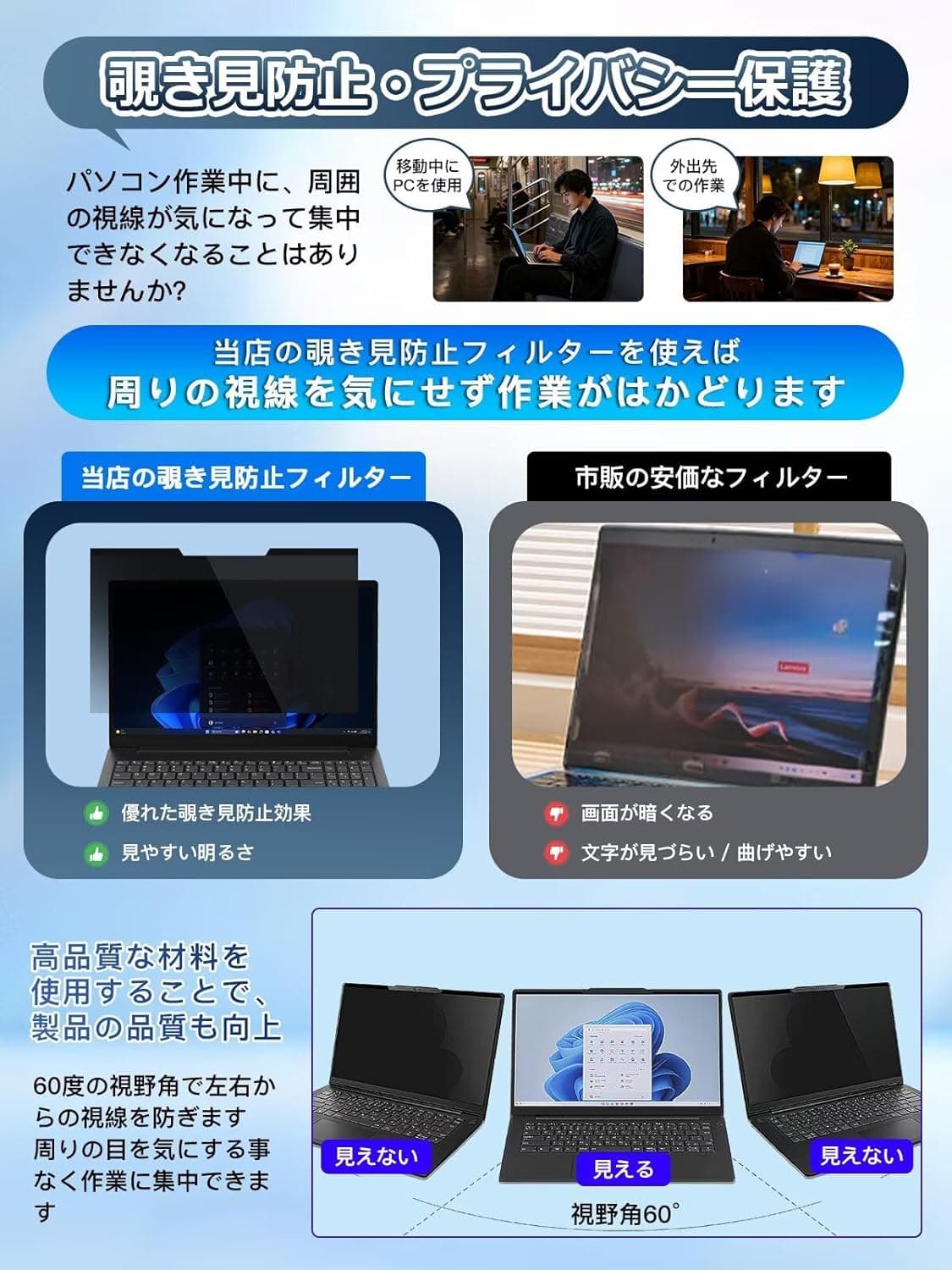
A magnetic privacy filter built specifically for the Panasonic Let's Note CF-FC series. Because it holds by magnets rather than adhesive, you can attach it only when you need it and pull it off when you get back to your own desk.
This article looks at what the stated 60-degree viewing angle and 69% transmittance actually mean in daily use, and at the pitfalls buyers usually discover after the purchase.
Overview
Sold under the NijiSkin brand, this filter is a dedicated accessory for the Let's Note CF-FC series. The short verdict: if you open your laptop in public several times a week and work-related information appears on screen, it is a cost-effective accessory.
If you almost always work at your own desk, the dimming drawback outweighs the benefit.
The specified viewing angle is roughly 60 degrees (about 30 degrees to each side of center). Beyond that cone the display goes dark and neighbors cannot read it.
The filter also lists a blue light cut rate of about 59%, UV blocking of about 99.9%, 3H surface hardness, and 69% transmittance, combining privacy and screen protection in a single sheet.
One face is glossy, the other is matte, so you can flip it — an uncommon feature in this category.
How to Read the 60-Degree Figure
Viewing angle is the most misunderstood spec on privacy filters. About 60 degrees means only a narrow fan directly in front of you stays legible; the smaller the number, the stronger the shielding.
Most retail privacy filters sit around 60 degrees, so this product is at the category standard.
What matters in practice is that the same figure does not necessarily apply vertically. Most privacy films target side-to-side shielding, and someone standing behind you and looking down can only be countered by how you tilt the display.
On an aisle seat or in a cafe where people walk behind you, combine the filter with seating tactics: lay the screen back, or put a wall at your back. Treat the filter as strong protection against the person beside you and only partial protection against the person behind you.
Compatibility Guide
The supported model is the Panasonic Let's Note CF-FC6 series. As a purpose-built part it does not fit other Let's Note lines such as CF-SV or CF-FV.
This is where buyers most often go wrong — "it says Let's Note, so it should fit" is not enough. Check the model label on the underside of the chassis and confirm your machine is a CF-FC before ordering.
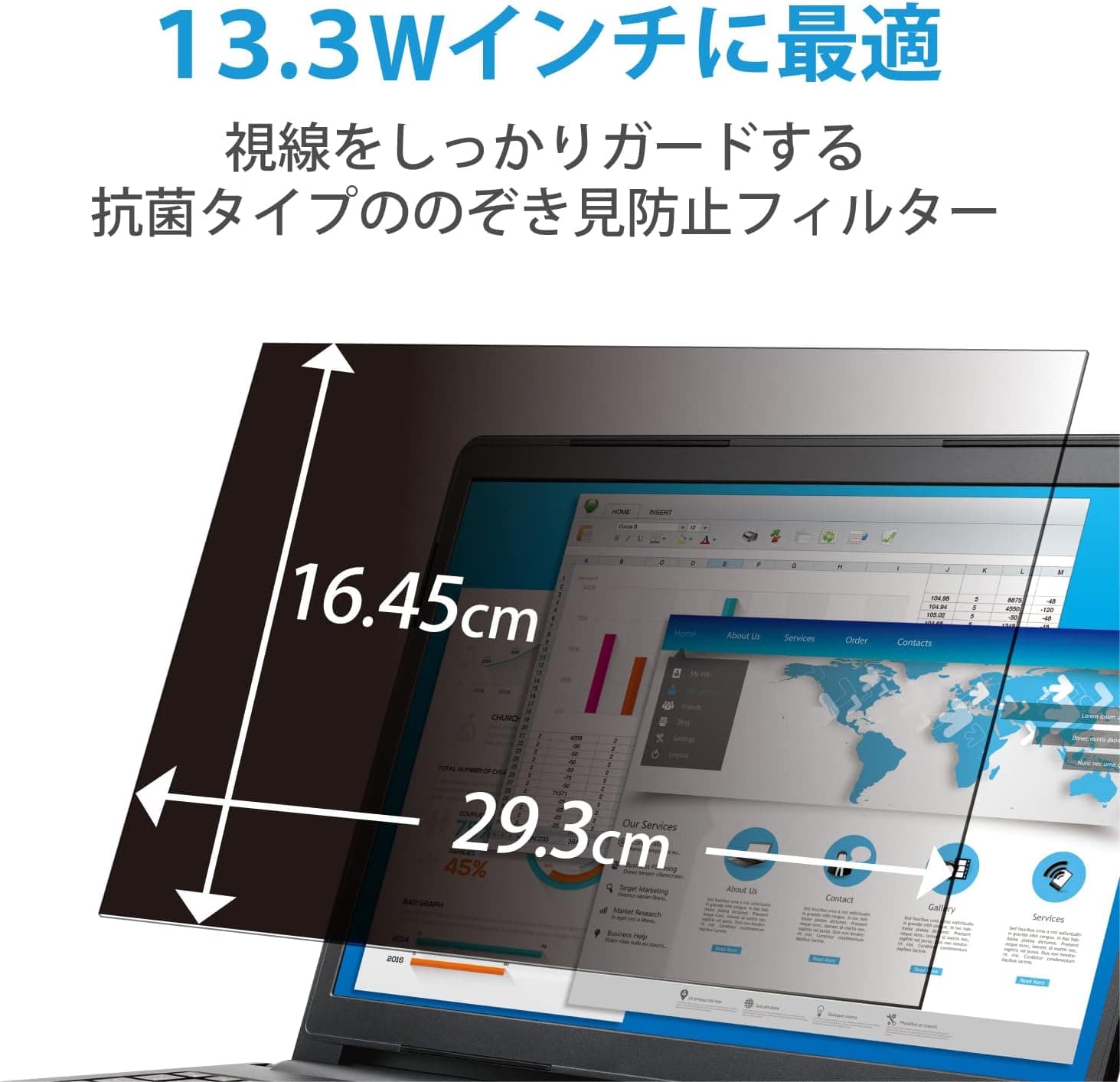
Privacy filter fit is not determined by diagonal size alone. The actual width, height, aspect ratio, and bezel dimensions all have to line up.
Let's Note screen ratios vary by model, so do not plan to reuse this on a similar-sized laptop from another brand: even with a close diagonal, a different aspect ratio leaves gaps or overhang.
Installation is magnetic — no tools, no adhesive. Nothing sticky touches the panel, so there is no residue or trapped-bubble risk, which also makes it easier to live with on a company-issued machine you eventually have to return.
The trade-off is that you align it yourself every time. If the mounting position drifts, a thin gap appears at the edge of the display, so take your time on the first fitting and memorize the feel.
As with any magnetic accessory, avoid pressing magnetic-stripe cards, mechanical watches, or legacy magnetic media against it for long periods. The strength involved is not a threat to the laptop or its SSD, but stacking it against hotel key cards in your bag is best avoided.
Product Info
The price was ¥3,480 as captured on 25 May 2026. Prices move often and sales or point promotions shift them further, so always check the current figure on the product page.
Note that the price record is labeled "Amazon US" while the actual source is Amazon.co.jp in yen; this labeling mismatch comes from the data pipeline, and the amount itself is reasonable for this product class.
| Item | Value |
|---|---|
| Viewing angle | Approx. 60 degrees (30 degrees each side) |
| Blue light cut | Approx. 59% |
| UV cut | Approx. 99.9% |
| Transmittance | 69% |
| Surface hardness | 3H |
| Attachment | Magnetic |
| Compatible model | Let's Note CF-FC6 series |
| Double-sided | Glossy / matte |
The line that matters most day to day is 69% transmittance. Roughly 30% of the light is lost, so the screen visibly dims once the filter is on.
Indoors, raising brightness a step or two hides the difference, but that costs battery. If you are mostly mobile, attaching it only when people are around is the smarter routine — and that is exactly what magnetic mounting is good at.
3H surface hardness refers to the pencil hardness test. It is not the 9H-class figure marketed on tempered glass, but it is enough to protect the panel from fingernails, cloth abrasion, and keyboard contact marks.
Privacy filters are resin films by construction, so 3H is the normal level for this category.
Reading the Review Score
As captured on 25 May 2026, the rating was 4.2 out of 5 across 30 reviews — about 84%, which is solid for a dedicated accessory at this price.
But 30 reviews is a small sample. Unlike a listing with several hundred, a handful of outliers can swing the average, and early-batch variation gets buried in it.
The practical approach is to read the negative reviews rather than trust the average. Low ratings on privacy filters almost always fall into three buckets: wrong size, dimmer than expected, or weak magnets.
The first two are predictable from the spec sheet (CF-FC6 only, 69% transmittance), so if you focus on the comments about magnet strength and finish quality, you get a fair read on actual build quality.
Compared with Alternatives
There are three broad options in this category. First, magnetic model-specific filters like this one.
Second, nano-suction types that can be repositioned, usually sold in generic sizes such as 14-inch 16:10. Third, the classic tape- or tab-mounted filters.
Magnetic mounting wins on speed and repeatable alignment. Nano-suction covers many machines but needs the mounting surface kept clean.
Tape mounting is cheapest but assumes permanent installation and loses grip each time you peel it. Choose by how often you remove it: several times a day favors magnetic, a few times a month is fine with a generic filter.
The other difference is edge treatment. A model-specific cut is shaped to the bezel and is unlikely to cover the webcam or sensors, while a generic panel of similar size sometimes does.
The more video calls you take, the more the purpose-built cut is worth.
Things to Consider
The most common failure is buying for the wrong model. Let's Note splits into several lines within the same generation, and this filter fits only CF-FC6.
Do not settle for "for Let's Note" — match the model number. Listing metadata (manufacturer, part number, compatible models) is sometimes recorded incorrectly on product pages, so confirm the target product from the product images and title as well as the spec text.
Second, the dimming is real and is not a defect — 69% transmittance is the spec. For photo editing, color grading, or anything where brightness and color accuracy are the job, permanent installation is a poor fit; color also shifts slightly through the film.
Attach it in public, remove it when you need to nail down color.
Third, the double-sided design. Being able to pick glossy or matte is genuinely useful, but flipping means realigning and leaves fingerprints on the film.
In practice most people settle on one side and leave it. As a rule of thumb, use the matte face under strong lighting or outdoors, and the glossy face when you want contrast and saturation.
Finally, understand the limits. A privacy filter defeats a glance from the next seat, but it does not stop someone photographing your screen from behind at an angle, and tilting the lid changes the geometry.
If you handle confidential material, the filter only works alongside good seat selection, a screen-lock habit, and posture that keeps the display away from onlookers. Believing one sheet of film has solved the problem is the most dangerous way to use it.
Best Use Cases
- Mobile workers and sales staff — cafes, co-working spaces, trains, and airport lounges where strangers sit beside you while you open client data. This is where the 60-degree restriction earns its keep.
- People who attach and remove it often — off at the office, on outside. Magnetic mounting takes seconds and does not degrade like adhesive.
- Buyers who also want screen protection — 3H hardness guards the panel from everyday scuffs, so you do not need a separate protector.
- Long-session users worried about eye strain — about 59% blue light and 99.9% UV blocking, plus an anti-glare face that cuts screen glitter.
Conversely, this is not for people who only work at a fixed desk, anyone doing color-critical work, or owners of any Let's Note other than the CF-FC6.
FAQ
Q. Will it fit other Let's Note models? A.
No. It is a dedicated cut; even a similar diagonal will leave gaps or overhang if the aspect ratio or bezel differs.
Consider a generic-size filter instead.
Q. How much darker does the screen get? A.
At 69% transmittance you lose roughly 30% of the light. Indoors, one or two brightness steps compensates, at some cost to battery life.
Q. Can the magnets harm the laptop or SSD? A.
Magnets of this strength are not expected to affect internal storage. Still, avoid carrying it pressed against magnetic-stripe cards in a bag.
Q. Does it work with a touchscreen? A.
Any added layer affects touch sensitivity to some degree. If your machine has a touch panel, check the product page for explicit touch compatibility before ordering.
Q. Glossy or matte? A.
Matte under bright lighting or reflections, glossy when you want contrast and color. Most owners pick one and keep it — flipping daily is not realistic.
Q. What does it cost? A.
¥3,480 as captured on 25 May 2026. Prices change frequently, so confirm the current figure on the product page.