Overview
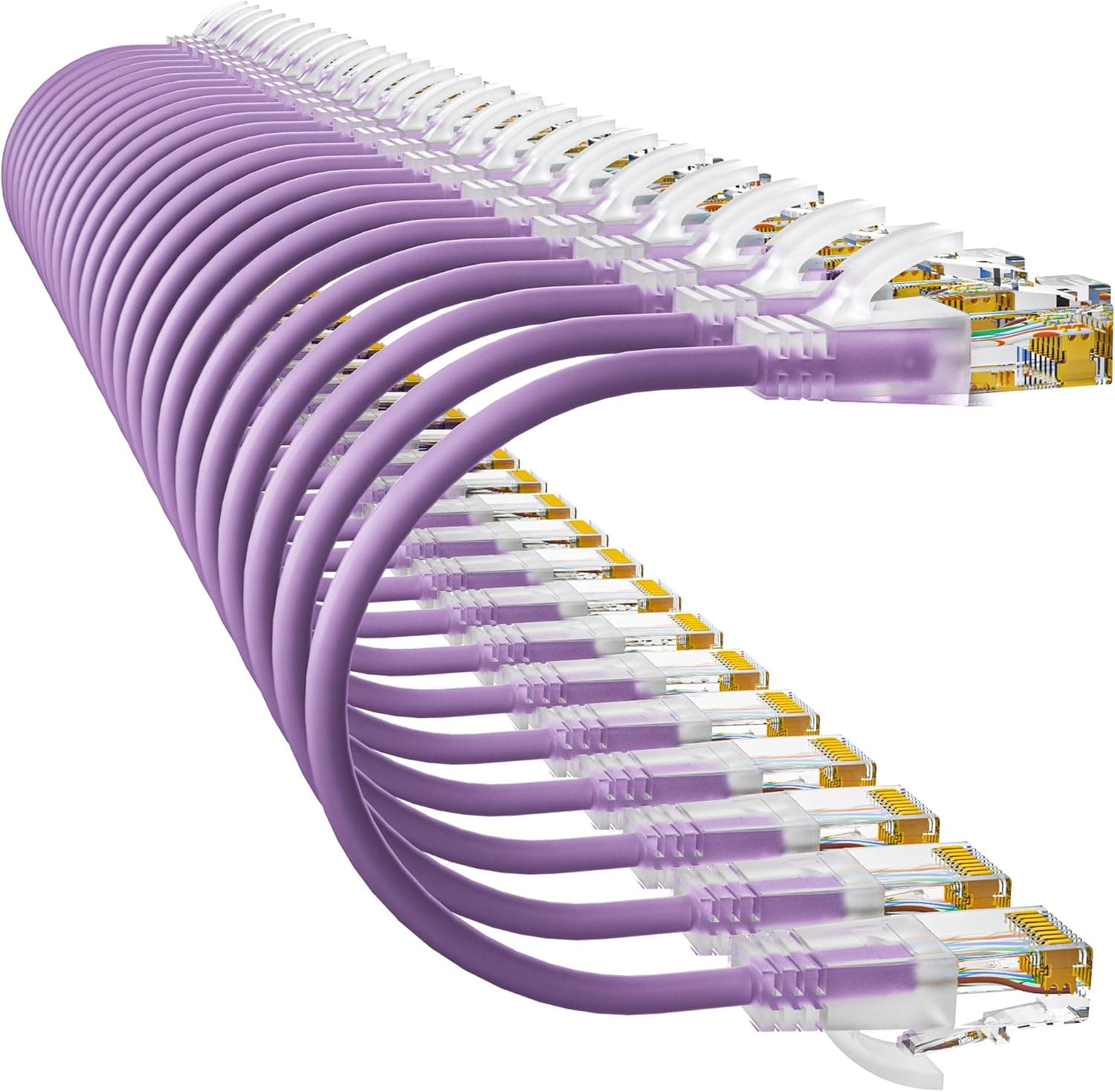
The MICRO CONNECTORS CAT6 RJ45 Modular Plug 50-Pack (model C20-088L6-50) is a consumable part for people who terminate their own Ethernet cables. The short verdict: it earns its place if you repeatedly need a run that is "1.4 m and no longer" — in-wall pulls, rack tidying, custom patch lengths.
If you only need a handful of cables, it does not. On Amazon.co.jp it holds 3.7 out of 5 stars across 27 reviews (about 74% positive), which is a fairly typical score for a part whose results depend heavily on the installer's crimping technique.
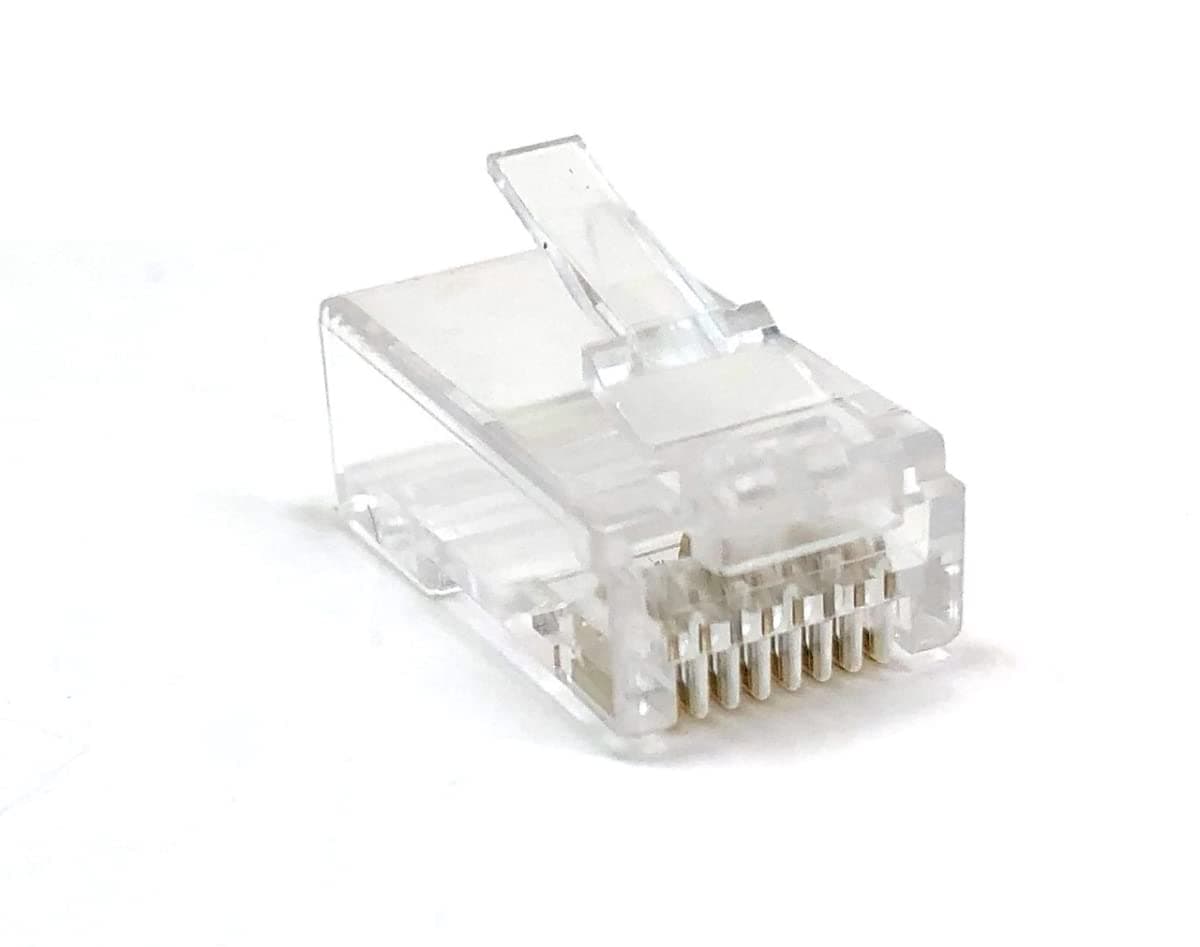
The specs are 8-position 8-contact (8P8C), gold-plated contacts, a built-in wire management load bar, support for 24-26 AWG round UTP cable, and 50 plugs per pack. The load bar is a small insert that stages the eight conductors in a staggered line before they enter the plug body, limiting how far the pairs stay untwisted and helping keep near-end crosstalk (NEXT) under control.
It adds one step versus a plain plug, but it noticeably improves repeatability.
Compatibility Guide
The supported cable is round, unshielded (UTP) Cat6 or Cat5e in the 24-26 AWG range. That single line is where almost every failed project goes wrong, so check your cable against it first.
| Check | Required | What happens if it does not match |
|---|---|---|
| Cable shape | Round | Flat cable will not seat; conductors cannot be routed through the load bar |
| Shielding | UTP (unshielded) | STP/FTP has a drain wire with nowhere to go — no ground path |
| Conductor gauge | 24-26 AWG | Thicker 23 AWG solid conductors often will not pass the load bar holes |
| Conductor type | Standard Cat6 solid or stranded | A mismatch shows up months later as intermittent link loss |
| Far end | Any standard 8P8C device | PCs, routers, switches, NAS and access points are all fine |
Gauge is the trap. A lot of bulk cable sold as Cat6A or Cat7 uses 23 or 22 AWG conductors, which are too thick here.
Read the AWG marking printed on the jacket before you order. Very thin 28 AWG slim cables are also outside the design range — the conductors may be too fine for the crimp blades to bite reliably.
One standards note: a Cat6 plug does not deliver Cat6A performance. If you are planning 10GBASE-T over long runs, buy plugs and cable that are explicitly rated Cat6A.
For 1GbE, or short 2.5GbE links, this product is comfortably within scope.
Product Info
This is the MICRO CONNECTORS RJ45 modular plug 50-pack, listed on Amazon.co.jp under ASIN B000IIDKK6.
The captured price was 8,493 JPY as of 28 May 2026. To be blunt, that is not cheap for 50 Cat6 plugs — roughly 170 JPY per plug, which sits above typical bulk pricing for comparable connectors.
It is a marketplace listing, so the price moves with the seller and stock, and time has likely passed since that capture. Check the current price on the product page before ordering.
Translating the specs into practical terms: the gold plating targets long-term corrosion resistance, which matters most in places you install once and never touch again, like inside walls or behind a rack. The built-in load bar raises termination accuracy, and the less experience you have, the more you benefit from it.
Fifty plugs is several years of household use, or one to two small-office cabling jobs.
With only 27 reviews behind the 3.7 average, treat the rating as directional, not statistical.
At that sample size a few one-star reports move the mean substantially, so read it as "generally works, with some mixed reports."
Crimping Steps and Common Mistakes
Load-bar plugs take one more step than plain ones:
Strip 25-30 mm of jacket and untwist the pairs.
Order the conductors to T568B (the common standard in Japan): white/orange, orange, white/green, blue, white/blue, green, white/brown, brown.
Feed all eight through the load bar, align the tips, and trim the excess.
Insert the load bar and conductors into the plug body, then look through the nose of the plug to confirm all eight reach the front contact positions.
Crimp in one firm motion with an RJ45 crimping tool.
Three mistakes account for most wasted plugs. First, stripping too much jacket — the longer the pairs stay untwisted, the worse the crosstalk, and Cat6 performance suffers.
Ideally a few millimetres of jacket is captured inside the plug. Second, crimping while one conductor is short of the front. You usually discover this on the tester, and a crimped plug cannot be reused.
Third, a poor crimping tool whose eight blades do not land evenly, leaving one pin intermittent. If you are buying 50 plugs, budget properly for the tool.
Write off the first three to five plugs as practice, and test every finished cable with a cheap continuity tester. Finding a bad termination after the cable is already inside a wall costs far more than the plug did.
Versus Pre-Made Cables
The decision comes down to how many cables you need and how much the exact length matters.
| Situation | Better choice | Why |
|---|---|---|
| 1-5 cables, stock lengths work | Pre-made cable | You never recover the tool cost or practice waste |
| Pulling through walls or ceilings | DIY (this product) | A pre-attached plug often will not fit through conduit |
| 10+ rack cables cut to exact length | DIY | Less coiled slack, better airflow and readability |
| Frequent plugging/unplugging | Pre-made snagless type | DIY plugs usually have an unprotected latch |
| Long-run 10GBASE-T | Cat6A-rated parts | This plug is specified for Cat6 |
Many Japanese-brand patch cables ship with break-resistant latch designs, which genuinely helps on equipment you unplug often. These DIY plugs have plain latches, so they suit permanent installed runs better than the back of gear you handle regularly.
Best Use Cases
This product clearly fits:
- DIY in-wall and in-ceiling cabling. Terminating after the pull is the whole point — an attached RJ45 head frequently will not pass through existing conduit or sleeves.
- Rack and AV-cabinet tidying. Cutting runs to within a few centimetres transforms slack management, and 50 plugs covers 10-20 cables in one session.
- Self-diagnosing cable faults. Spare plugs let you re-terminate only the suspect end to isolate a problem — valuable in a home or SOHO network with several devices.
- People who already own a crimper and tester. With the tooling paid for, buying connectors in bulk is straightforward.
If you need a few cables and own no tools, a pre-made cable is cheaper, faster and more reliable.
Things to Consider
First, a crimping tool is mandatory and not included. Without one, not a single plug in the pack is usable, and a stripper and continuity tester are effectively required too.
Buying the full tool set new can cost more than the plugs. Judge the total.
Second, the cable restriction is tighter than it looks. Round, unshielded, 24-26 AWG — miss any one and the plug is useless.
Discovering that your bulk cable is 23 AWG Cat6A, flat, or shielded after the plugs arrive is a common and avoidable outcome. If you already own the cable, verify the jacket markings first.
A note on the listing data: the captured 8,493 JPY is expensive for a 50-pack, and the collected price label reads "Amazon US" while the URL and currency point at the Japanese store in yen. Mismatches like this are not unusual in automatically collected listing data.
Confirm the seller, fulfiller, currency and quantity yourself on the product page before ordering. For the same reason, cross-check the product images and title against the listed manufacturer and model number — registered listing details are occasionally wrong.
This is also an overseas-brand product, so Japanese-language instructions or packaging may not be included, and you will need to settle on a wiring standard yourself. Mixing T568A on one end with T568B on the other produces a crossover cable, so standardise on T568B for home wiring.
Finally, if this is for commercial or public-facing installation work, check the certification and workmanship requirements that apply to you first. Parts that are fine for personal DIY are not automatically appropriate where you carry responsibility for the result.
FAQ
Q. Can I use these on Cat6A cable? A.
Physically it depends on gauge, and 23 AWG Cat6A often will not pass the load bar. Even if it fits, a Cat6 plug does not certify Cat6A performance.
For 10GBASE-T, buy Cat6A-rated plugs.
Q. Does any crimping tool work? A.
It must support RJ45 (8P8C) at minimum. Cheap tools tend to press unevenly and leave a single pin intermittent, so allocate real budget to the tool if you plan to use all 50 plugs.
Q. Do I have to use the load bar? A.
It is built in, so the plug is designed around it. Staging the eight conductors before insertion is exactly what raises your success rate as a beginner.
Q. Will these fit flat Ethernet cable?
A. No. Round cable only — flat cable requires a different connector design.
Q. I will never use 50. Should I buy a smaller pack? A.
Expect to consume roughly 1.5x the number of terminations you actually need, once practice and mistakes are counted.
If that is still only about 10, a smaller pack or pre-made cables will cost less overall.
Q. Is a 3.7 rating bad? A.
With 27 reviews, a few low scores swing the average hard. For a part whose outcome depends on technique and tooling, it is not an alarming score — but it is not glowing either, so it is worth comparing price and availability against alternatives.
Product Disclosure (Amazon)
- Manufacturer: MICRO CONNECTORS
- Seller: Dshop11
- Fulfilled by: Dshop11
- ASIN: B000IIDKK6
- Note: This article covers a manufacturer-made product based on Amazon listing details.