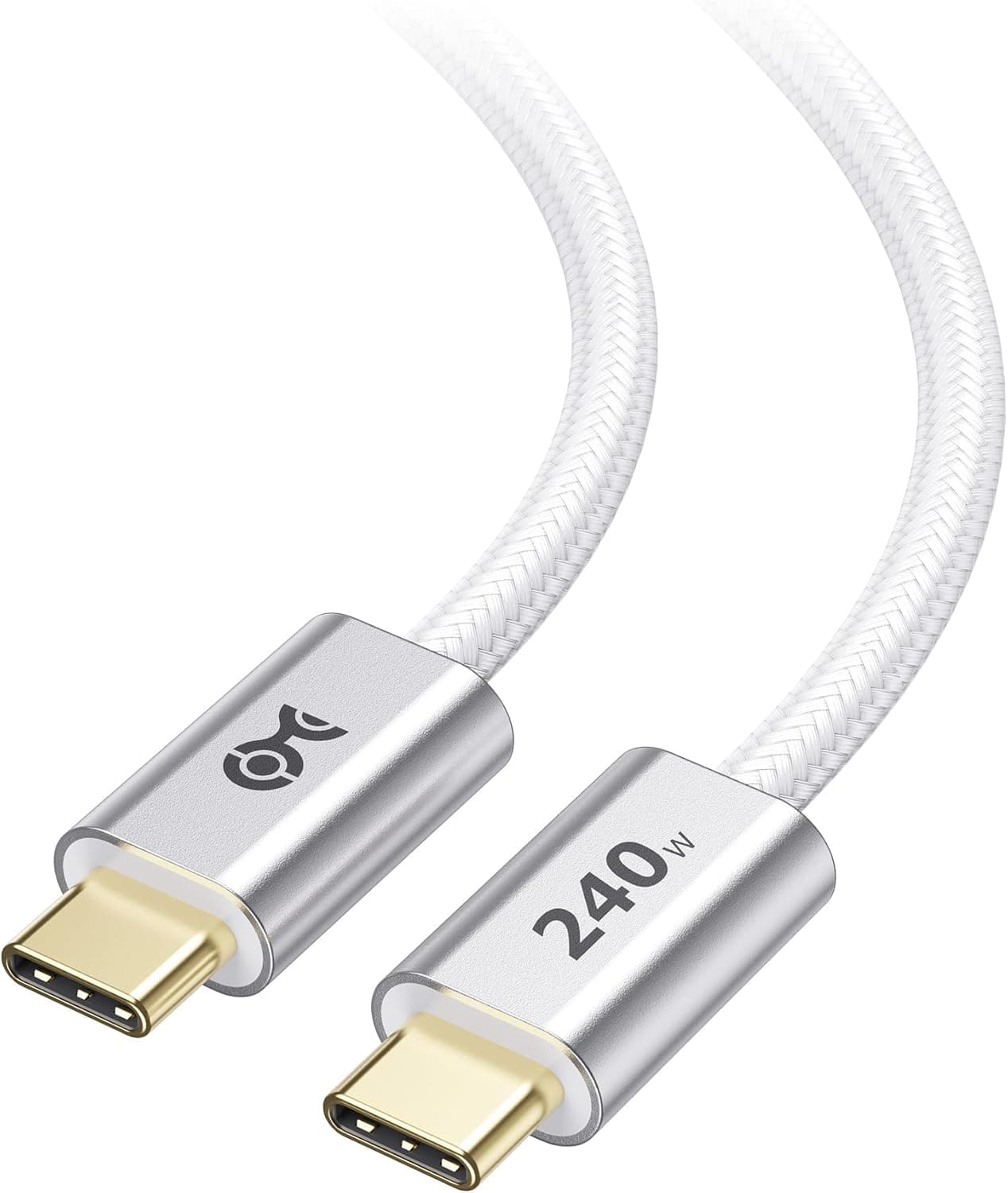
Overview
The Cable Matters Braided 240W USB-C Charging Cable is a charging-first cable built around USB PD 3.1 EPR.
It handles up to 240W (48V/5A), but data tops out at 480Mbps (USB 2.0 speeds) and there is no video output via DisplayPort Alt Mode.
In other words, this is not an all-in-one cable — it is a cable that deliberately trades bandwidth for power.
That trade-off is a design decision rather than a flaw. Charging a laptop needs watts, not gigabits, and dropping video and high-speed data frees the conductors up for power delivery.
The 6-foot (1.8m) length is long enough to reach from a wall adapter behind the desk to a laptop in front of you.
On Amazon.co.jp, the listing showed 51 reviews at 4.8 out of 5 stars (96% positive) as of the May 27, 2026 capture — a small sample, but a consistent one.
Bottom line: it suits people running a MacBook Pro 16-inch or a USB-C-powered gaming laptop who already have separate cables for docks and monitors. It does not suit people who want one cable for everything.
What 240W Actually Means
240W is the ceiling introduced by USB PD 3.1 EPR (Extended Power Range), reached by pushing voltage beyond the old 100W (20V/5A) limit up to 28V, 36V, and 48V.
The key point is that a 240W cable does not make charging faster on its own — the delivered power is set by whichever of the charger and the device is lower. Plug this into a 65W charger and you get 65W.
The value of a 240W cable is headroom. It carries a 5A e-marker IC, so if you upgrade to a 100W or 140W charger later, the cable is not the part you have to replace.
Conversely, if your charger is a 30W or 45W brick, none of this capability is doing anything for you, and a thinner, softer 60W cable will be nicer to handle.
| Use case | Fit | Why |
|---|---|---|
| Laptop charging (100W+) | Excellent | 240W headroom, e-marker built in |
| Phone fast charging | Excellent | Overkill, but works fine |
| Video out to a monitor | No | No DisplayPort Alt Mode |
| External SSD transfers | No | Capped at 480Mbps |
| Docking station uplink | Limited | Power only; not for video or data |
The rows marked "No" are real limits. Buying without understanding them is how you end up with a monitor that will not display and a drive that will not mount at speed.
Compatibility Guide
This is a USB-C male to USB-C male cable that works with USB PD devices generally: MacBook Pro (2018 and later), iPad Pro, iPhone 15/16, Surface Pro, Chromebooks, Android phones, and power banks. Physically it follows the standard USB-C form, so port fit is essentially never the problem.
The things to watch are electrical and functional. You can plug it into a Thunderbolt 4 or USB4 device and it will connect, but it will not carry 40Gbps. Power flows normally, so everything looks fine until an eGPU or fast SSD turns out to be slow.
Docking stations behave the same way: fine on a power-only port, unusable as the upstream port that carries video and data.
One more note for iPhone 15/16 owners. The phone's charging ceiling is far below 240W, so this cable will not charge it any faster than a basic one.
If your reason for buying is simply that the iPhone moved to USB-C, a shorter and thinner cable is more pleasant day to day. The reason to use this one is consolidation — one cable that also charges your laptop.
On the power side, actually pulling 240W requires a PD 3.1 EPR charger with 48V/5A output.
Chargers that go that high are still uncommon, so plan on operating in the 100W-140W range in most setups.
Product Info
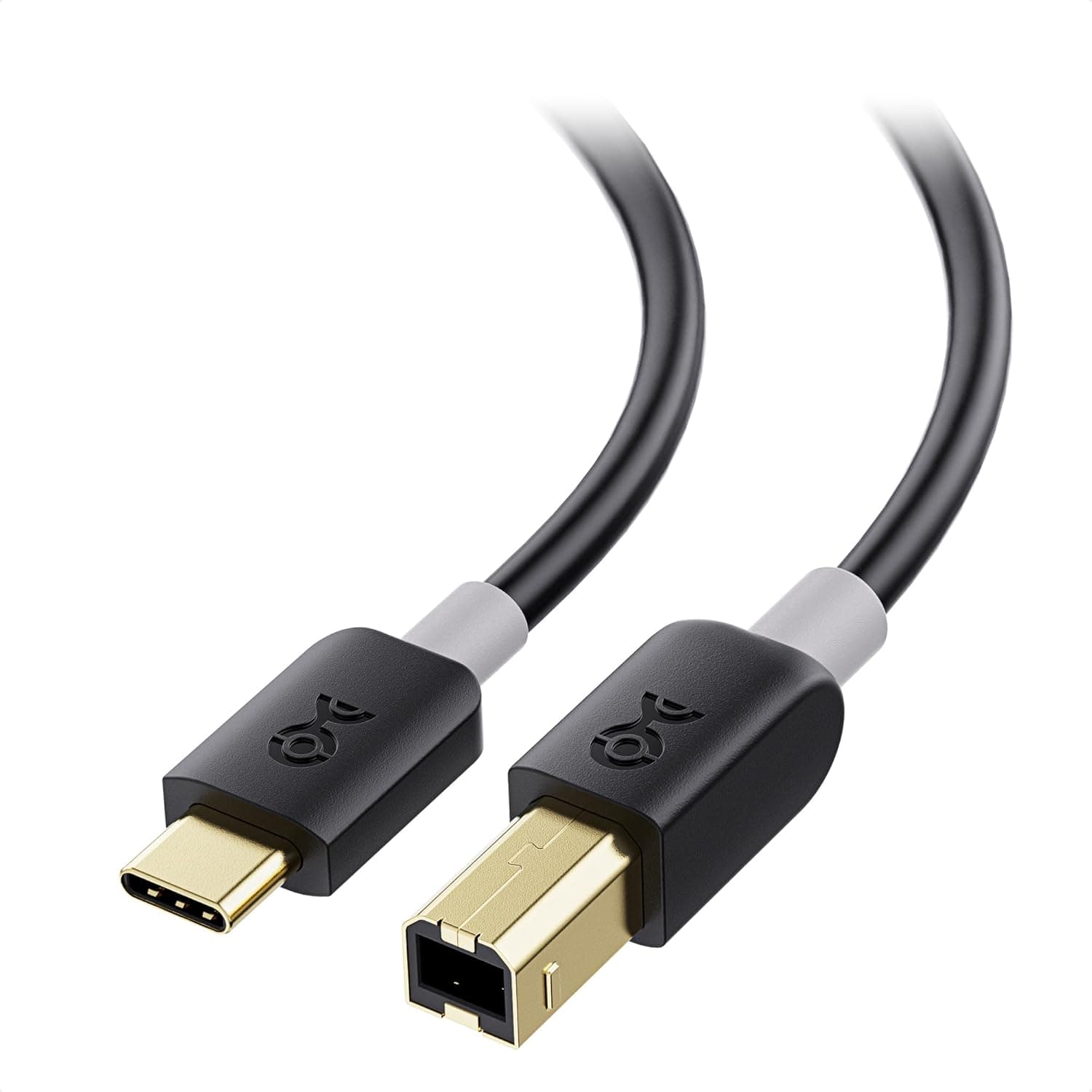
The key specs: USB-C to USB-C, 6 feet (about 1.8m), 240W (48V/5A) maximum power, 480Mbps (USB 2.0) data rate, gold-plated connectors, a braided jacket, reinforced aluminum housings, and a built-in e-marker IC.
An integrated silicone cable tie is included, which matters more than it sounds for a 1.8m cable you carry around.
Pricing was ¥3,610 (incl. tax) on Amazon.co.jp as of the May 27, 2026 capture, with a separate eBay US listing at $13.99 as of the July 10, 2026 capture.
Both are point-in-time figures that move with sales, exchange rates, and stock, so check the product page for the current price before buying. For a 240W, braided, e-marker-equipped cable, that range is reasonable rather than remarkable.
Reviews stood at 51 ratings and 4.8 out of 5 stars (96% positive) as of the May 27, 2026 capture.
Fifty-one is a modest sample, so it carries less statistical weight than a long-running product with thousands of ratings, though the distribution shows very few low scores. Note also that the product information states it is not USB-IF certified.
Power negotiation is handled by the e-marker IC, but if your workplace requires certified cables, confirm that first.
How It Compares
USB-C to USB-C cables differ mainly in what they choose to give up. A 40Gbps USB4 or Thunderbolt 4 cable carries video and fast data, but costs clearly more and tends to be thicker and stiffer.
A 60W charge-only cable is cheap and flexible but will not reach full laptop charging speeds.
This product sits in between: top-tier on power, minimal on everything else. As a fixed power cable at a desk that is a sensible allocation, and pairing it with a separate USB4 cable for display and storage is the least wasteful setup.
If you genuinely want one cable to do everything, buy a USB4 or Thunderbolt 4 cable instead and skip the disappointment.
If you need several, the same brand's two-pack and three-pack options bring the per-cable cost down. Mixing a short 0.9m cable with this 1.8m one covers most desk and travel situations.
Before You Buy
The biggest pitfall is skipping over the "no video" wording. It is stated right in the product name: no DisplayPort Alt Mode, so it cannot drive an external monitor or a USB-C display.
Choosing this cable while trying to build a multi-monitor dock setup is a guaranteed failure. Decide first whether what you are connecting is power, video, or data.
Data is also capped at 480Mbps. For external SSDs or large backups, that is slow enough to notice immediately.
Syncing phone photos or documents is fine; moving video footage is not.
Do not assume 240W means faster charging. Effective power is decided by the charger and the device.
If your charging feels slow, the part to replace is usually the charger, not the cable.
Stiffness is part of the trade. High-power braided cables run thick, which can be awkward in tight spaces or when using a laptop on your lap.
For casual café use, keeping a thinner 60W cable alongside it is more comfortable.
No USB-IF certification is less a practical problem than a procurement one. For personal use, the built-in e-marker handles negotiation and there is little to worry about.
One last note about listing data. Retail product pages occasionally carry manufacturer names, model numbers, or compatibility tables that do not match the actual item.
Nothing looked contradictory here at the time of writing, but check the product images, the title, and the "240W" and "no video" wording yourself before ordering. Cable Matters sells 60W models, two-packs, and USB4 cables under similar names, and they are easy to confuse.
Best Use Cases
The best fit is someone charging a laptop that needs 100W or more over USB-C — a MacBook Pro 16-inch, a Dell XPS, or a USB-C-powered gaming notebook. At 1.8m it works well as a permanent desk power cable, and the braided jacket holds up to daily plugging and unplugging.
Next are mobile workers who want a single charging cable. It covers everything from phone to laptop, and the included silicone tie keeps it from tangling in a bag.
If you later upgrade to a PD 3.1 EPR charger, the cable will not be the bottleneck.
It is a poor fit if you want the same cable to drive a monitor or move data from an external SSD, if your charger tops out at 60W, or if you prioritize thin and flexible cables. If any of those describe you, look at a different category.
FAQ
Q. Will it really charge at 240W? A.
The cable supports 240W (48V/5A), but actual power is set by the lower of the charger and the device. You need a PD 3.1 EPR charger with 48V output to reach it.
Q. Can it output video to a monitor?
A. No. There is no DisplayPort Alt Mode support; you need a separate cable for video.
Q. Does it work with Thunderbolt 4 / USB4 devices? A.
For charging, yes. It will not carry 40Gbps, so use a USB4 cable for fast data or video.
Q. Can I charge an iPhone 15/16 with it? A.
Yes, though the phone's charging ceiling is low enough that 240W support gives no speed benefit. The point is sharing one cable with your laptop.
Q. How fast is data transfer?
A. 480Mbps (USB 2.0). Fine for photos and documents, not for running an external SSD.
Q. What does it cost? A.
¥3,610 (incl. tax) on Amazon.co.jp as of the May 27, 2026 capture.
Prices change, so check the product page before buying.
Product Disclosure (Amazon)
- Manufacturer: Cable Matters
- Seller: Amazon US
- Fulfilled by: Amazon US
- ASIN: B0FB317QCH
- Note: This article covers a manufacturer-made product based on Amazon listing details.