Overview
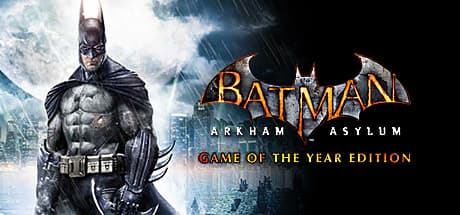
Batman: Arkham Asylum drops you alone onto Arkham island after the Joker engineers a full-scale riot. Instead of discrete levels, the island is one connected map: new gadgets unlock doors and walls you walked past hours earlier.
Structurally it plays much closer to a Metroidvania than to a mission-based action game.
Play splits three ways: hand-to-hand brawls against unarmed inmates, predator sections where you thin out armed guards from gargoyle perches, and detective work tracing evidence through the facility. Chapters rotate between them, which is why the game rarely feels repetitive despite a compact setting.
The GOTY Edition adds four Challenge Maps, including Crime Alley and Scarecrow Nightmare. These sit outside the campaign as score-attack arenas that grade your combat and predator play on combo count and time.
Features and Systems
FreeFlow combat runs on strike, counter and evade. The trick is rhythm, not speed — mashing drops your combo, while watching the warning icon above enemies and countering on cue keeps it alive.
Later fights stack shielded enemies, knife-wielders, stun-rod carriers and large berserkers in one room, so you're picking the right answer for each within seconds.
Predator sections hand you a room of armed guards, ceiling gargoyles and a grapnel. Every time someone vanishes, the survivors get jumpier — sweeping flashlights, watching floors, checking vents.
Repeating one tactic gets punished, so the design pushes you toward breakable walls, ducts and explosive gel.
Detective mode overlays enemy positions through walls, shows whether they're armed, and highlights traces like fingerprints and alcohol residue. It's so convenient that many players leave it on permanently and miss the environmental detail.
Turning it off for stretches is worth it.
Riddler challenges scatter trophies, riddles, patient interviews and destructible objects across the island. Riddles require scanning a specific object from a workable angle, so knowing the answer isn't always enough.
The main story runs into the low teens of hours; full Riddler completion extends that considerably.
System Requirements
Steam lists minimum requirements of Windows XP/Vista, a 3GHz Intel or AMD CPU or any dual core, a PCI Express SM3.0 GPU (NVIDIA 6600 / ATI 1300 class), 1GB RAM on XP or 2GB otherwise, 8GB free storage and DirectX 9.
No recommended spec is provided in the data, so the minimum is the only baseline here.
What that really means: any current PC clears this by a wide margin. The GPU bar is DirectX 9, shader model 3.0 era hardware — modern integrated graphics such as Intel Iris Xe or Radeon graphics in Ryzen chips exceed it comfortably.
8GB of storage is trivial today. Performance is not the question.
Compatibility is. This is an XP/Vista-era title, so frame rate caps, ultrawide and high-refresh setups, and first-launch configuration are where problems appear.
If it won't start or the aspect ratio looks wrong, suspect settings rather than horsepower. NVIDIA PhysX adds cloth, paper and fog effects; disabling it costs nothing in the campaign and is the first thing to switch off if you hit instability.
| Item | Minimum | What it means now |
|---|---|---|
| OS | Vista / XP | Modern Windows mostly needs compatibility tweaks |
| CPU | 3GHz Intel/AMD or dual core | Any current budget CPU far exceeds it |
| GPU | SM3.0 (GeForce 6600 / Radeon 1300) | Integrated graphics already clear this bar |
| RAM | 1GB (XP) / 2GB | 8GB systems have plenty of headroom |
| Storage | 8GB | Small enough to keep on an SSD |
A gamepad suits this game better. Counter timing and combo input read more naturally on a controller, though keyboard and mouse work if that's what you have.
Review Trends
Years after release the game still holds a strong reputation. Praise clusters around the same things: the feel of the combat, the claustrophobic atmosphere of a locked-down asylum, and Mark Hamill's Joker taunting you over the PA system as an active part of the pacing.
Guard chatter shifting as you pick them off is another frequently cited strength.
Criticism clusters too. Boss fights are the usual target — the recurring large enemies have one correct approach, which contrasts sharply with how open the regular combat is.
The finale draws long-standing complaints about being weaker than everything preceding it. And because the game is old, some negative feedback is really about launch or display issues rather than the game itself.
One more point: language support. The data lists English, French, German, Italian and Spanish — not Japanese.
The game is dialogue-heavy and several Riddler riddles lean on English wordplay, so this matters. Check the store page's language section yourself before buying.
Who It's For
- Players who care about combat feel. Timing-based rather than mash-based satisfaction is the core appeal here.
- Stealth fans who dislike instant-fail design. Getting spotted is recoverable, so tension stays without frustration.
- Explorers over linear-path players. Backtracking with new gadgets is a large part of the structure.
- Batman comic and animated series fans. Patient records and interview tapes bury a lot of character background in the collectibles.
- Short-session players. Challenge Maps work fine in 30-minute chunks.
Caveats and Who Should Skip It
Japanese-language players. As noted, Japanese isn't in the listed language support.
Story comprehension is one thing, but Riddler riddles assume you can parse English phrasing, and skipping them removes most of the completionist content.
Anyone expecting an open world. The tags include open-world, but this is one compact island, not a free-roam Gotham.
Buy it expecting a sprawling city and you'll be disappointed — this is the single biggest expectation gap.
Don't be misled by the category label. This article sits under a puzzle category on the site, but the game is an action-adventure.
Detective mode and riddles are puzzle-adjacent, not what someone shopping for puzzle games wants. Category tags are sometimes assigned automatically, so confirm the genre and screenshots on the store page.
Store listings themselves can be outdated on language and system requirements too — worth a look before you buy.
Players with low horror tolerance. The Scarecrow sequences attack the presentation itself.
It's psychological rather than gory, but the constant dark, enclosed setting won't suit everyone.
Players who hate scripted boss patterns. Regular encounters offer real choice; bosses want you to find the one sequence and repeat it.
That drop-off frustrates people who came for the combat freedom.
Age-related risk. Flawless behaviour on current drivers, high-refresh displays and ultrawide monitors isn't guaranteed.
Performance is a non-issue; a bit of configuration might not be. Accept that and the game holds up remarkably well.
Getting Started
The first few hours look full of inaccessible areas. Don't fight it — follow the main route until explosive gel and the line launcher open things up, then re-read the map.
Most of what was blocked connects.
In combat, focus purely on counters at first; keeping the combo alive matters more than landing hits. In predator rooms, isolating one guard and waiting beats rushing a group.
Difficulty can be raised later, so start lower until the combat rhythm clicks.